Astronomers Find Vast Reservoirs of Hydrogen around Early Galaxies


Astronomers with the Hobby-Eberly Telescope Dark Energy Experiment (HETDEX) have detected enormous hydrogen halos, called Lyman-alpha nebulae, around more than 30,000 galaxies 10 to 12 billion years ago, suggesting that the raw material needed for galaxy growth was far more abundant than once thought.
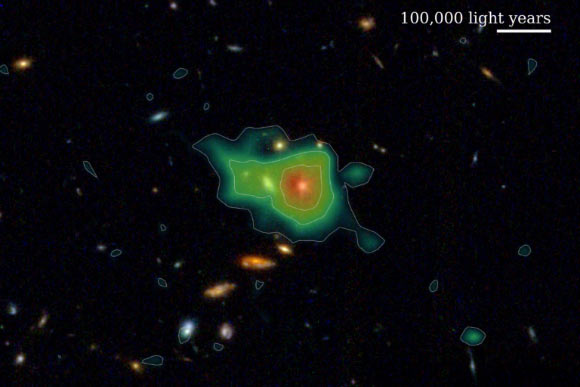
A huge halo of hydrogen gas found in HETDEX data and superimposed on its location, as shown in deep imaging from the NASA/ESA/CSA James Webb Space Telescope; Found 11.3 billion years ago, this system shines with the combined light of many galaxies within it, with the brightest region shown in red. Image credit: Erin Mentuch Cooper, HETDEX/NASA/ESA/CSA/STScI.
Hydrogen gas is notoriously difficult to detect because it does not generate its own light.
However, if it’s near an object that gives off a lot of energy – for example a galaxy or group of galaxies filled with UV-emitting stars – that energy can make the hydrogen glow.
To detect this, astronomers must devote a lot of time to precise instruments, which are often in high demand.
Although previous astronomical studies have discovered some of these halos, their instruments have only been able to detect the brightest and most extreme examples.
And focused observations of early galaxies are usually so zoomed in that they cut out all but the smallest halos.
As a result, everything between the little guys and the big horns has remained elusive.
HETDEX observations are beginning to fill this gap. Using the McDonald Observatory’s Hobby-Eberly Telescope, the study maps the position of more than a million galaxies in its quest to understand dark energy.
“We captured almost half a petabyte of data not only on these galaxies but also on the regions in between,” said Dr. Karl Gebhardt, principal investigator of HETDEX and chair of the Department of Astronomy at the University of Texas at Austin.
“Our observations cover a region of the sky measuring more than 2,000 full Moons. The scope is enormous and unprecedented.”
“The Hobby-Eberly telescope is one of the largest in the world,” added Dr. Dustin Davis, HETDEX scientist and postdoctoral researcher at the University of Texas at Austin.
“And the instrument that HETDEX uses produces 100,000 spectra in each observation. So we have huge amounts of data and there are all kinds of interesting, fun, weird things waiting for us to find them.”
To find the hydrogen halos, astronomers selected the 70,000 brightest galaxies from more than 1.6 million primitive galaxies identified so far by HETDEX.
With the help of supercomputers at the Texas Advanced Computing Center, they examined how many of them showed traces of a surrounding halo.
According to the team, these halos are tens of thousands to hundreds of thousands of light years in size.
Some are as simple as a football-shaped cloud surrounding a single galaxy; others are sprawling, irregular blobs containing several galaxies.
“Those are the fun ones,” said HETDEX data manager Erin Mentuch Cooper, a researcher at the University of Texas at Austin.
“They look like giant amoebae with tendrils extending into space.”
An article on the results was published on March 11, 2026 in the Astrophysics Journal.
_____
Erin Mentuch Cooper and others. 2026. Lyα Nebulae in HETDEX: the largest statistical census linking Lyα halos and blobs across the cosmic noon. ApJ 1000, 38; doi: 10.3847/1538-4357/ae44f3


