Astronomers Spot Surprising Iron ‘Bar’ at Heart of Ring Nebula


Astronomers using the WHT Enhanced Area Velocity Explorer (WEAVE), a powerful new instrument mounted on the William Herschel Telescope in La Palma, have detected an unexpected elongated structure of ionized iron inside the famous Ring Nebula.
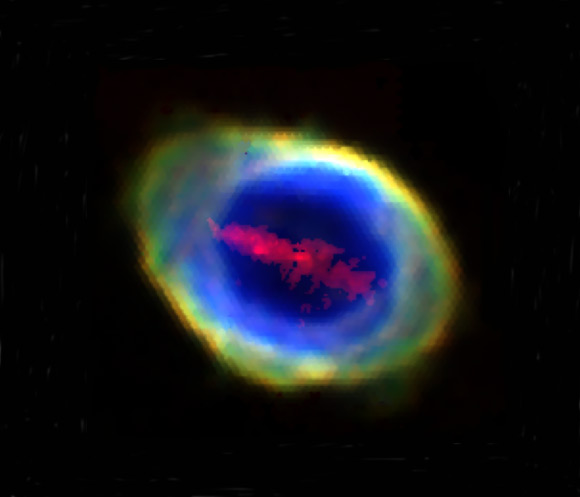
A composite image of the Ring Nebula constructed from four images of WEAVE/LIFU emission lines. Image credit: Wesson and others., doi: 10.1093/mnras/staf2139.
The Ring Nebula is an archetypal planetary nebula located approximately 2,000 light years away in the constellation Lyra.
Otherwise known as Messier 57, M57 or NGC 6720, this nebula was discovered by French astronomer Charles Messier while searching for comets in January 1779.
Messier’s report of his independent discovery of Comet Bode reached French astronomer Antoine Darquier de Pellepoix two weeks later, who then independently rediscovered the Ring Nebula by tracking the comet.
The newly discovered bar-shaped cloud of iron atoms fits inside the inner layer of the elliptical-shaped nebula.
The length of the cloud is approximately 500 times that of Pluto’s orbit around the Sun, and its mass of iron atoms is comparable to the mass of Mars.
The cloud was discovered during observations obtained using the Large Integral Field Unit (LIFU) mode of the new WEAVE instrument on the Isaac Newton Group’s 4.2m William Herschel Telescope.
“Even though the Ring Nebula has been studied using many different telescopes and instruments, WEAVE has allowed us to observe it in a new way, providing much more detail than before,” said Dr Roger Wesson, an astronomer at University College London and Cardiff University.
“By obtaining a continuous spectrum across the entire nebula, we can create images of the nebula at any wavelength and determine its chemical composition at any position.”
“As we processed the data and scrolled through the images, one thing became as clear as anything: this previously unknown ‘bar’ of ionized iron atoms, in the middle of the familiar and iconic ring.”
The nature of the iron “bar” in the Ring Nebula is unclear.
There are two potential scenarios: the bar may reveal something new about how the parent star’s ejection of the nebula progressed, or (more intriguing) the iron could be a plasma arc resulting from the vaporization of a rocky planet caught in the star’s earlier expansion.
“We definitely need to know more, particularly whether other chemical elements coexist with the newly detected iron, as this would likely tell us the right class of model to pursue,” said Professor Janet Drew, an astronomer at University College London.
“At present, we are missing this important information. »
The results were published today in the Monthly Notices of the Royal Astronomical Society.
_____
R. Wesson and others. 2026. WEAVE imaging spectroscopy of NGC 6720: an iron bar in the Ring. MRNRA 546 (1): staff2139; doi: 10.1093/mnras/staf2139


