Avoiding Armageddon: Experts Must Hit a Sweet Spot to Redirect an Asteroid


A theoretical mission to avoid an asteroid that heads towards the earth is fraught with sufficient risks to write a film by Michael Bay. Rather than the chills of Armageddon, such as a defective exercise or a president with a finger of the grip of itching, new research suggests that one of the greatest risks confronted with an anti-entenois operation would be a “gravitational lock hole” returning the rocky loop to earth on a later date.
The work was highlighted at the joint meeting of the Europlanet Sciences Congress and the Division of Planetary Sciences (EPSC-DPS) in Helsinki.
“Even if we intentionally distant an asteroid from the earth with a space mission, we must make sure that it does not derive in one of these keys afterwards. Otherwise, we will again face the same threat of impact on the line,” said Rahil Makadia, researcher in space technology at the University of Illinais in Urban-Champin, who presented the results.
Learn more: City-Killer Asteroid will not harm the earth, but it can rather hit the moon
How Dart broke an asteroid
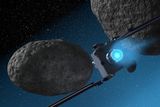
In 2022, fiction became reality when NASA organized a mission to intercept an asteroid. Their double asteroid redirection test (DART) broke the small asteroid dimorphos, which orbit another asteroid called Didymos at around 7 million miles from the earth. While no asteroid was on a collision trajectory with our world, the study was a success. He has shown that an impact could successfully modify the path of a flying space rock, which made hopes that all the objects related to the earth could be sent to a new course by future missions.
The new works of Makadia suggest that in any scenario threatening the land, such redirection should consider the risk of grazing the rock in a so-called lock hole. It is a small area of space where the severity of a planet modifies the path of an asteroid passing in a way that brings it back to the planet from a new angle of years later. In this way, a dart mission that pushes an asteroid in a gravitational lock hole does not avoid the danger, but only delays it.
The challenge for any future mission is to find an ideal place on the side of an asteroid that sends it definitively to the void rather than on a mission of return to earth. The Makadia team has developed a tool to predict the path of a deviated asteroid, based on information processed from DART.
Find the perfect strike site
The technique incorporates a large amount of information. The global form, the mass and the rotation of the asteroid, as well as topological details such as craters or hills, are all taken into account in the analysis. Although Dart information is useful, as each asteroid potential threat will have its own unique structure, these details would be ideally collected by a recognition mission before redirect. If an asteroid approaching quickly does not give the earth the possibility of checking its contours with a spacecraft, Makadia said that the analysis can be carried out from the surface of the earth.
The details of the asteroid can be treated to determine the probable trajectory of the asteroid after impact, allowing researchers to identify a perfect strike location.
“With these probability cards, we can repel asteroids while preventing them from returning to an impact trajectory, protecting the land in the long term,” concluded Makadia in a press release.
Learn more: The offense of asteroids gives companies hope in the search for rare metals
Article Sources
Our Discovermagazine.com writers use studies evaluated by high -quality peers and sources for our articles, and our publishers examine scientific precision and editorial standards. Review the sources used below for this article:


