BBL: Miami consolidates its position as the US capital of the Brazilian butt lift | Health


They come from all corners of the country, to the city that has established itself as the mecca of the Brazilian butt lift, or BBL, a cosmetic surgical procedure for buttock augmentation. Despite problems that have accumulated over the years, including clinics operating in legal gray areas and the highest number of cosmetic surgery deaths in the country, the latest statistics show that nothing can knock Miami out of the top spot. Although mortality has decreased thanks to stricter regulations and more precise surgical methods, all is not rosy and a large part of this dynamic industry remains in the shadows.
Thousands of people travel to South Florida each year to undergo this surgery, which involves extracting fat from different parts of the body using liposuction and injecting it into the buttocks. According to the latest statistics, of the nearly 30,000 buttock augmentation surgeries performed in the United States last year, half were performed in the Southeast region, which includes Florida. Miami, with hundreds of plastic surgeons and dozens of clinics, is the epicenter of America’s vibrant cosmetic surgery industry, and BBLs are its crown jewel.
It is the fastest growing cosmetic surgery procedure over the past decade. While their number nationally has remained unchanged in recent years, between 2022 and 2024 it will double in the Southeast, according to figures from the American Society of Plastic Surgeons. BBLs are also the cosmetic surgery with the highest mortality rate. South Florida leads the nation in the number of cosmetic surgery-related deaths, and the majority of cases came from BBL. Alarmed, state lawmakers passed laws regulating the practice, and the industry appears to have matured and focused more on patient safety. However, the sector still operates in a large regulatory vacuum and complications continue to arise, particularly in postoperative care, according to the surgeons and experts consulted for this file.
The BBL boom in Miami predates the image popularized by the Kardashians. Experts point out that its popularity is largely due to the influence of the aesthetic ideals of the large Latin American diasporas living in the region, the warm climate and an image-obsessed culture fascinated by the promise of physical transformation. Studies indicate that many patients believe that reshaping their figure boosts their self-confidence and view BBL as a way to achieve an “ideal physique.” Studies also point to the social comparison effect, exposure to “curated images of curvy bodies” on social media as an important factor in shaping these norms.
“This procedure is so popular because it is so powerful: no other can create results like this,” says Dr. Pat Pazmiño, a Miami-based plastic surgeon and ASPS member. “Previously in plastic surgery, when we wanted to contour or increase volume, we used implants. But you had to insert a foreign body and the implants had to be replaced. On the other hand, when you use fat grafting from the patient, you can create any contour, of any size, in many areas where implants would not be used. And you don’t have to replace them.”
Pazmiño was part of a team that identified that most BBL deaths were due to a complication called pulmonary fat embolism (PFE), which occurs when fat enters the bloodstream through veins in the gluteal muscles and impedes blood flow to the lungs. To avoid this, adipose tissue must be injected directly above the muscle, avoiding penetration, a method that has been implemented as law in the state and has been widely adopted in the profession. Pazmiño also encouraged the use of ultrasound during surgery to improve visibility and avoid piercing the muscle.
It seemed the problem had been resolved, but deaths continued, mostly at low-cost clinics that helped increase Miami’s popularity as a BBL mecca. “Women from all over the United States were coming to Miami to get BBLs and dying. It made Florida and Miami look terrible,” says Pazmiño. “They have dangerously low prices. If you go to Google and type in ‘BBL prices Miami,’ you’ll see prices as low as $2,000 or $2,500 at these clinics, which is crazy. Because when you work with a board-certified surgeon, our prices are five or six times higher,” he adds.
In 2023, more laws were passed, but this time, rather than focusing on method, they focused on practice. For example, the doctor had to see the patient for the first time at least 24 hours before surgery and could only see one patient at a time.
“Many of these surgeons at low-budget clinics met patients for the first time just minutes before the procedure. It is not possible to establish a strong doctor-patient relationship in such a short time,” Pazmiño said. State law also establishes that surgeons cannot delegate the liposuction or fat grafting part of the procedure to others, nor leave the operating room during the operation.
There is no national system for tracking BBL case outcomes, but the measures appear to have produced a significant change in the South Florida market, with surgeons, patients and lawmakers being “hyper-aware” of the safety issue, Pazmiño says. “The good news is that the number of EFP deaths has decreased significantly in the past year since the law was passed in 2023. The bad news is that patients are still dying from BBL, but from other causes, such as infections, hemorrhagic shock from bleeding, perforation of an abdominal organ, and inadequate postoperative recovery care. We have taken a big step forward, but our work is not done,” he notes.
Current regulations do not require the surgical procedure to be performed in a hospital or outpatient surgery center, where the patient can spend the night under observation, and many procedures are performed in mall offices that do not offer postoperative care.
Competition is intense in Miami’s busy BBL market, and the company has turned to social media to find new customers. Dozens of cosmetic surgery centers are looking to attract customers with Christmas or Halloween discounts, simultaneous surgery packages or combos, and installment payment plans. A single BBL, for example, may cost $4,500 and a tummy tuck $3,500, but the combined price is $8,500. The combined price may include more procedures, to “save time and money,” the ads say.
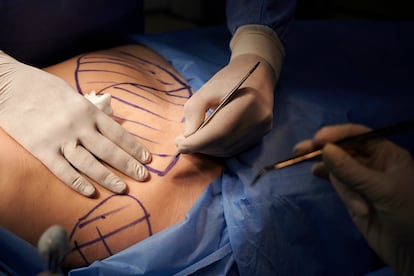
Surgeons explain the benefits and decisions in videos on TikTok, Facebook or Instagram, and clinics post before and after photos, patient interviews and tips for achieving the desired result. Images of patients in underwear or semi-nude show the areas the surgeon will work on with dotted lines painted with markers, and images after the procedure – sometimes so fresh that bruising is visible on the skin – accompanied by hashtags like #BBLMiami or #totaltransformation.
Those who are interested look for recommendations in Facebook groups on which doctor to see or where to undergo post-operative care, making sure it’s a “legitimate place, with certified professionals.”
Post-operative care is one of the least regulated areas of the industry. There is an entire network of postoperative care services that revolves around BBLs, especially for those coming from out of state. Videos posted on social media show how some transport post-operative patients lying face down in the back of a car on disposable absorbent towels wrapped in gauze from the clinic to a hotel. Others provide bedside care, helping them change their compresses, dress or bathe. Still others offer “shaping” massages to help “sculpt” the desired silhouette. At the Miami airport and nearby hotels, it is common to find post-operative patients wearing tight compression garments around their waists, thighs and buttocks.
This concern led Philadelphia resident Valerie Fiorentino to cancel her plans to have a BBL in Miami. “I ended up hearing too many scary stories about complications and not receiving proper care after surgery. I heard of girls who booked stays at recovery homes with the intention of being cared for by a registered nurse, only to be lied to and not receive proper treatment for blood clots and infections,” she notes.
Dr. Michael Salzhauer, known on social media as Dr. Miami, where he has millions of followers, says that “aftercare is just as important as the operation itself, especially in terms of safety” and that many do not anticipate “how much attention and medical care they will need” after these procedures. Salzhauer has created a team of nurses he says he has trained over the years, who monitor his patients 24/7 for days at a hotel just yards from his clinic in the affluent Bal Harbor neighborhood north of Miami Beach. “If you don’t take proper care — if you don’t clean them, if you don’t take their vital signs, if the medications aren’t administered at the right time — a lot of things can go wrong,” says the surgeon, who estimates that half of all plastic surgery deaths in South Florida occur after surgery.
“People need to know that it’s a serious operation. It’s a surgical operation. It’s not like getting a haircut. They need to think about all the medical details, the follow-up, and all that, so that the result is good and there are no problems,” he adds.
Dr. Pazmiño, for his part, emphasizes the importance for people to ensure that they are treated by a board-certified surgeon, but adds that “you have to be a little more specific, because it’s like telling someone, when they get in a car, to drive carefully.” Patients should ask their doctor if a hospital would allow them to perform the surgery, to ensure that they are indeed certified by a legitimate board. The Florida Department of Health did not respond to a request for comment.
Register for our weekly newsletter to get more English media coverage from EL PAÍS USA Edition


