Before Dinosaur Extinction, Rodent-Like Mammals were Already Flourishing in Ancient Arctic


Paleontologists have described three previously unknown species of multituberculate mammals, named Boreal Camurodon, Qayaqgruk peregrinusAnd Kaniqsiqcosmodon polaris – which lived in polar forests around 73 million years ago. One of these species, Qayaqgruk peregrinusis closely allied to a Mongolian group, representing the first direct evidence of a multituberculate migration from Asia to North America and challenging assumptions that the Arctic was evolutionarily isolated.
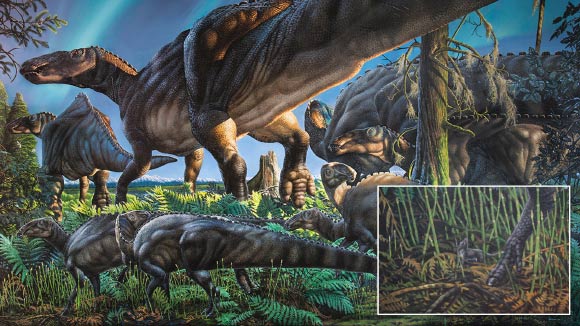
A reconstruction of the Upper Cretaceous paleoenvironment of Alaska. Image credit: James Havens.
Approximately between the size of mice and rats, multituberculates were the longest-lived group of mammals known in Earth’s history.
These creatures persisted for more than 100 million years, from the Jurassic period to the end of the Eocene epoch, about 35 million years ago.
They even survived the Chicxulub impact that killed off all non-avian dinosaurs 66 million years ago.
Scientists have long wondered what allows multituberculates to outlast many other mammals, and the three new Arctic species offer a clue.
“Although the polar regions did not support the same level of biodiversity as the tropics, they were nevertheless very active places where life flourished, extending far back in time,” said Dr Sarah Shelley, a palaeontologist at the University of Lincoln.
The fossil teeth of Boreal Camurodon, Qayaqgruk peregrinusAnd Kaniqsiqcosmodon polaris were found in 73-million-year-old deposits of the Prince Creek Formation, located near the top of the world in the Arctic Circle.
Even then, the region experienced months of winter darkness, freezing temperatures, and likely seasonal food shortages. But these little creatures thrived.
“These three new mammal species add to a growing body of evidence that this ancient Arctic region was home to unique pole-adapted species,” said Dr. Patrick Druckenmiller, a paleontologist at the University of Alaska Fairbanks.
The researchers found striking differences in tooth shape between the three species, suggesting that they likely ate different foods.
Boreal Camurodon had the teeth of herbivores, while Qayaqgruk peregrinus was an omnivore that probably fed on insects as well as some plants.
Kaniqsiqcosmodon polaris It also appeared to have been omnivorous, but it may have primarily fed on plants.
In a region where food is limited, the ability to evolve and define its own diet could have helped different multituberculate species coexist.
“Such adaptability could also have helped them survive the asteroid impact,” Dr Shelley said.
“There’s a lot of diversity in the multituberculate group. They lived incredibly long and I think they can reveal a lot about the resilience of mammals, not only in the face of mass extinction, but also in the climate stresses that many organisms face today.”
Scientists also discovered that Qayaqgruk peregrinus is closely related to a species found in what is now Mongolia, suggesting Qayaqgruk peregrinus“Our ancestors traveled from Asia to North America.
This dispersal likely occurred around 92 million years ago, making it one of the earliest known examples of mammals crossing between continents.
“This means that there was a land corridor between Asia and North America for these small mammals to pass through,” said Professor Jaelyn Eberle, curator at the University of Colorado Museum of Natural History.
“And this land bridge was already quite active 90 million years ago.”
The discovery adds to growing evidence that species have been migrating and reshaping ecosystems across continents for hundreds of millions of years.
“It really challenges our view of native species,” Dr Shelley said.
“Deep time reminds us that a place is not just a point on a map, but a long, complex history of landscapes and people.”
The discovery is reported in an article in Proceedings of the National Academy of Sciences.
_____
Sarah L. Shelley and others. 2026. Arctic ecosystems shaped mammal dispersal and diversification before the Cretaceous-Paleogene mass extinction. PNAS 123 (22): e2601794123; doi: 10.1073/pnas.2601794123