Chimps ‘lager a day’ in ripe fruit fuels drunken monkey theory


Elizabeth Dawson and Helen BriggsBBC climate and science team

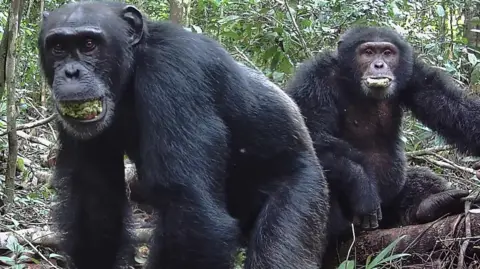 Aleksey Maro
It has been found that wild chimpanzees consume the equivalent of a bottle of blonde beer alcohol per day by eating ripe fruit, say scientists.
They say that it is proof that humans may have had our taste for alcohol of the ancestors of current primates that counted on fermented fruit – a source of sugar and alcohol – for food.
“The human attraction for alcohol is probably born from this food heritage of our common ancestor with chimpanzees,” said study researcher Aleksey Maro from the University of California in Berkeley.
Chimpanzees, like many other animals, have been seen feeding on ripe fruit lying on the forest, but this is the first study to understand how many alcohol they could consume.
The research team has measured the amount of ethanol or pure alcohol, in fruit such as figs and plums consumed in large quantities by wild chimpanzees in Côte d’Ivoire and Uganda.
Based on the quantity of fruit they eat normally, the chimpanzees ingenious were about 14 grams of ethanol – equivalent to nearly two British units, about a 330 ml Lager bottle.
The most commonly eaten fruits were the highest in alcohol.
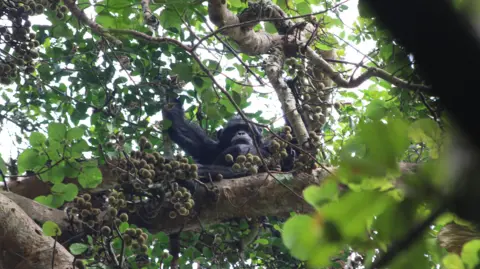 Aleksey Maro
Research adds weight to the so -called “drunk monkey” hypothesis – the idea that human appetite for alcohol has been inherited from our Primate ancestors.
This was first proposed by Professor Robert Dudley of the University of California in Berkeley, who is co-researcher of the study.
Scientists were initially skeptical. But more observations on the “scrambling monkeys” have emerged in recent years, said Professor Catherine Hobaitter, a primatologist at St Andrews University, who was not part of the research team.
“What we are doing with this work is that our relationship with alcohol is deeply returning in evolutionary time, probably around 30 million years,” she told BBC News.
“Maybe for chimpanzees, it’s a great way to create social ties, spend time together on the forest, eat these fallen fruits.”
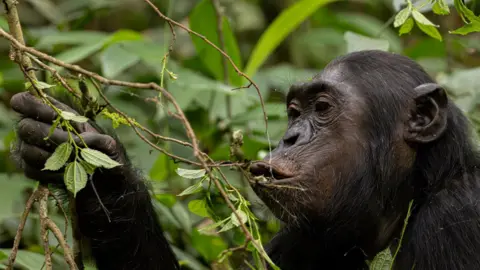 Getty images
Dr. Kimberley Hockings, who studies primates at the University of Exeter and was not involved in research, said that it was important to note that the chimpanzees of this study were not consuming enough alcohol to become drunk. If they had done, “that would not clearly improve their chances of survival,” she said.
According to the International Union of Nature Conservation, chimpanzees are threatened and the greatest threats they face include the loss of their forestry houses for agriculture, logging and the construction of roads or cities.
Research is published in the Revue Science Advances.


