‘Black hole morsels’: A Stephen Hawking theory could reveal strange new objects that challenge physics


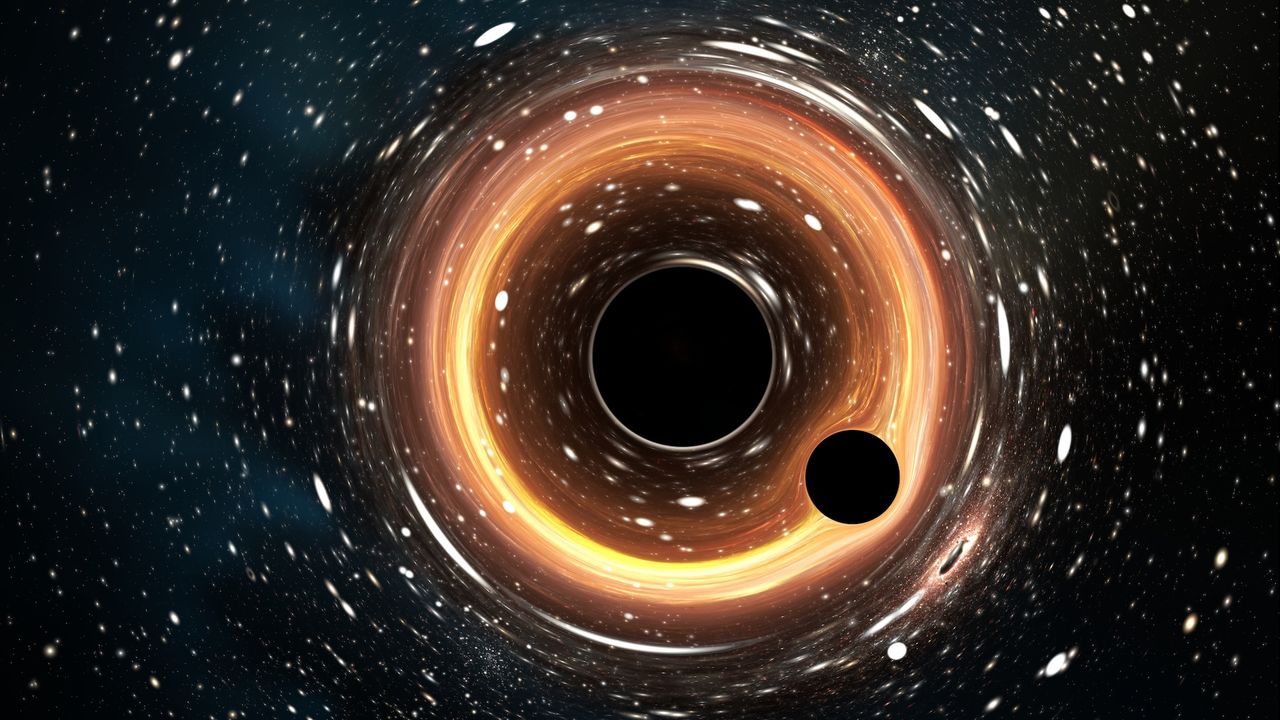
Tiny black holes Created following violent cosmic collisions could offer an unprecedented overview of the quantum structure of space and time, offers a new theoretical study.
In addition, the signals of these “black hole pieces” could potentially be detected by current instruments, reported scientists in the study, which was published in the journal Nuclear physics B.
“Our work shows that if these objects are formed, their influence can already be detectable using existing gamma rays observatories”. Francesco SanninoA theoretical physicist at the University of South Denmark and co-author of the study, told Live Science by e-mail.
Hawking Radiation and the smallest black holes
One of the deepest mysteries of modern physics is the way gravity behaves at the quantum level. The new study offers a daring proposal to explore this diet by looking for the light produced by Tiny black holes Created following the giant collisions of black holes.
The idea that black holes are not entirely black and could therefore emit low radiation, was first proposed by Stephen Hawking in the 1970s. His calculations revealed that quantum effects near a black hole event horizon would prevent it from emitting radiation and losing mass – a process now known as the hawking radiation. The temperature of the black hole should be inversely proportional to its mass. Thus, for massive astrophysical black holes, the effect is tiny, with temperatures so low that the radiation is actually undetectable. But for very small black holes, the situation is different.
“The pieces of black hole are hypothetical micro-black holes which could form during the violent fusion of two astrophysical black holes”. Giacomo cacciapagliaA principal researcher at the French National Center for Scientific Research (CNRS) and co-author of the study, said in an email. “Unlike the largest parent black hole, these pieces are much smaller – comparable in mass to asteroids – and therefore much warmer due to the opposite relationship between the mass of the black hole and the hawking temperature.”
In relation: Scientists never detect the fusion of the most massive black holes – and he has born of a monster 225 times as massive as the sun
Due to this high temperature, these pieces would evaporate relatively quickly, releasing bursts of high energy particles such as Gamma rays And neutrinos. The analysis of the team suggests that this influence could form a distinct signal which could already be within the reach of current detectors.
A new handle on quantum gravity
Although no piece of such has been observed, the researchers argue that the formation of these tiny black holes is theoretically plausible. “The idea is inspired by similar processes in neutron star mergers,” Stefan HoheneggerChief researcher at the Institute of Infinite Deuts in Lyon and co-author of the study, explained in an email. “It is supported by estimates of relativity executives beyond string theory and extra-dimensional models. “”
In such extreme environments, small -scale instabilities can pinch tiny black holes during the fusion process. These objects, in turn, could evaporate through the radiation of hawking on time ladders ranging from millisecond to years, according to their mass.
Above all, if such radiation is detected, it could open a window on new physics. “The Hawking Radiation Code of information on the underlying quantum structure of space-time,” said Sannino. “Its spectral properties could reveal deviations from Standard model On an extreme energy scale, potentially leading to discoveries of unknown particles or phenomena such as the additional dimensions predicted by various theories. “”
Such energy ladders are far beyond the range of the most powerful particle colliders, as Large collision of Hadrons at CERN. The possibility that the pieces of black hole can provide a natural “accelerator” to probe this physique is what makes them so convincing.
According to the team, the signature of a piece of black hole would be a delayed burst of high -energy gamma rays radiating in all directions – unlike typical gamma radions, which are generally radiation.
The instruments capable of detecting such high energy signals include atmospheric telescopes Cherenkov, such as the high -energy stereoscopic system (HESS), in Namibia; The Cherenkov Observatory at high altitude (HAWC), in Mexico; And the large high altitude air shower observatory (Lhaaso) in China, as well as satellite detectors, such as the spatial telescope of Gamma Fermi. “Some of these instruments already have the required sensitivity,” noted Hohenegger.
The researchers did not stop theorizing. They used the existing Hess and HAWC data to place the upper limits on the quantity of mass could be emitted in the form of pieces during known black hole mergers. These limits represent the first observation constraints on such phenomena.
“We have shown that if the black hole pieces are formed during the mergers, they would produce an explosion of high -energy gamma rays, with the moment of burst linked to their masses,” said Cacciapaglia. “Our analysis shows that this new multimedial signature can offer experimental access to quantum gravitational phenomena.”
What comes then
Although the study provides a convincing case for the songs, many uncertainties remain. The exact conditions of their training are still poorly understood, and no complete simulation has been carried out on the scale necessary to model them. But researchers are optimistic.
“Future work will involve refining the theoretical models for the formation of Morsels and to extend the analysis to include more realistic mass and spin distributions,” said Sannino. The team also hopes to collaborate with observational astronomers to carry out dedicated research in archived and future data sets.
“We hope that this research line will open a new window on the understanding of the quantum nature of the gravity and the structure of space-time,” said Hohenegger.
If pieces of black hole exist, they can not only light the sky with exotic radiation, but could also shed light on some of the deepest questions not resolved in physics.


