Boasting an Unusual Set of Teeth, This Extinct Crocodilian Ate Dinosaurs and Plants


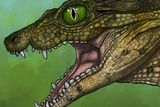
Underground excavated in the southwest of Montana, the skeletal remains of an old Crocodilian creature have built a new branch of a family tree from the time of Cretaceous. This croc – nicknamed “Elton” – only reached 2 feet long when he died about 95 million years ago.
A study recently published in the Journal of Vertebrate Paleontology Show how the discovery of Elton has filled the gap between parents who have long lost modern crocodiles for a long time. The extinguished crocodyliform has now been adopted in a newly established family group, and its unique set of teeth revealed links to similar species that lived during the Cretaceous period – even in Eurasia.
Learn more: As masters of survival and evolution, the crocodile now has two new species
A Crocodilian Rockin
Elton was discovered for the first time in 2021, when Harrison Allen, a undergraduate student at the Montana State University at the time, came across a fossil the size of a pink tip to the Blackleaf geological formation of Montana. This prompted more excavations, which led the researchers to find dozens of fossilized skeleton fragments which were to be eliminated from sediments. Finally, all the pieces of this skeletal puzzle were set up – the researchers understood that they belonged to a small juvenile crocodyliform.
“We have already found dinosaurs (in black heaps), but it was the second known vertebrate animal that we have ever found in this training,” said Allen, who is the main author of the new study.
Elton’s name probably rings a bell. Indeed, he was initially appointed according to singer Elton John – while the researchers sift through the sediments, they increased with a few songs, including the tube of Elton John in 1972 “Crocodile Rock”. The nickname, according to a press release on the study, is simply stuck.
The researchers, however, later found a scientific name for Elton which is not as musical: Thikarisuchus xenodent. He received this name because of his strange and sheathed teeth, one of the focles underlines the study.
Gather the family
Since the skeletal fragments were so tiny and fragile, the researchers had to use a series of computed tomography to reconstruct the specimen. Overall, they found bones of almost all the areas of the animal’s body, including its members, vertebrae, jaw and 50 millimeter skull.
Researchers have also noticed similarities between Thikarisuchus And two other members of the Neosuchia Clade (which includes all modern Crocodilians and their close relatives): Wannchampsus Kirpachi And a specimen not described known as “Glen Rose Form” (or USNM 22039). This inspired them to offer a new clade incorporating the three, which they call Wannchampsidae.
By exploring this family group even more, the researchers determined that it was closely linked to another extinguished group found in Eurasia, Atoposauridae. These two groups were tiny and adapted to land, a rarity among the Neosuchian species (most of which were aquatic or semi-aquatic). The two groups also shared certain cranial and dental characteristics found in another group more distant from Africa in Cretaceous and South America.
“This suggests that during the same period, we note a convergent development between two distant groups due to similar environmental conditions, the availability of prey and who knows what prompted the fangs on the opposite sides of the planet to develop similar features,” said Allen.
Versatile teeth of Thikarisuchus
Based on its bones, the researchers deduced that Thikarisuchus has been kept in a burrow, similar to other fossils of organizations in the training of Blackleaf.
Thikarisuchus And the other two Wannchampsids are also distinguished because they had a dentition of heterodont, which means that they had teeth with more than one form to achieve different objectives. They would have had teeth which helped them to catch prey of mammals or smaller dinosaurs, and others intended to decide or chop plant material or insects. The researchers therefore suggest that the diet in the Wannchampsides probably varied from omnivorous to the insectivore.
The discovery of Elton clearly indicated one thing: the crocodilians of the past were extremely diverse. Some were fully seafarers, while others were entirely terrestrial. Some were herbivores, while others were omnivorous. Even with a new family group on the photo, there is still a lot to learn about old crocodyliforms and their matching characteristics.
Learn more: At 12 feet and 550 pounds, this relative of crocodile devoured dinosaurs about 70 million years ago
Article Sources
Our writers at Discovermagazine.com Use studies evaluated by high -quality peers and sources for our articles, and our publishers examine scientific precision and editorial standards. Review the sources used below for this article:


