Bonobos are capable of pretend play, just like human children

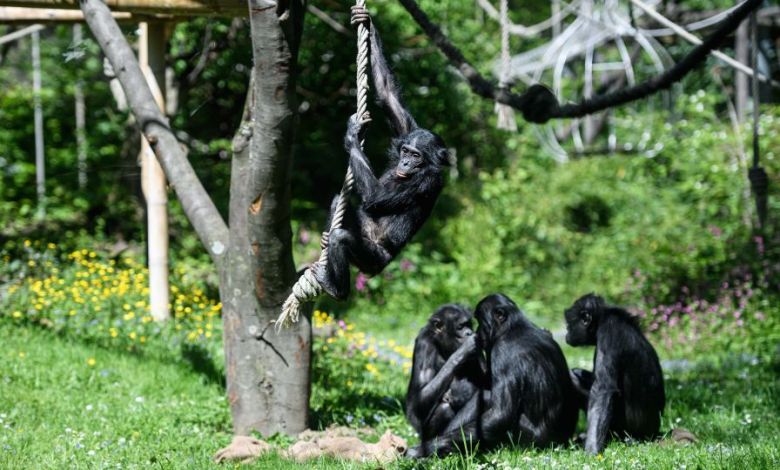
Children love to pretend, organize imaginary tea parties, teach teddy bear classes or run their own grocery store. Now, a new study suggests that such imaginative play is not a uniquely human talent, but a skill that great apes also possess.
The proof came from a bonobo named Kanzi, who participated in three simulated snack experiments conducted by two researchers at Johns Hopkins University in Baltimore, Maryland.
Previous observations of individual monkeys playing alone had raised the possibility that the animals could engage in pretend play, study authors Amalia Bastos and Christopher Krupenye noted in the study published Thursday in the journal Science.
In previous research, a young captive chimpanzee was observed twice between 2003 and 2004 dragging what appeared to be imaginary blocks across the ground, in the same manner as when he played with real wooden blocks.
Female chimpanzees, observed in the wild in Uganda over a 14-year period, have also been seen carrying and playing with sticks as if they were dolls, just as chimpanzee mothers carry their babies.
However, the anecdotal nature of the evidence left room for doubt, the researchers said.

Kanzi the bonobo, who participated in the study in 2024, died in March 2025. – Ape Initiative
For example, animals could have imitated behavior they had observed in humans, rather than using their imagination. Or perhaps a monkey that “picks” a blueberry from a photograph might actually think blueberries are real. Or, if playing with wooden blocks is very rewarding, a monkey might continue to repeat the same action even if the blocks aren’t there.
To address these concerns and provide stronger evidence, researchers conducted controlled tests using juice and grapes in 2024 when Kanzi was 43, a year before his death.
“Where’s the juice?”
First, Kanzi was given two squirt bottles, one empty and one containing juice, and asked to choose which bottle contained the juice. Over the course of 18 trials, he chose the correct bottle each time.
Next, an experimenter presented the bonobo with two empty, clear cups and pretended to pour juice from an empty pitcher into each cup. They then poured the imaginary juice from one of the cups and put it back into the pitcher.
When asked, “Where is the juice?” » Kanzi correctly chose the cup that still contained the imaginary juice 68% of the time, which is higher than if he chose randomly.
However, in case Kanzi thought there was real juice in the empty cups, the researchers performed a second task to see if he could distinguish real juice from imaginary juice. Over the course of 18 trials, Kanzi was presented with a cup containing juice and another empty cup filled with imaginary juice, and asked, “Which one do you want?”
Kanzi correctly chose the cup of juice 14 out of 18 times, showing that he knew the difference between real and fake.
The final experiment involved a similar setup to the first task, but instead of juice, a grape was used. Kanzi managed to identify which jar contained the fictitious grape in 68.9% of cases, even faster than in the first experiment.
The researchers concluded that their “findings suggest that the ability to represent fake objects is not uniquely human.”
“Throughout his life, Kanzi repeatedly demonstrated skills that forced us to reevaluate our understanding of ape cognition,” Nicholas E. Newton-Fisher, a primate behavioral ecologist who teaches evolutionary anthropology at the University of Kent in England, told CNN on Friday.
“It therefore seems appropriate that it also provided experimental evidence for imagination. This is an exciting finding that lends experimental support to anecdotal reports from captive and wild individuals,” added Newton-Fisher, who was not involved in the study.
Kanzi’s Unique Abilities
Kanzi, who died in March, “was a particularly interesting subject” for the study because he had a linguistic background, Bastos, who is now a lecturer at the University of St. Andrews in Scotland, told CNN on Friday. Kanzi was “one of the very few monkeys” to understand verbal prompts, which he responded to using a lexigram of more than 300 symbols.
As part of the Ape Initiative research center, Kanzi has participated in various cognitive research projects, including a 2025 study that showed that bonobos can point out a hidden object if they notice that their human partner doesn’t know where it is.
Because of these abilities, and since Kanzi was the only bonobo tested in the study, it is unclear whether the results can be applied to other monkeys, the researchers said.
“But since there are a lot of these anecdotes, I wouldn’t be surprised to see it extend beyond Kanzi,” Bastos added.
“As the authors of this research note, generalizing Kanzi to other bonobos and other ape species will require further research,” Newton-Fisher said.
However, “while it is appropriate that we proceed with some skepticism,” he added, “I suspect that we systematically underestimate the cognitive abilities of these species.”
Nonetheless, Newton-Fisher said we must remember that while “the mental abilities of adult apes are often compared to those of human children to assess their level of cognitive sophistication,” apes have minds and brains of their own. So, “how – imagination, for example – manifests in a monkey may not be a “reduced” version of the equivalent capacity in humans. »
Sign up for CNN’s Wonder Theory science newsletter. Explore the universe with information on fascinating discoveries, scientific advances and much more.
For more CNN news and newsletters, create an account at CNN.com


