Musk and Altman face off in court over future of OpenAI : NPR

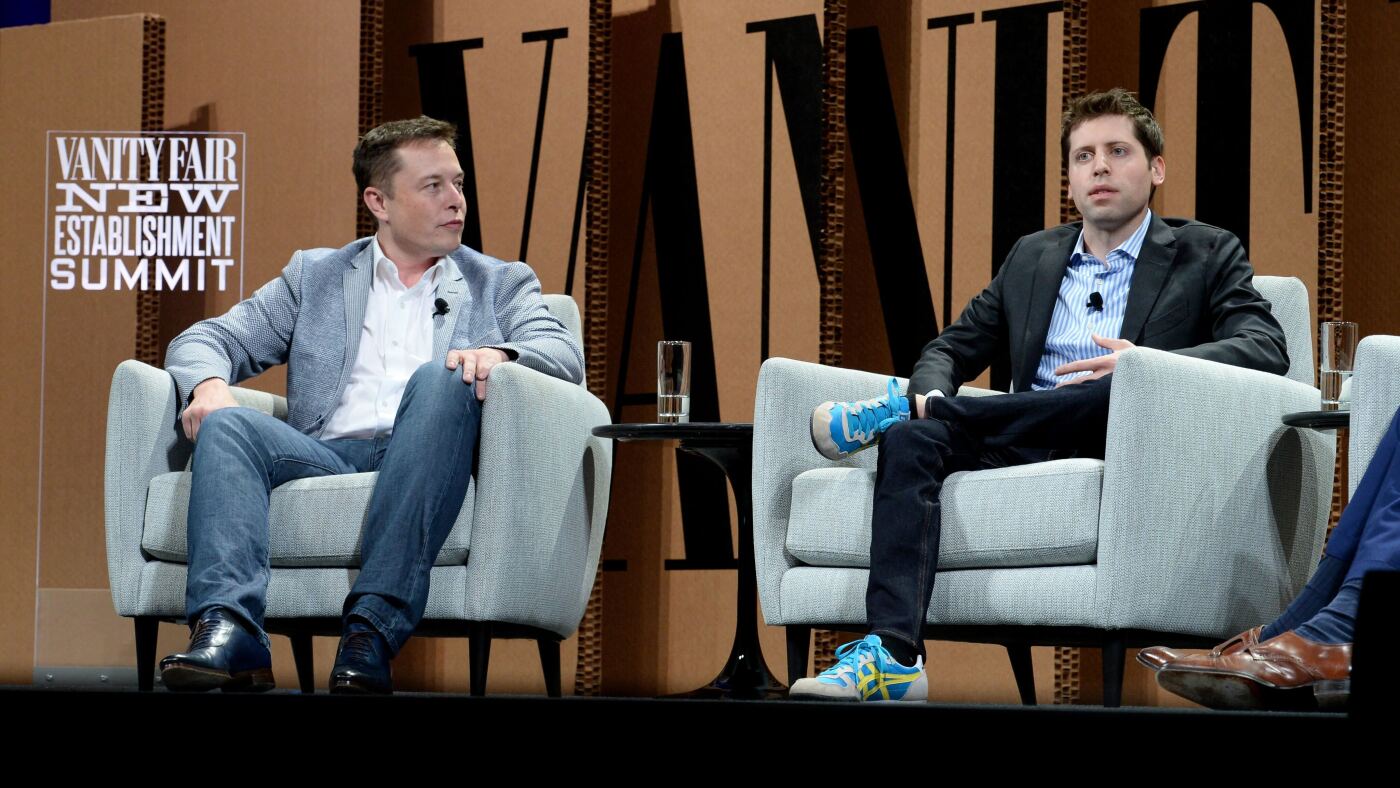

Elon Musk and Sam Altman speak at the Vanity Fair New Establishment Summit at the Yerba Buena Center for the Arts on October 6, 2015 in San Francisco, California.
Michael Kovac/Getty Images for Vanity Fair
hide caption
toggle caption
Michael Kovac/Getty Images for Vanity Fair
Two titans of the tech world will face off in court starting Monday.
Tesla and SpaceX’s Elon Musk is suing OpenAI CEO Sam Altman in a high-stakes showdown between former partners over the future of one of the world’s most influential AI companies.
Musk alleges he was misled when Altman transformed OpenAI from a non-profit entity into a for-profit behemoth. Thanks to ChatGPT’s viral success, the company now has a valuation approaching $1 trillion and is considering an IPO.
“This is a clash between two huge personalities, Elon Musk and Sam Altman,” said Casey Newton, a longtime technology journalist and founder of the Technology Newsletter. Platform. “And I think what’s at stake is potentially the future of OpenAI and the future development of all AI.”
OpenAI was created in 2015 by Musk, Altman and a handful of others as a charity aimed at creating artificial intelligence “for benefit humanity“, free from shareholder pressures and profit considerations.
But according to declarations According to OpenAI, the founders concluded early on that to raise enough money to access the computing power and chips needed to build world-class AI, they needed to attract investors with deep pockets – and the best way to do that was to create a for-profit company.
Analysts say Altman and Musk argued over who would run the company, and Musk lost. He left the OpenAI board in 2018; the company mentioned potential future conflicts with Tesla. In 2023, Musk launched his own AI company, called xAI.
In the trial that begins Monday, Musk claims that Altman and other OpenAI executives broke the law when the company transformed itself into a for-profit business. (TechnicallyThe for-profit company, established in 2019, is a subsidiary of the nonprofit OpenAI Foundation, but it dwarfs the charity.)
“The perfidy and deception are of Shakespearean proportions,” Musk’s lawyers wrote in a court filing, adding that Altman was engaged in a “lengthy fraud.”
OpenAI supports that Musk was well aware that the company needed to become a for-profit business and was participating in discussions about it.
Now, Musk is demanding that the billions of dollars earned by the for-profit company be “returned” to Altman and others — equity and money that was earned through what Musk considers an illegal corporate conversion. Musk wants the court to order those earnings returned to the part of OpenAI that is still non-profit.
Musk’s filings also indicate that he will seek an order “reversing the for-profit conversion… [and] returning OpenAI to the role of a true public charity.
He also seeks to oust Altman from OpenAI’s for-profit leadership and board of directors.
Musk was OpenAI’s largest individual backer from the start, contributing more than $44 million to the startup, according to court documents. Analysts say money was crucial to getting the operation off the ground.
OpenAI’s profile has skyrocketed since ChatGPT went live, four years after Musk left office. In court documents, OpenAI says it has almost a billion weekly active users and is worth $852 billion.
OpenAI recently closed a $122 billion funding round and The Wall Street Journal reported that it is planning an IPO, potentially later this year.

The company declined to comment on reports of plans for an IPO, and attorneys for OpenAI and Musk declined to comment on the lawsuit.
Analysts say the matter is complex. “I think there’s a fundamental question about the extent to which businesses can change, adapt to circumstances, can reinvent themselves,” said Jill Fisch, a business law professor at the University of Pennsylvania Law School.
“I think it’s reasonable to ask the question: When you invest in something that says, look, we’re going to be run in a certain socially responsible way, and whoever runs the company decides, no, this isn’t working, we need to pivot, are there limits to their ability to do that?” she asked.
“It’s part business case and part ego,” said Alex Kantrowitz, a technology watcher and host of the Big Technology podcast. He points out that Musk is asking the court to return the winnings to the charity, not himself. “For Elon, pride is more important than money here,” Kantrowitz said.
If Musk wins and the court accepts the proposed solutions, it would radically change the structure of one of the world’s largest AI companies – and Platformer’s Newton says it could affect the artificial intelligence industry as a whole.
“My understanding is that the main goal is to try to stop OpenAI in its tracks,” he said. “Prevent them from developing future models and essentially eliminate one player from the AI race.”
The case is being tried in the United States District Court for the Northern District of California in Oakland, with Judge Yvonne Gonzalez Rogers presiding.
Jury selection takes place Monday and opening arguments are expected to begin Tuesday. Musk and Altman are expected to testify.


:max_bytes(150000):strip_icc():format(jpeg)/Health-GettyImages-StairClimber-e10f933747014cf7b2f9d0ff48fbc757.jpg?w=390&resize=390,220&ssl=1 "Forget Hot Girl Walks—Everyone's Using the Stair Climber Now. What Are The Benefits?")
