California voters allow Democrats to redraw congressional map : NPR

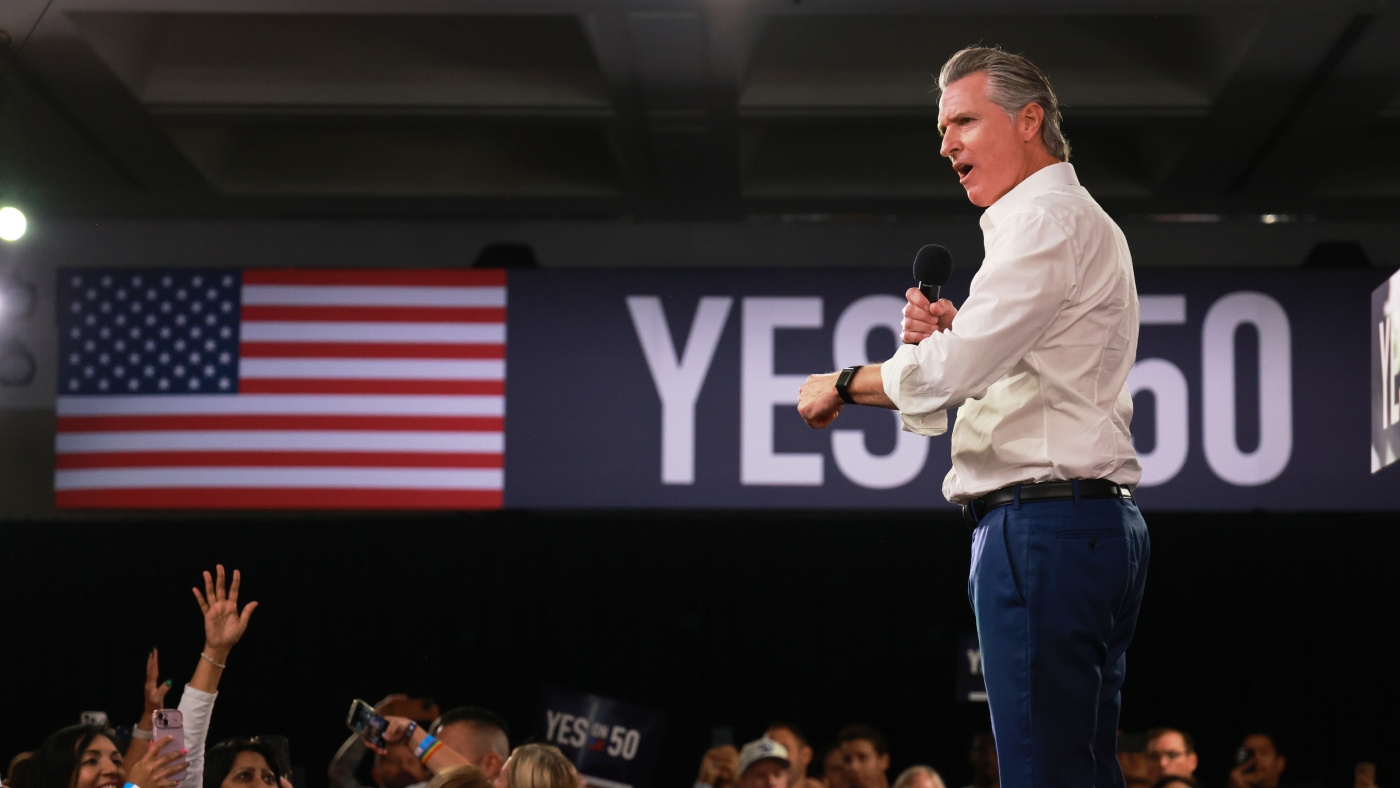

Gov. Gavin Newsom speaks at a campaign event for Proposition 50 in Los Angeles on Saturday. Newsom was the driving force behind the ballot measure, as a way for California Democrats to fight back in the redistricting battle initiated by President Trump.
Ethan Swope/AP
hide caption
toggle caption
Ethan Swope/AP
SAN FRANCISCO — California voters easily approved a ballot measure to redraw the state’s congressional map in favor of Democrats, according to an Associated Press race call, marking the party’s biggest victory yet in a national redistricting battle ahead of the 2026 midterm elections.
The measure, called Proposition 50, will replace lines drawn by an independent commission with a map that could net Democrats as many as five new seats in next year’s U.S. congressional elections.
The AP called the race just as polls closed in California. The result caps a strong election night for Democrats, who also pocketed notable victories in Virginia and New Jersey.
During an abbreviated campaign that saturated California’s airwaves with ads, Gov. Gavin Newsom convinced voters that the state needed to draw new maps to thwart gerrymandering carried out at President Trump’s behest in Republican-led states like Texas.
In Texas, Missouri and North Carolina, the new GOP-friendly maps were adopted after approval by the state legislature.
But in California, Newsom and his Democratic allies needed to get voter approval for the new policy lines, because voters had given the power to draw congressional lines to an independent citizens’ commission in 2010.
The commission remains popular in California, but Newsom was able to amplify the partisan stakes of the campaign, arguing that California cannot stand idly by and watch Republicans gain a significant advantage through redistricting ahead of the midterm elections that will decide control of power in a closely divided House of Representatives.
The results, said California political strategist Erica Kwiatkowski Nielsen, “show a huge appetite and just a willingness among Californians to stand up to Donald Trump.”
“I think the campaign has done a fantastic job of saying and acknowledging people’s fears that, hey, we’ve been a leader in California on redistricting, but this isn’t politics as usual,” Nielsen said. “We are living in unprecedented times.”
Newsom’s ‘yes’ camp wins money battle
Newsom, who has positioned himself as a primary foil to Trump, has amassed a war chest to support the measure — bringing in nearly $120 million as of Friday. Major donors included the House Majority PAC, a group working to elect Democrats to the House, and George Soros’ Fund for Political Reform.
The Yes campaign has blanketed the state with ads featuring top Democrats, from former President Barack Obama to New York Rep. Alexandria Ocasio-Cortez.
Polls in the final week of the campaign showed that more than 90% of Democrats supported the measure and more than 90% of Republicans opposed it.
This does not bode well for opponents of Proposition 50, given Democrats’ strong registration advantage in the state.

The campaign against Proposition 50 was led by Charles Munger Jr., a Bay Area donor who funded the initial campaign to create the Citizens’ Redistricting Commission in 2008. Munger contributed nearly $33 million to the No on 50 campaign — but his donations made up about three-quarters of the $44 million raised by opponents.
Other Republican heavyweights stayed away from the campaign and spending against Proposition 50 dried up in the final weeks of the race, with polls showing the measure opening up a wide lead.
Even Arnold Schwarzenegger, the former Republican governor of California who worked with Munger to create the Citizens Commission, played a moderate role in the campaign — expressing his opposition to Proposition 50 in a handful of interviews and public appearances.
Changes to the state’s congressional map are sure to trigger a series of tough decisions for incumbent Republicans in the weeks to come.
U.S. Reps. Ken Calvert, Darrell Issa, Kevin Kiley and Doug LaMalfa will have to run in districts where the chances of re-election range from difficult to virtually impossible.
The new lines approved under Proposition 50 will remain in place until the 2030 elections, after which the Citizens Commission will once again assume redistricting responsibilities.


