CERN Physicists Pin Down W Boson Mass with Unprecedented Precision


Using data from more than a billion proton collision events collected at CERN’s Large Hadron Collider (LHC), physicists have measured the mass of the W boson with record precision. The value matches the standard model’s prediction, giving researchers confidence that no unexpected forces are lurking in the measurement.
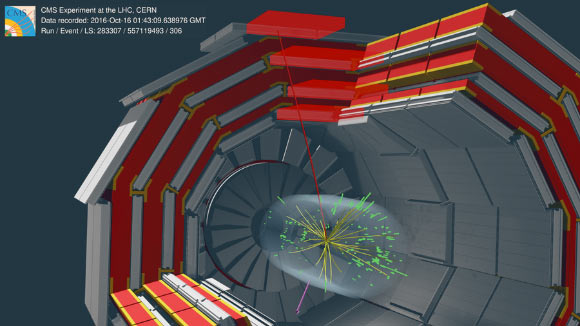
Candidate CMS collision event for a W boson decaying into a muon (red line) and a neutrino that escapes detection (pink arrow). Image credit: CMS/CERN.
First discovered in 1983, the W boson is one of two elementary particles that embody the weak force, one of the four fundamental forces of nature.
The weak force allows some particles to change their identity, for example from protons to neutrons and vice versa. This transformation is at the origin of radioactive decay, as well as nuclear fusion, which powers the Sun.
Catching a W boson is almost impossible, because it decays almost immediately into two types of particles, one of which, a neutrino, is so elusive that it cannot be detected.
Physicists need to measure the other particle, known as the muon, and model how it might add up to the total mass of its parent, the W boson.
In the new study, physicists used the Compact Muon Solenoid (CMS) experiment, a particle detector at the LHC that precisely tracks muons and other particles produced following proton collisions.
From billions of proton-proton collisions, they identified 100 million events that produced a W boson decaying into a muon and a neutrino.
For each of these events, they performed detailed analyzes to refine a precise mass measurement.
In the end, they determined that the W boson had a mass of 80,360.2 ± 9.9 megaelectron volts (MeV).
This new mass is consistent with the predictions of the Standard Model, which is physicists’ best guide to describing the fundamental particles and forces of nature.
The precision of the new measurement is tied with a previous measurement carried out in 2022 by the Fermilab Collider Detector (CDF).
This measurement surprised physicists because it was significantly heavier than predicted by the Standard Model, and therefore raised the possibility of new physics, such as particles and forces that have yet to be discovered.
Since the new CMS measurement is just as precise as the CDF result and is consistent with the Standard Model as well as a number of other experiments, it is more likely that physicists are on solid ground in their understanding of the W boson.
“It’s a huge relief, to be honest,” said Dr. Kenneth Long, a physicist at MIT.
“This new measurement is strong confirmation that we can trust the standard model. »
The team’s work was published this month in the journal Nature.
_____
CMS collaboration. 2026. High-precision measurement of the mass of the W boson with the CMS experiment. Nature 652, 321-327; doi: 10.1038/s41586-026-10168-5


