China Is Now the World’s Climate Champion


Economy
/
November 18, 2025
The news from COP30 doesn’t raise much hope, but China’s embrace of renewable energy shows that climate protection makes sound economic sense.
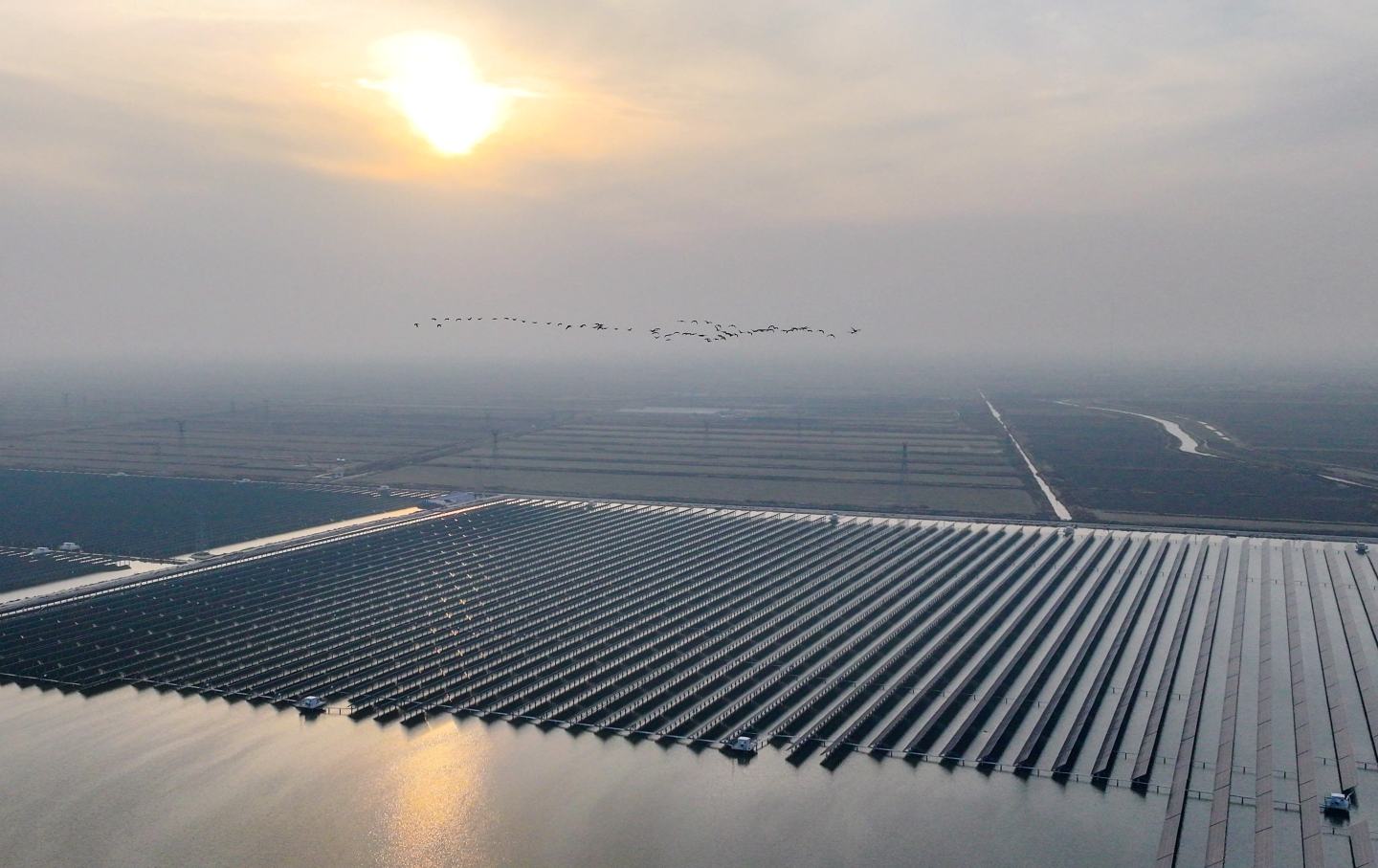
A photovoltaic power station in Binzhou city, Shandong province, November 18, 2025.
(Costfoto/NurPhoto via Getty Images)
There is a positive buzz around the COP30 climate negotiations in Belém, Brazil, but that has nothing to do with the summit itself. The conferences began in 1992 and at this summit, world leaders laid the foundation for the first international treaty to combat climate change. But these days, UN-hosted summits are overrun by fossil fuel lobbyists, and many of the largest industrialized countries simply ignore it. This year, the United States is boycotting, and whatever happens, it is not expected to significantly reduce global emissions.
The source of relief in Belém has instead been the cumulative recognition – summarized in a widely distributed report from Ember, a global energy think tank – that China is surpassing the United States and the European Union in its clean energy technology and industries. China deploys more than twice as much renewable capacity (solar and wind) as the rest of the world combined. As a result, China’s carbon emissions remained stable last year and are expected to decline this year, while those around the world hit record levels.
China’s success is not attributable to international summits or moralistic name-calling, but to stubborn self-interest. Clean energy from the sun and wind is the cheapest energy in the world, and mass-produced clean technologies are affordable everywhere.
“China recognizes that the whole system needs to be reconfigured,” Muyi Yang, an analyst at Ember, a global energy think tank, told me. “China has broken away from the development model based on fossil fuels, although its economy is also full of challenges, like many others in the world at the moment. But it sees a new type of development based on environmental stability.”
Current number

Over the past decade, China has reduced emissions at home and abroad through its exports of clean energy technologies, enabling other countries to adopt cleaner energy solutions more quickly, reports the Center for Research on Energy and Clean Air (CRECA), a Helsinki-based think tank. China’s current renewable energy figures exceed many of its own targets and will leave behind the EU, long a global champion of climate protection. Its secret lies in the same type of incentives and policies that Germany and other Europeans enacted in the 1990s, when they led the world in renewable energy innovation and growth.
“China is the reason why the battle against global warming seems more than ever won,” said Jonas Waack of Zeitunga German daily newspaper. “China now finds itself at the center of global decarbonization, not because more governments want to protect the climate, but rather because there is no surer path to prosperity.”
China’s solar production has increased 14-fold in a decade and now dominates the global market. It installs the wind and solar equivalent of five large nuclear power plants per week. By 2024, China will add four times more solar power generation to its supply than the EU, and six times more wind power. China exceeded its own 2030 targets six years early by installing a massive 1,200 GW of wind and solar capacity in 2024, and exceeding other expectations, such as on sustainable forest management. By 2030, non-fossil fuels will account for 25 percent of its energy consumption: a league beyond the United States, which is going backwards, but still behind the EU, which has already passed 25 percent.
China still relies on fossil fuels – it is the world’s largest consumer of coal – but its demand for gasoline, diesel and jet fuel has stabilized in the last year. China’s dependence on these fuels was actually 2.5% lower than 2021 levels, according to the International Energy Agency. The IEA attributes this phenomenon to “structural changes” such as electrification: China’s electrification rate, which accounts for around 30% of final energy consumption, is significantly higher than that of the United States and the European Union. Today, about half of China’s car sales are electric, the result of national policies ranging from incentives to trade-in agreements.
Moreover, and not least, Chinese clean technologies are conquering a market that Europe hoped to dominate. China owns 86% of global module production and controls almost the entire supply chain for some critical components.
In the electric vehicle market, it is only slightly less dominant: it controls three-quarters of the sector, having overtaken Tesla in 2023. With its wealth in rare earth metals, an important component of battery storage, it is also ahead in this area, as well as in low-emissions hydrogen production technology. Additionally, China is investing heavily in clean energy projects in more than 50 countries, bringing the energy transition to the rest of the world.
China’s progress is particularly good news, as China is the largest emitter of carbon dioxide in the world – by far: the country is responsible for 90% of the growth in CO2 emissions.2 emissions since 2015. Today, its share of total emissions is 32 percent, far ahead of the United States (13 percent), India (8 percent) and the EU (6 percent).
Popular
“Swipe left below to see more authors”Swipe →
China’s investment in a future focused on renewable energy has more than one motivation, according to CRECA’s Belinda Schäpe. Yes, finances are very important, she admits: ten percent of China’s GDP comes from the clean technology sector, and that figure could soon double. But energy security plays a role. China remains a large importer of fossil fuels, including crude oil, coal and natural gas. Russia is among its main oil suppliers. But Schäpe says the environmental calculations are more than window dressing: heat waves and floods are hitting China and its urban centers are drowning in air pollution.
China, although in the lead, could behave more like the “defender of international cooperation on climate change” as it recently bragged about being. It continues to invest heavily in coal. Its oil demand for petrochemicals (not intended for combustion) is also increasing. Its emissions are more than twice those of the United States. He has not abandoned an economic model focused on growth. And the 2035 targets for the world’s largest greenhouse gas emitter are ridiculously conservative, just 7 to 10 percent reduction from peak emissions, while a 30 percent drop is required to meet the Paris targets. Beijing’s net zero emissions target for 2060, for example, is unambitious and uninspiring (Germany’s is set for 2045), and it falls far short of what is needed to avoid climate catastrophe.
It is nevertheless up to it to maintain the global momentum that exists at a time when climate protection is in decline. China’s achievements and forward-looking thinking humiliate Europe and North America. The many benefits of a clean energy transformation have been documented for over a decade, highlighted and tested by experts around the world. Admittedly, President Joe Biden understood this and acted accordingly, pushing the United States to the forefront of global climate protection. Most high-level European politicians know this too, but they have been dominated by the fossil fuel and nuclear industries, as well as right-wing populists. It is a damning indictment of Germans like Angela Merkel and Friedrich Merz, who know that a radical energy transition is both imperative and profitable, but are too timid to say it out loud. In the European Parliament, German Christian Democrats are joining forces with far-right factions to roll back the European Green Deal – in the name of the free market.
In many ways, China is not a country worth emulating. But he obviously took into account the extensive research and experience available and concluded that he had more to gain than to lose in transforming his economy. Europe and the United States have lost their leadership in the restructuring of global energy supplies. This bodes ill for the future of liberal democracy.