Color doesn’t exist—at least not how you think


Red means stop. Red means hazard. Red means passion. Color evokes a range of emotions and associations. It inspired an entire Taylor Swift album. And yet, if someone asked you to describe what red actually looks like, without pointing out something red, you would almost immediately hit a wall.
So why does a color as evocative and distinctive as red (or any color, for that matter) still manage to elude our attempts to describe it in words?
If you just said, “It’s because color doesn’t exist,” well done! If you’re like me and your face has just turned an indescribable shade of red, welcome to the club.
“There is no color in the world,” says American neuroscientist Christof Koch. “There are photons of a particular wavelength emitted by the sun that strike an object and then reflect back into the viewer’s eye. The electrical activity generated there then travels up into the cortex of the brain and is transformed into something we call color.”
In other words, red is not something that waits to be experienced in an objective, uniform way. It’s something your brain makes up. So, does color really exist? Neuroscientists may not think so. At least not in the way we think.
Does color really exist? Short answer: not really.
Koch, a Distinguished Scholar at the Allen Institute for Brain Science, discusses the subjective experience of color using a famous thought experiment called Mary’s Room. Introduced in the 1980s by philosopher Frank Jackson, the experiment involves a hypothetical neuroscientist, Mary, who lives in a black-and-white room. Mary knows everything there is to know about color: the wavelengths, the photoreceptors, how color is processed in the visual cortex. She read all the papers and conducted all the experiments. But Mary never actually saw color.
One day, Mary leaves the black and white room. And for the first time in her life, she sees a red tomato.
The question Jackson asks is deceptively simple: When Mary sees the red tomato, does she learn anything new?
Jackson’s answer was yes. Despite knowing everything science could tell her about color, Mary is confronted with something no textbook could convey: the actual experience of seeing red.
“The feeling, the phenomenal quality, whatever you call it, the experience is subjective,” Koch says. “People have invented a dozen or more words to describe it. It remains inexplicable.”
This “it,” Koch says, is the experience itself – the sensation of seeing red that no scientific language has ever been able to capture.
Related Stories “Ask Us Anything”
Philosophers call this experience a quale (pronounced KWAH-LAY), the first-person felt experience of something: the redness of red, the sharpness of pain, the taste of coffee. Unlike the wavelength of red, which can be measured precisely, a quale cannot be measured objectively. This is entirely an inside job.
Koch claims that the Mary’s Room thought experiment argues against materialism, the philosophical view that everything in the universe, including human experience, can be explained by physics. If materialism is right, there is nothing that science cannot ultimately explain. Mary’s Room suggests the opposite: there are some things that science just can’t explain.
Everyone sees colors differently, but not that differently
For the most part, we go about our days equipped with this surprisingly loose consensus about our shared reality. If your blue isn’t quite the same as mine, it’s close enough that it won’t cause problems most of the time. But every once in a while, something happens that reminds us how differently our brains can construct the same reality.
In 2015, a photograph of a striped dress went viral for a reason that had nothing to do with fashion. The dress appeared blue and black to many, but millions of people looking at the same image saw white and gold and could not understand how anyone could see it differently. In what now seems like a quaint public divide, the internet has become divided over the highly controversial reality of blue/black versus white/gold.
“It’s like they’re looking at the same screen,” Koch says. But “half the population has seen one film and the other half has seen a different film.”
The explanation, Koch says, has to do with how the brain handles ambiguous lighting. Every time you look at an image, your brain makes an automatic, unconscious calculation of its overall brightness. This calculation is based on your habits and life experience.
Research by Pascal Wallisch, a neuroscientist at New York University, drawing on more than 13,000 participants, found that early risers were significantly more likely to see white and gold, while night owls tended to see blue and black.
Because early risers spend more waking hours in natural daylight, their brains are calibrated to filter out blue light, leaving white and gold. Night owls, accustomed to warmer artificial light, filter it and land on blue and black.
“You get up early in the morning and see a lot of sunlight, or you get up really late and wake up mostly at night to artificial light,” Koch says. “So, based on this implicit assumption, your brain gives rise to these two different perceptions: white and gold, or blue and black.” It’s not a conscious, deliberate decision you make to view the dress one way or another.
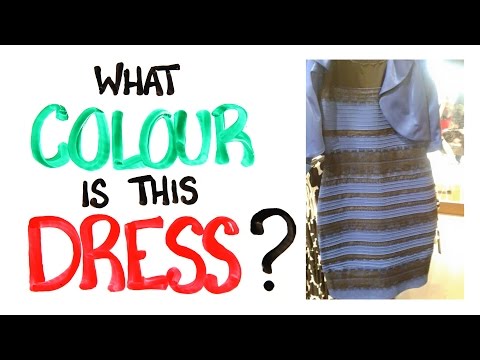
What color is this dress? (SOLVED with SCIENCE)
Is this dress blue and black or white and gold? Your answer might depend on whether you’re an early riser or a night owl. Video: What color is this dress? (SOLVED with SCIENCE), AsapSCIENCE
For Koch, dress is a window into something fundamental in human perception.
“There is input from the world, but then your particular brain may make one set of hypotheses, and my brain may make a different set of hypotheses,” he adds. “But we obviously agree most of the time, otherwise we wouldn’t have evolved.”
And for the most part, we agree. A species that could not agree on certain fundamental common realities would not have gotten very far. So don’t worry: your understanding of red is probably quite similar to mine.
We all have unique built-in filters that change the way we see the world.
It turns out the dress is just the beginning. Koch cites the concept of a “perception box.” Writer and researcher Elizabeth R. Koch (no relation) coined the term in 2021 to describe the hidden forces that shape our worldview.
According to this theory, we each have our own perception box. Think of two people standing in front of the same abstract painting. One sees something beautiful and moving: the other sees a disorder. Same picture, completely different experience. This is your perception box at work. This is shaped by your genes, your upbringing and all the experiences you have had.
“We all live in slightly different frames of perception,” he says. “Walls are invisible and can expand or shrink depending on our genes, neural wiring and experience.”
According to Koch, these walls determine much more than the colors we see. They shape how we interpret relationships, how we process emotions, and even how we respond to the evening news. Two people can watch the same event and come away with completely different realities, not because one of them is lying, but because their boxes of perception are simply constructed differently.
As for the color red, you can measure its wavelength. You can map exactly what is happening in the brain when the eye encounters it. But the actual experience of redness – that felt, inner, indescribable thing – lives inside your box of perception, and nowhere else.
“This applies to all conscious experience,” he says. “This applies to pain, for example from an infected tooth, or to the distress you feel when someone leaves you. It is true for taste, for boredom, for mystical experience and for psychedelic experience. It has the same ineffable quality.”
Which brings us back to red. You always knew it when you saw it. But this color you see? It’s yours and yours alone.
In Ask us anythingPopular Science answers your wildest and most burning questions, from everyday things you’ve always wondered to bizarre things you never thought to ask. Do you have something you always wanted to know? Ask us.

The best new PopSci 2025 releases




:max_bytes(150000):strip_icc()/Health-GettyImages-DietitiansAgreeHealthiestPeanutButter-2e06613d17b74f32ab3b3c23deb2d549.jpg?w=390&resize=390,220&ssl=1 "We Asked 3 Dietitians What the Healthiest Peanut Butter Is—And They All Said the Same Thing")
