Colossal black hole 36 billion suns in mass is one of the largest ever seen in the universe


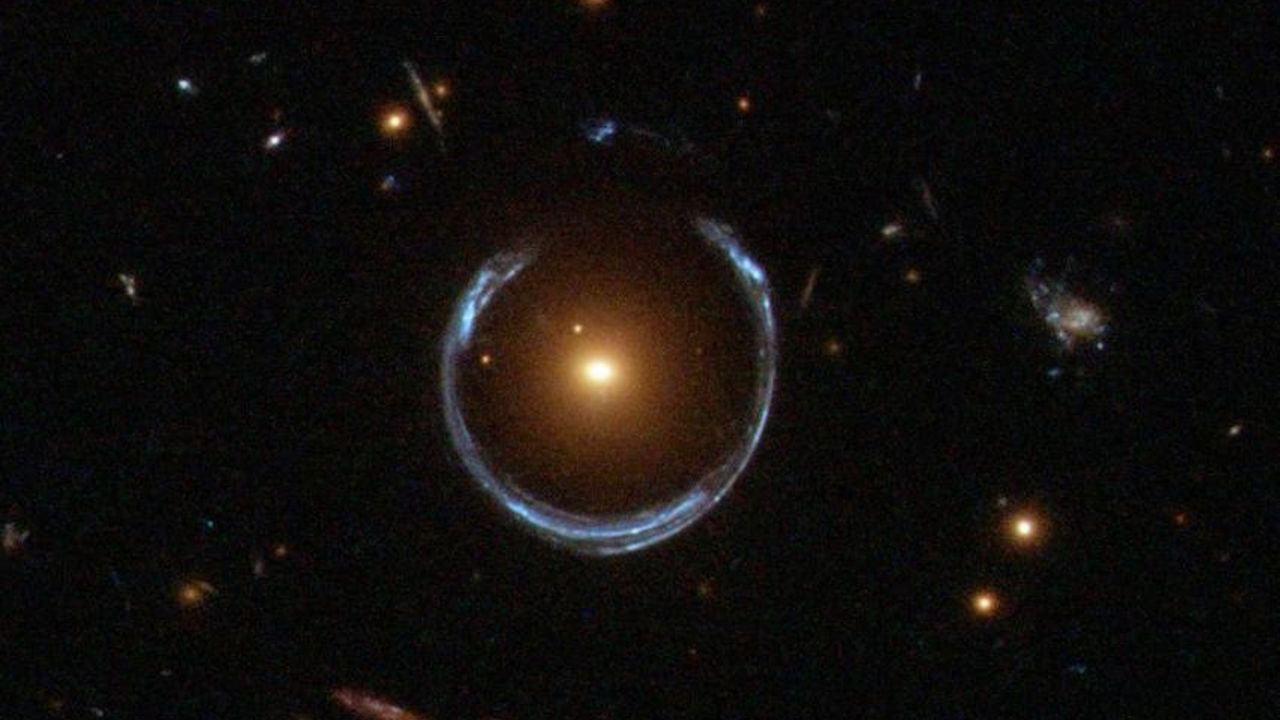
The massif “Cosmic iron“Galaxy System probably hosts a colossal black hole measuring 36 billion times the mass of our sun – one of the largest ever seen in the universe, according to a new study.
Scientists found the cosmic monster by looking through a halo of light called “Einstein ring“This is a kind of gravitational lens. The lens occurs when a solid primary object, such as a group of galaxies or a black hole, deforms space-time, magnifying the light of objects more distant behind.
The discovery of an ultramassive black hole was described on August 7 in the newspaper Monthly opinion from the Royal Astronomical Society.
When it comes to measuring young and large black holes, the field is full of uncertainty. We cannot see black holes directly (they are visible by their effect on radiation or objects nearby), therefore instead, scientists use models to assess their size. But because young people are so far from us, and each model has an “error bar”, size estimates cannot be considered completely precise.
“It is one of the biggest, but not the biggest,” Thomas ConnorAn astrophysicist at the Center for Astrophysics, Harvard and Smithsonian who were not involved in research, told Live Science. Connor added that the new paper shows at least one other black hole perhaps exceeding that of the galaxy on horseback.
As for what is probably the biggest black hole we know, a study by the astrophysical newspaper in 2019 suggested that your 618 is the supreme size singularity, weighing roughly or about 40 billion solar masses.
For astronomers, however, it is not only the size of the black hole that is interesting. More broadly, the big black holes in young galaxies highlight how little we know on the start of the universe.
It is believed that most massive galaxies welcome supermassive black holes. It is possible that the galaxies and the black holes co-evolve, the authors of the new study wrote. However, it is not clear if the evolution remains coupled among the host galaxies and the “ultra -sized black holes”.
Increasingly, observatories such as the James Webb space telescope (JWST) locate ultramassive black holes in the universe very early – Lift big questions about how these monstrous objects could form in such a short time.
Connor said that there were not yet easy answers to this question.
He compared the size of the black hole of Horseshoe Cosmic – and those like that – to find a LeBron James of toddler age in a daycare center of children. Determine how galaxies have become so large which are quickly “theoretically and calculating, incredibly difficult,” added Connor.
Galaxies and their black holes may go through a larger growth push than expected during their first days, engulfing most of the materials available, then remaining at rest for billions of years. But this idea still calls into question “of the fundamental limits on the speed with which things can grow,” said Connor.
Connor said that this paradox of massive black holes in a young universe forced astronomers to look at the environments in which they grew up, to learn more about evolution. Dark matter can play a role that is not clearly understood, for example.
This last black find with a cosmic iron was partly possible by chance, involving stellar movements associated with a gravitational lens, said Connor. The problem is that there are probably other massive galaxies with supermassive black holes that we cannot easily see, because the lens is not always available for astronomers.
“Are there massive galaxies that we would need to find a way to measure their black holes in a comparable way?” He said.
Black Hole Quiz: What is the supermasse that your knowledge of the universe?


