Coral Die-Off Marks Earth’s First Climate ‘Tipping Point’, Scientists Say


October 13, 2025
3 min reading
Coral disappearance marks Earth’s first climate ‘tipping point’, scientists say
Rising global temperatures have caused widespread bleaching and death of coral reefs around the world.
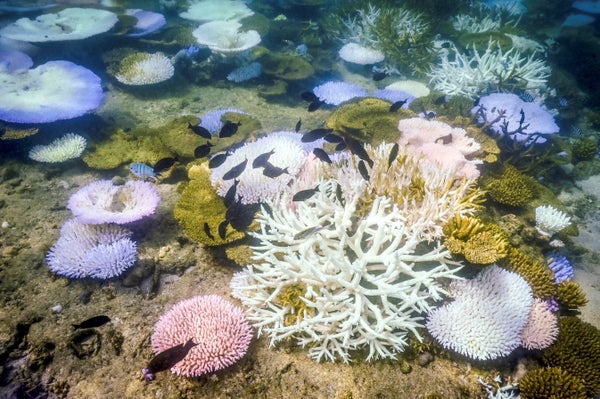
Large areas of coral in Australia’s Great Barrier Reef have died due to extremely high water temperatures.
Rising temperatures across the world have pushed coral reef ecosystems into a state of widespread decline, marking the first time the planet has reached a climate “tipping point,” researchers announced today.
They also argue that without rapid action to reduce greenhouse gas emissions, other systems on Earth will also soon reach planetary tipping points, thresholds of profound change that cannot be undone.
“We can no longer talk about tipping points as a future risk,” says Steve Smith, a social scientist at the University of Exeter, UK, and lead author of a report released today on how close Earth is to reaching around 20 planetary tipping points. “This is our new reality.”
On supporting science journalism
If you enjoy this article, please consider supporting our award-winning journalism by subscription. By purchasing a subscription, you are helping to ensure the future of impactful stories about the discoveries and ideas shaping our world today.
Peak temperature
Led by Smith and other scientists from the University of Exeter, the report assesses the risk of crossing tipping points such as ice sheet collapse, rising seas and Amazon rainforest dieback. It also discusses progress toward various positive tipping points focused on social and economic change, such as clean energy adoption.
The group’s first such assessment, released less than two years ago, raised alarms but did not officially declare that any climate tipping point had been reached. However, in recent years, global temperatures have risen, raising concerns among some scientists that global warming is accelerating and could have even more widespread consequences in coming decades than the changes already recorded.
Australia’s Great Barrier Reef is ‘transforming’ due to repeated coral bleaching
The impact on coral reefs has been particularly severe over the past two years, pushing these ecosystems to their tipping point, researchers say. Warming waters have caused coral bleaching around the world, a process that occurs when organisms expel symbiotic algae that provide them with nutrients, oxygen and bright colors. The fourth global bleaching event in recent decades began in January 2023 and researchers estimate that it has affected more than 84% of the planet’s coral ecosystems.
The initial tipping point report spoke of large-scale threats to corals in the future, but the latest global bleaching event has made clear that the crisis is now, says Michael Studivan, a coral ecologist at the University of Miami in Florida.
“Here we are,” says Studivan, suggesting that coral reefs are facing massive disruptions, both more severe and more frequent. “The recovery period that typically happens between disturbance events doesn’t really happen anymore, and that’s kind of the big problem for the corals.”
Essential ecosystems
Corals would continue to decline even if humans stabilized global temperatures at around 1.5°C above pre-industrial levels. This is one of the objectives of the 2015 Paris climate agreement, but the threshold of 1.5°C could be exceeded in the coming years, researchers estimate. To maintain coral reefs at “a meaningful scale”, humanity must not only stop temperature rise, but also cool the planet to around 1°C above pre-industrial levels by extracting carbon dioxide from the atmosphere, the report said.
Facing irreversible tipping points raises a different kind of challenge for national and international institutions, which have until now focused on incremental actions to address long-term temperature trends, says Manjana Milkoreit, a political scientist at the University of Oslo and co-author of the report. To prevent tipping points from being crossed, she says, there needs to be a focus on immediate emissions reductions and developing technologies to remove carbon from the atmosphere.
“We have the knowledge,” says Milkoreit. “What we need is some kind of governance that matches the nature of this challenge. »
This article is reproduced with permission and has been published for the first time October 12, 2025.
It’s time to defend science
If you enjoyed this article, I would like to ask for your support. Scientific American has been defending science and industry for 180 years, and we are currently experiencing perhaps the most critical moment in these two centuries of history.
I was a Scientific American subscriber since the age of 12, and it helped shape the way I see the world. SciAm always educates and delights me, and inspires a sense of respect for our vast and beautiful universe. I hope this is the case for you too.
If you subscribe to Scientific Americanyou help ensure our coverage centers on meaningful research and discoveries; that we have the resources to account for decisions that threaten laboratories across the United States; and that we support budding and working scientists at a time when the value of science itself too often goes unrecognized.
In exchange, you receive essential information, captivating podcasts, brilliant infographics, newsletters not to be missed, unmissable videos, stimulating games and the best writings and reports from the scientific world. You can even offer a subscription to someone.
There has never been a more important time for us to stand up and show why science matters. I hope you will support us in this mission.


