‘Dark DNA’ may explain dancing spiders’ extraordinary diversity



 Pallab GhoshScientific correspondent
It is not only the dazzling colors and the smooth movements of the dancing spiders of Australia that make them special.
There are more than 100 different species from peacock spider, while most animals have only five or ten.
The researchers believe that this is partly due to Spider’s “Dark DNA” – a mysterious part of the animal genetic code, and they study it to find out more.
They think that this dark DNA could allow it to quickly adapt to changing environmental circumstances by turning into new species.
What scientists discover, they say, could help explain why there are so many variations in the natural world.
“We are interested in the way the spiders are evolving to become so diverse,” Jonah Walker told Sanger Institute at BBC News.
“When you go out, you see so much variation in plant and animal species,” he said.
“Peacock spiders are at the extreme end of this. And therefore, by studying them, we can use this extreme case to try to understand which processes produce a variation in general.”
Peacock spiders are across Australia and each is the size of a pin head. It is appointed because of the brilliant colors that men have on their abdomen, which they show in an attractive mating ritual.
They create a sound of drums with their feet, a spider song and move rhythmically while displaying their functionalities with dazzling patterns. What is remarkable in these creatures is how varied they are in their appearance, their songs and their dance movements.
Mr. Walker was afraid of spiders, but he overcome his phobia because he was so attracted to science behind the spiders and took the project as part of his doctoral research.
“When I told my friends and family that I was going to study the spiders in Australia, I had worried looks and that I was obviously worried myself. But a few seconds watching them dance were sufficient for the fears to be carried away.”
Mr. Walker has worked with his group leader, Dr. Jonana Meier and an international team to collect each of the species discovered so far.
They then meticulously classified precise details on the behavior, movement and songs of each. The latest part of the jigsaw was to reference all this information with the DNA of each species.
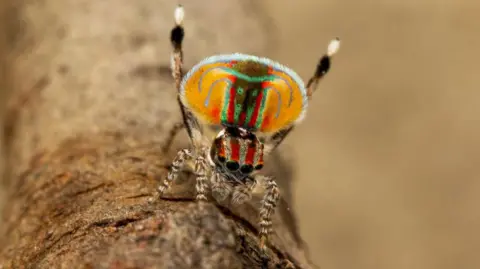 Jonas Walker
By comparing the results of each species, they hope to know which genes are responsible for each line and, ultimately, why there are many different types of peacock spider.
Research is a work in progress, but the team already has a strong scientific advance to investigate more.
“This is the beginning, but one of the enticing things that we have discovered is that it may not only be the genes that are responsible for diversity, but the bits between the two, the so-called dark DNA ”, which can influence how spiders evolve,” explains Mr. Walker.
DNA consists of a long chain of molecules. Certain parts of them are involved in the decision of specific features. In the case of humans, they can decide on the color or color of the eyes. These sections are called genes.
But most of the DNA sections are not genes, and no one really knows what they are doing. Sanger researchers think that this so-called dark DNA can be responsible for the diversity of peacock spiders.
They have three times more dark DNA than humans.
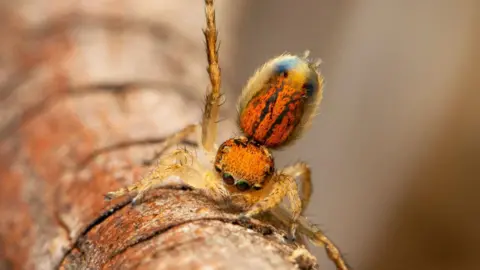 Jonas Walker
Some butterflies also have an exceptionally large number of species. Dr. Meier has already decoded the DNA of a thousand species of butterflies and butterflies.
But spiders, butterflies are only the start of one of the most ambitious genetic projects ever undertaken. The plan is to decipher the genetic code of each plant, animal and fungus on the planet in the next 10 years.
“Like all plants, animals and mushrooms, we have very similar DNA,” said Dr. Meier at BBC News.
“By understanding the DNA of all the different organizations, we learn the general principles of the functioning of genes and the function of dark DNA, and therefore it also helps us to know a lot about ourselves”
The researchers decoded the DNA of 3,000 different species insofar as the Earth Biogenome project.
The goal is to decode 10,000 next year and complete the 1.8 million living species during the next decade. The knowledge acquired, hope for scientists, will allow them to acquire an unprecedented overview of the evolution of all living beings and complex interrelations between them.


