designing moonbases in games and reality

When you purchase through links on our articles, Future and its syndication partners may earn a commission.

Credit: Bethesda/NASA
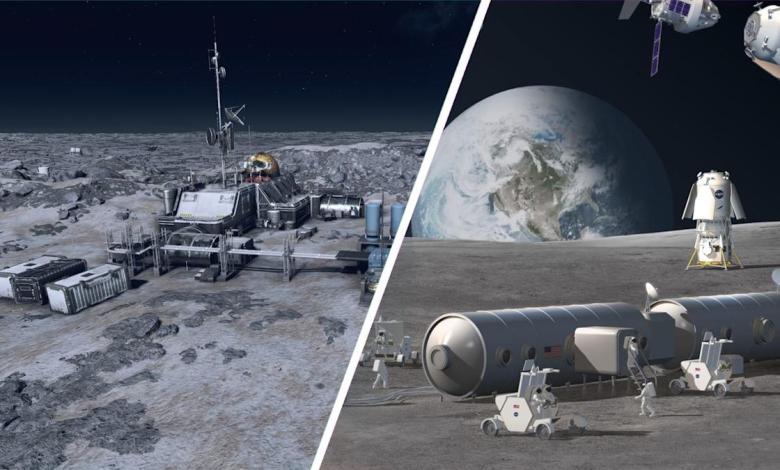
NASA’s Artemis program is the space agency’s plan to return humanity to our nearest cosmic neighbor, the Moon. This time, however, the idea is not just brief contacts and exploratory surveys, but a sustained lunar presence, and the agency recently announced a long-term road map for building a A permanent $20 billion moon base.
Artemis II has just circled the Moon and returned home safely, paving the way for future missions to our natural satellite and the introduction of permanent infrastructure alongside Artemis V in 2028.
They may not be directly correlated, but along with humanity’s growing interest in conquering the stars, we’ve also seen a spike in popularity in space base-building games. There’s a wave of dedicated builders like Space Engineers and Oxygen Not Included, and base building has also appeared in larger RPGs like No Man’s Sky and Starfield.
The lunar surface is a perfect setting for a base construction simulation. After all, you don’t need to introduce artificial challenges when you’re already struggling with isolation, resource scarcity, technical constraints, and environmental extremes.
So, which games are best for approaching the challenges Artemis will face in colonizing the surface of the moon? And above all, which ones are the most fun, realistic or not?
Virtual moon bases: from Starfield to independent simulations

Credit: Bethesda
Unsurprisingly for a massive, open-space Bethesda RPG, Star FieldThe emphasis is more on fun mechanics than demanding realism. While base building doesn’t seem like an afterthought, it’s also not the primary focus of the game, which inevitably leads to some streamlining and simplification.
Starfield lets you build modular outposts and use them as hubs for your next space adventures. Very little attention is given to environmental factors and more to practical concerns such as how they can serve the game’s other systems. As such, they feel less like true bases or homes and more like industrial outposts. You can mine resources, automate production, and build crafting and upgrade stations (and it’s a good place to hide all the mountains of gear/junk that every Bethesda game is practically awash in). Habitability is secondary to finding resources to exploit.
There are some management elements, like power requirements and creating cargo links if you want to connect multiple bases, but the focus is on accessibility and usability. That said, they can be a lot of fun to design and optimize, and the build systems are easy to use and intuitive. If you’re looking for a lightweight base-building simulation that supports a larger game, Starfield is a great choice, but don’t expect a deep approximation of what building a moon base can actually look like.

Credit: Bethesda
For this, a better choice is a game like Moonbase Alpha or, despite its name, Surviving Mars.
Alpha Lunar Base is explicitly supported and published by NASA itself. You play as an astronaut assigned to a base located at the south pole of the moon. Shortly after your arrival, you witness a meteorite impact that cripples the outpost’s life support systems.
Your goal is to repair and restore crucial systems by coordinating a team of up to six players, equipped with rovers, robots, and authentic equipment that a real research team would have access to on a lunar expedition. Although the scope of the game is quite limited, Moonbase Alpha is probably the most realistic look at what setting up the moon (and exploring the lunar surface) would actually look like.

Credit: Virtual Heroes / Army Game Studio / NASA
It features an accurate lunar landscape, real EVA and oxygen mechanisms, and lots of real NASA equipment, such as solar panels, power generation systems, and robots. Construction is already complete here, so it’s more of a “moon base life simulator” than a builder.
For a more complete base-building experience while still retaining a reasonable amount of verisimilitude, Surviving Mars is the better choice. However, to replicate the lunar base experience, you’ll likely need the Green Planet DLC (which adds numerous terraforming systems) as well as a few mods to give you the true lunar experience.
Survive the Moon

Credit: Haemimont Games
Surviving Mars includes realistic systems such as modular pressurized domes, life support management, limited power and water resources, and supply dependence on Earth, making it a strong indicator for a lunar base. The emphasis on resource scarcity, crew specialization, and critical infrastructure reflects the challenges of operating a true lunar outpost.
To get as close to lunar conditions as possible, you’ll need to choose a map with low temperature and water availability, as well as high solar exposure. There are also mods available that will allow you to remove atmosphere effects and flatten the terrain to get closer to the lunar aesthetic.
To truly simulate lunar conditions, you can also impose certain limits, such as using only domes as pressurized habitats and using solar panels as primary power. You’ll also want to minimize wind and build large storage batteries, limit the crew to between ten and thirty people, and emphasize logistics and reliance on Earth.

Credit: Keen Software House
With these constraints in mind, progress is slow and deliberate: you constantly balance energy, oxygen, and water with almost no margin for error, knowing that a single failure can result in a total loss. Between the small crew and heavy reliance on terrestrial resupply, the experience becomes tense and methodical – closer to running a real-life lunar outpost than a city builder, where survival depends on redundancy, efficiency, and careful planning rather than expansion.
Other good gaming options are Oxygen not includedwhich features extremely detailed simulation elements such as gas pressure, heat transfer and (surprise) oxygen management, and lets you build on asteroids, similar to the surface of the moon.
Space engineers is another good choice, with its lack of atmosphere, low gravity, and ability to build pressurized bases and design airlocks, power grids, and vehicles.
There are also some exciting candidates on the horizon, including Possible: lunar industriesbilled as “the first realistic lunar colony management game”.
Artemis Base Camp vs. Video Game Design
Credit: NASA
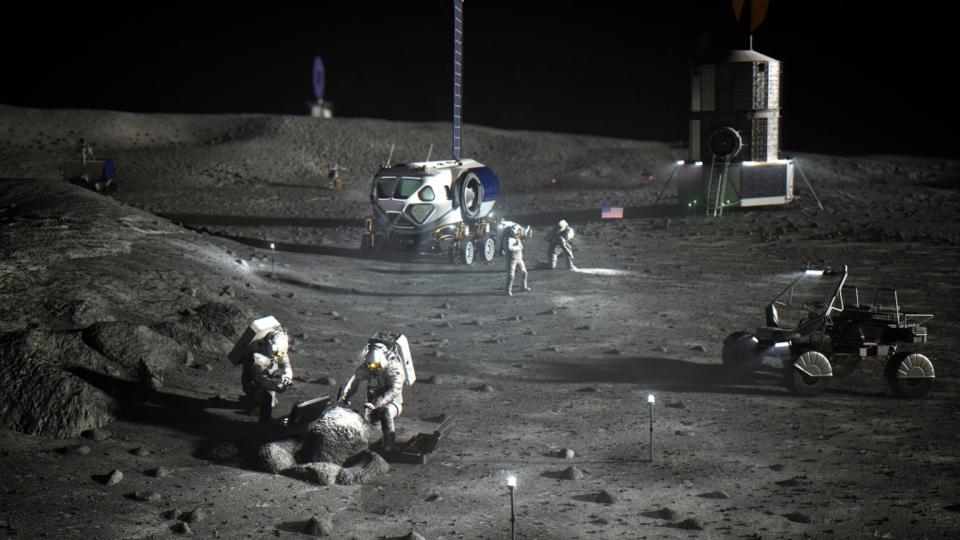
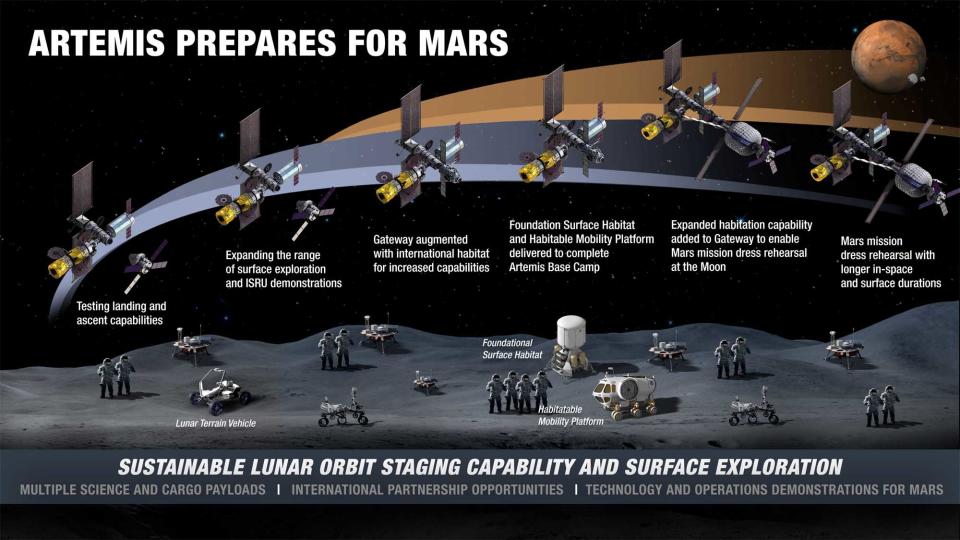
So where do the games line up with the actual layout of Artemis Base Camp? NASA’s plan for Artemis infrastructure includes surface habitats, Lunar terrain vehicles (LTV) to roam the landscape and transport equipment, pressurized rovers and solar power, energy storage and modular microgrid systems for energy production/conservation.
Many games replicate these systems to one degree or another. The best ones focus on the importance of in situ resource utilization (ISRU)which will be extremely important in real-world lunar colonization, given how labor, time, and resource-intensive importing goods from Earth is.
It will be vital for Artemis expeditions to harvest local resources, such as water from polar ice, especially after NASA announced it abandon the proposed lunar gateway (a small station intended to orbit the moon) to focus on building a lunar base.
Credit: NASA
Games like Space Engineers and Surviving Mars also do a great job simulating energy bottlenecks; one of the major challenges of power a real lunar base it’s not so much about generating enough energy as it is about delivering it efficiently and reliably.
Modular expansion is also something that games tend to master; this allows the base to grow safely, efficiently and sustainably in an extreme and resource-limited environment.
In the real world, this means that violations in one domain can be contained and not lead to a cascading catastrophic failure. This also means that modules can be specialized, allowing for efficient power distribution and redundancies.
Life imitating art

Credit: NASA
By the time Artemis astronauts begin to gain a real foothold at the Moon’s south pole, the plan will seem eerily familiar, at least to simulation junkies who have dreamed of a functioning lunar colony for decades now.
THE best space colonization games have already taught us to think in terms of energy budgets, fragile supply chains, and ways to survive in a hostile vacuum.
It will be fascinating to see how some of the more realistic games have predicted what a real moon base will look like as Artemis gradually builds humanity’s first true off-world home.


