Diminished Lives: an Assault on the Humanities


April 8, 2026
More and more students are being indoctrinated into a cold cult of “efficiency,” where training workers for corporate employment is seen as the ultimate priority.
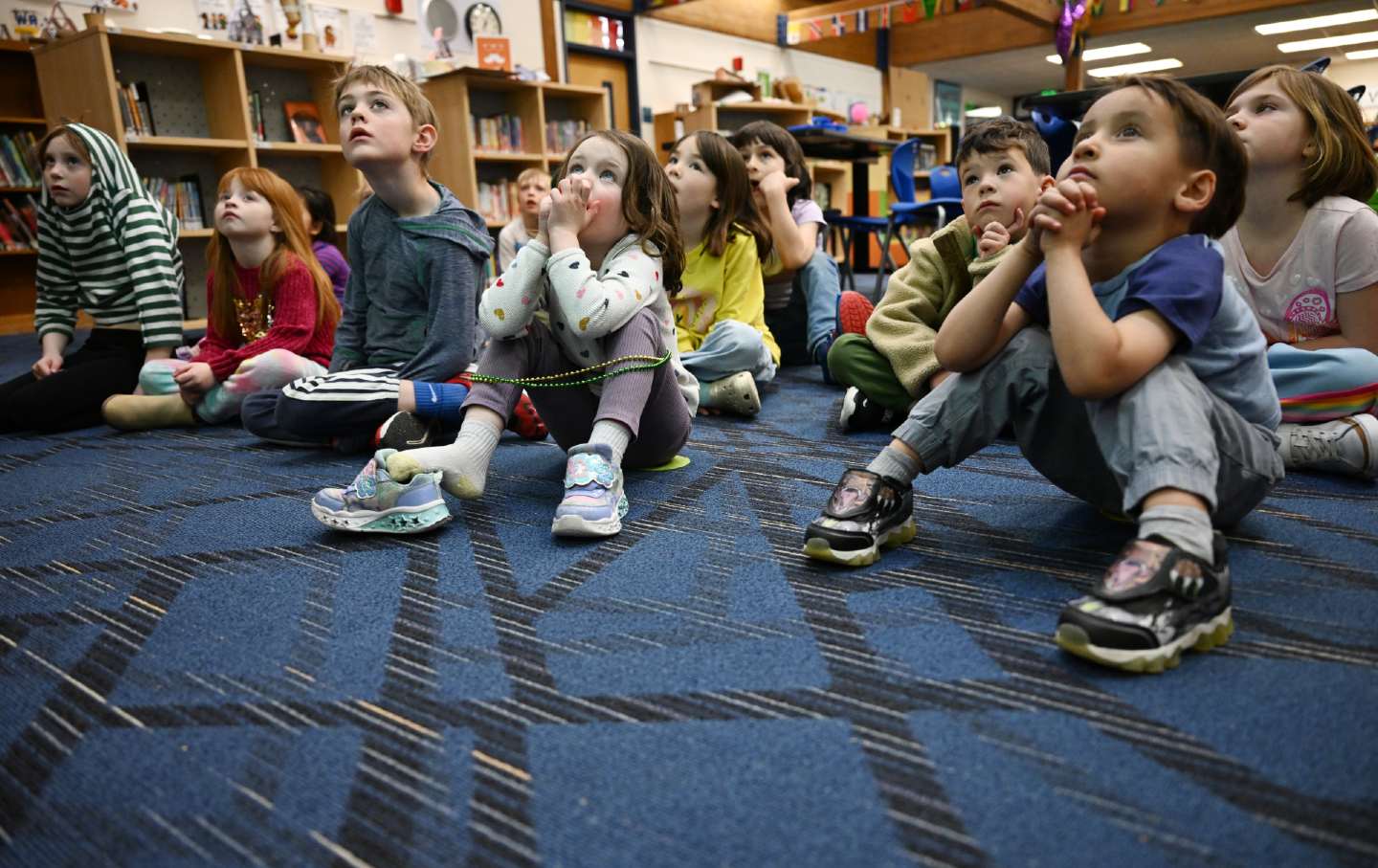
Kindergarten students at Coal Creek Elementary School in Louisville, Colorado, March 11, 2026.
(RJ Sangosti/MediaNews Group/The Denver Post via Getty Images)
Anyone who spends a lot of time visiting children in public primary schools will probably notice that the time traditionally devoted to the study of arts and letters has undergone a notable reduction. “Severe budget cuts [the] humanities and other non-STEM fields,” according to Robin DG Kelley, professor of American history at UCLA, have accompanied the growing assault on critical inquiry.
This trend, which I began to notice in the years after the passage of the No Child Left Behind test law, is part of a larger pattern of retreat from the humanities in general, to which there is tending to be less and less attention, it seems, because the benefits or “results” of engaging a child in a work of literature they enjoy do not lend themselves easily to rigorous, scientific measurement. “I want to change the face of teaching reading from an art to a science,” a senior U.S. Department of Education official said in 2002. If she had simply meant that reading instruction should be based on research known to have a scientific basis, her statement would have seemed like common sense to me. Unfortunately, in too many schools the science theme quickly turned into a storm of arctic air that swept away any serious concern about the artistry of language in the books and stories that children increasingly had no time to read.
“So maybe we don’t teach an entire novel,” noted a curriculum administrator in a New York district in an interview with The New York Times in 2015, “but we make sure to teach the concepts that the novel would have transmitted”.
That’s a funny statement. I don’t think many people read a novel to discover “a concept” or set of concepts hidden within its pages. I think most people read a novel to enjoy the story and get caught up in the lives of the people it describes and how their personalities and characters develop as the story progresses. This is obviously impossible if students only read a few paragraphs or pages.
A case in point: One of the bright young teachers I knew when she was a graduate student here at Cambridge became a fifth-grade classroom teacher a few years later in a poorly funded district in Virginia. There was no school library, and in the classrooms literary books had been largely abandoned and replaced by tiny pieces of writing called practical texts.
The teacher, who had studied education after earning her undergraduate degree at the University of Virginia, had worked as a teacher in a fairly affluent neighborhood in a suburb near Cambridge, where the pressure of testing had been less severe and where she had had the opportunity to introduce her students to books she had known and loved since she was a child. So the idea of using what she calls “ridiculous little pieces” of test-aligned material as a pillar of teaching struck her as, as she puts it, “pretty incredible.”
Current number
Later, she sent me a package that included several passages that her students were required to read during a six-week period leading up to the final round of standardized exams—during which, she told me, they did not read any books.
One of the longest pieces she sent was a nonfiction passage about a sea creature I’d never heard of called the blobfish. He began by saying that the blobfish has “a human-looking face” and, in the next sentence, is “a human-looking fish” and, in the paragraph that follows, has “an almost human appearance.” Although it is “perhaps not one of the most attractive of sea creatures,” the passage continues, “it is certainly one of the most interesting.” Its shapelessness “allows the blobfish to float easily” in “the ocean depths where it dwells.” The blobfish “spends all its time floating” and, two sentences later, the blobfish (plural) “spends most of its time floating…They are made to float.”
The blobfish “may not be the most attractive fish,” children are told a second time in the final paragraph, after which a multiple-choice question asks students to identify the structure that was used to organize the passage. The teacher said one of her students stuck her fingers down her throat to show how interesting she found it.
It is not surprising that so many teachers, with his good education and cheerful personality – and his fierce resistance to the loss of his autonomy – are unwilling to stay long in schools where the “ridiculous little bits” of mediocre writing and the pressure to conform to standardized banalities stifle any enjoyment to be had in the arts and letters.
The banning of books on social justice issues and works dealing with the country’s racial history is another reason why teachers who came into teaching with a sense of social conscience are fleeing the classroom. About 12 years ago, a friend of mine in Arizona told me about teachers in the Tucson district who had developed a Mexican American studies curriculum that also included the writings of James Baldwin and dissident historians, like Howard Zinn.
But legislative leaders were not satisfied. The Legislature passed a law to eliminate the program, and Republican Gov. Jan Brewer signed the law in 2012. Among the titles pulled from shelves were works by Cesar Chavez, Isabel Allende, Sandra Cisneros, Laura Esquivel and Thoreau (“Civil Disobedience”) – and, disconcertingly enough, Shakespeare’s play. The storm.
In recent years, right-wing parent groups have attempted to exclude from their children’s schools hundreds of other books that encourage critical thinking or address the conflicts that divide us, along the lines of gender, class and race.
Popular
“Swipe left below to see more authors”Swipe →
Overall, between the onslaught of groups like these and the broader constraint imposed by school curricula on reading almost any book of literary merit from start to finish, the teachers I know speak of a bleak, bare-bones scenario.
I walk into a primary school classroom and, being old-fashioned as I am, I look to see if Harriet the Spy is sitting there, invitingly, on the top shelf of a bookcase. Depending on the level and age of the students, I am also looking for Owl Moon, Peeny’s Butter Fudge, Born on water, Bridge to Terabithia, Grandma’s handbag, The wind in the willows, Number the stars, A wrinkle in timeAlice’s adventures when she fell down the rabbit hole and, of course, Eeyore, Pooh and Piglet as they were portrayed not by Disney but by EH Shepard.
Most of these books and dozens of other ancient or modern treasures are usually listed by the state or district as recommended titles for children of different ages, and they are usually there, somewhere in the classroom, packaged in shelves or boxes. But too often, books sit on shelves and boxes for too many days and hours while children fill in bubbles on their practice texts. Healthy, well-educated teachers tell me they hate it. They did not come to teach to become dedicated technicians of mechanistic learning. They want to seed their students’ futures with a lifelong love of reading.
This is most difficult to achieve in the type of schools where obsessive measurement of results and the cult of cold “efficiency” in training workers for corporate employment are seen as the ultimate priorities. What cannot be measured will not be taught. What will not be “useful” – fascination, pleasure and wonder – is no longer sought after. This results in diminished lives for millions of our children and a continued flight of teachers from their schools.
More than The nation
What the battle over a mixed-use development in a historic city reveals about liberal America.
Sophie Mann-Shafir

Yale just cut summer storage reimbursements for first-generation and low-income students. The university has a $44 billion endowment. What he chooses to budget for speaks volumes.
Student Nation
/
Zachary Clifton

Too often we narrow our scope to remote communication. We must integrate into communities to make a real difference.
Gregg Gonsalves

The city is at the forefront of fighting the use of big tech to surveil residents. But AI poses new threats.
Functionality
/
Sasha Abramski
A manifesto for an AI revolution that benefits as many people as possible, not just billionaires.
Functionality
/
Representative Ro Khanna


