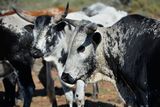
Anthropologists have often assumed that once human societies start producing their own food, they quickly abandon hunter-gatherer practices. Researchers studying some of the earliest adopters of livestock farming in eastern Africa have turned that idea on its head. The new work instead suggests that these ancient pastoralists continued to eat a wider variety of foods, including wild animals, for at least a millennium after they began herding livestock.
“These early herders didn’t put all their eggs in one basket. They were keeping livestock, but they were also still fishing, hunting, and gathering,” said Kendra Chritz, a researcher at the University of British Columbia, in a statement.
The new study was published in the Proceedings of the National Academy of Sciences.
Read More: This Cow’s Multi-Purpose Tool Use Challenges Assumptions About Animal Intelligence
Analyzing Clues Hidden in Ancient Teeth
Chritz’s team studied ancient livestock herders who lived in Kenya and Tanzania between about 9,500 and 200 years ago around Lake Turkana. They analyzed the remains of over 100 people, looking for chemical markers, or isotopes, in their bones.
Ancient teeth contain clues as to what a person ate while their teeth were developing. The remains analyzed included those of early livestock herders and those from later periods, when their practice had become more widespread. There were also remains from people who primarily fished and those who foraged for their food.
The earliest herders’ teeth held the biggest surprise. These samples, dating back around 5,000 years, showed that the herders ate some grass-eating animals — likely domesticated cattle — but also a wide range of other foods. The diversity in these samples was similar to that observed in hunter-gatherer diets.
“The isotopic record is fascinating because it can reveal individual-to-individual variation, even among fisher foragers who lived at a single site,” said Elisabeth Hildebrand, an anthropologist at Stony Brook University who co-authored the new paper, in the press release. “This kind of information goes beyond what one can discern from the animal bones left at a site after human consumption.”
The team found further evidence in ancient ceramic cooking pots. Fatty chemical traces bound to the clay in these pots showed that herders ate some animals — marked by traces of fats in the pots — but there were far fewer traces of dairy products, suggesting that livestock were a part of the herders’ diets, but not their only food option.
Maintaining Multiple Food Sources
When herding arrived in the region around Lake Turkana, major environmental changes were underway. Water levels in the lake dropped as drought gripped the area, leaving the grasslands fragile. It makes sense, the authors said, that herders didn’t entirely rely on their cattle for food.
“Livestock are valuable, but they’re also vulnerable,” said Chritz. “If rainfall is unpredictable and pasture is scarce, having multiple food options can make the difference between getting by and going hungry.”
It took over a thousand years for herders in the area to shift their diets toward domesticated food sources. This later change suggests the environment had stabilized enough for the herders to specialize in their diets.
“The findings illuminate the ingenuity and resilience of the people who shaped this landscape thousands of years ago, and we are proud that Kenya’s heritage is at the center of this story,” said Emmanuel Ndiema, an earth scientist at the National Museums of Kenya and study co-author in the press release.
Read More: How Amsterdam Island Turned into an Unlikely Haven For Feral Cows
Article Sources
Our writers at Discovermagazine.com use peer-reviewed studies and high-quality sources for our articles, and our editors review for scientific accuracy and editorial standards. Review the sources used below for this article: