
Fossil jaws of the ancient monkey species Stirtonia victoriae from the La Victoria Formation in Colombia suggest that a shift toward leaf-eating allowed early primates in South America to grow larger and occupy new ecological niches. The discovery may also hint at when the lineage developed the anatomical features that later produced the powerful howls of today’s howler monkeys.
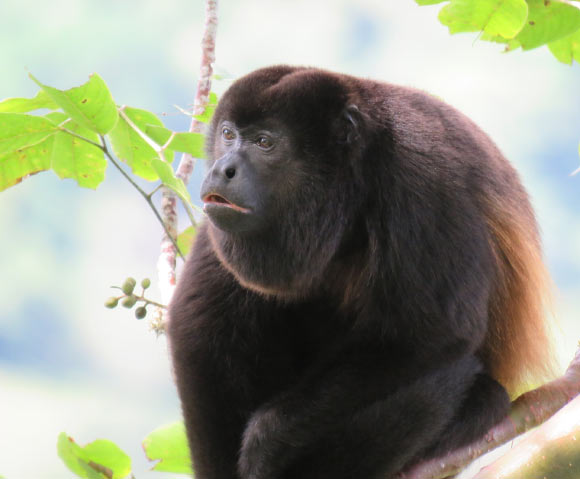
The mantled howler (Alouatta palliata) in Panama. Image credit: Ariel Rodriguez-Vargas / CC BY 4.0.
Stirtonia victoriae lived in what is now Colombia during the Miocene epoch, some 13 million years ago.
“Before the discovery of Stirtonia victoriae, we didn’t have any evidence of leaf consumption in South American primates,” said Dr. Siobhán Cooke, a researcher at Johns Hopkins University.
“This can help us answer important questions about ecological evolution in one of the most biodiverse areas of the planet.”
“What new things were occurring in the development of the proto-Amazonian rainforest when these monkeys were alive?”
In the new study, Dr. Cooke and colleagues examined two mandible fossils of Stirtonia victoriae from the La Victoria Formation in the Tatacoa desert of Colombia.
The findings pinpoint a timeframe for the monkey’s leaf-eating ability, expanding its diet beyond fruit, letting them grow larger in size and easing up competition for food among these ancient howler monkeys and other species of primates.
“Millions of years ago, the ancient monkeys climbed from tree to tree in what is now the Tatacoa desert, but which was once full of swampy grass, forests and riverbanks,” Dr. Cooke said.
They lived among the Amazon basin’s long-extinct fauna, among them giant sloths and huge armored armadillos.
“Previously, we had few other fossil finds from Stirtonia victoriae to learn from, relying only on a few fragments of bone from their face and head,” Dr. Cooke said.
“In addition to providing key information about biodiversity, diet and body size of these monkeys, the most recent discoveries may also reveal when the howler monkey acquired its eponymous ‘howl’ as the loudest land mammal.”
“The jaw had a wide, deep mandibular body, which may have allowed for the hyoid neck bone to balloon the same way as modern howler monkeys, resulting in their iconic call.”
“However, we cannot be certain that they engaged in this behavior.”
The paleontologists scanned the jaw fossils and created a 3D model of the bones to analyze them.
From the structure of the lower molars, they can determine what Stirtonia victoriae ate, how large they were and how this species differentiated themselves from the other primate families living as the Amazonian basin was forming.
They compared the Stirtonia victoriae fossils to 3D model jaws of other South American primates that lived during that time, including the smaller Stirtonia tatacoensis species, another howler monkey ancestor.
They also took a close look at the jaws of modern howler monkeys and their close-living ancestors, including rainforest-dwelling spider monkeys and woolly monkeys.
“Like modern howler monkeys, Stirtonia victoriae had relatively large molars with protrusions that act as ‘shears’ when they grind against one another to help break down carbohydrates, which are adaptations scientists typically see in leaf-eating primates,” Dr. Cooke said.
The researchers also reconstructed the body mass of Stirtonia victoriae and determined that these monkeys weighed between 17 and 22 pounds (8-10 kg).
“Prior to this, the South American monkeys we have in the fossil record are much smaller,” Dr. Cooke said.
“This tells us that these monkeys had a plentiful food source, mainly leaves, that allowed them for the first time to evolve and occupy an ecological niche that allows for larger body mass.”
“Stirtonia victoriae marks the very beginning of a large, diverse group of primates in South America.”
“Now, we can begin to pinpoint when different modern lineages started to evolve.”
The study will be published in the journal PaleoAnthropology.
_____
Siobhán B. Cooke et al. 2026. Mandibular Specimens of Stirtonia victoriae from the La Victoria Formation, La Venta, Colombia. PaleoAnthropology 1: 148-170; doi: 10.48738/2026.iss1.3992


