Endangered orangutan filmed using canopy bridge to cross public road in Indonesia: “A world first”


A Sumatran orangutan was filmed for the first time using an artificial canopy bridge to cross a public road on the Indonesian island of Sumatra, conservationists said Monday.
Rapid development has reduced the jungle habitat of the critically endangered speciesand deadly conflicts with people increased.
The fleeting scene, captured by a motion-sensitive camera, showed a young Sumatran orangutan stopping at the edge of the forest, carefully grabbing a rope and stepping out into the open. Halfway there, he stopped, glancing down at the road below.
“Then, with a cheeky glance at the camera, he continues on his way,” the Sumatran Orangutan Society, or SOS, said in a social media post showing the video.
Conservationists said it was the first documented case of a species on the brink of extinction using an artificial bridge to cross a public road that had divided its habitat.
“This was the moment we were waiting for,” Erwin Alamsyah Siregar, executive director of the Indonesian conservation group Tangguh Hutan Khatulistiwa, or TaHuKah, told the Associated Press. “We are very grateful that the canopy here provides benefits to orangutan conservation efforts.”
He said the bridge spans the Lagan-Pagindar road in Pakpak Bharat district, a vital corridor connecting remote villages to schools, healthcare and government services. But the road also passes directly through prime orangutan habitat, dividing around 350 orangutans into two isolated forest areas: Siranggas Wildlife Reserve and Sikulaping Conservation Forest.
When the road was upgraded in 2024, the gap in the forest cover widened, eliminating natural passages for tree-dwelling wildlife.
“The development was necessary for the people,” Siregar said. “But without intervention, the orangutans would have been trapped on either side.”
TaHuKah, working with SOS and local and national government agencies, came up with a simple solution: rope bridges suspended between trees, allowing arboreal animals to cross above traffic.
If other species, including gibbons and long-tailed macaques, have also been seen crossing paths there, “this is a world first for Sumatran orangutans,” SOS told AFP.
Sumatran Orangutan Society/TaHuKah via AP 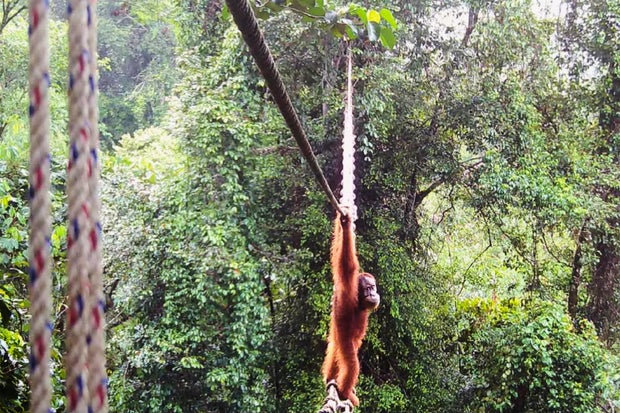
“An orangutan crossed the border, but a population of 350 people still remains isolated,” SOS said in a statement published on social networks.
Five canopy bridges were installed, each equipped with a camera trap, carefully positioned after surveys of orangutan nests, forest cover and animal movements. The structures were designed to support the weight of the orangutan – no small feat for the world’s largest tree-dwelling mammal.
The program is closely monitored, with camera traps on every bridge and regular patrols to prevent encroachment on the forest. Conservationists hope more orangutans will follow the first pioneer.
“Seeing this young male orangutan confidently crossing the road is an important milestone for conservation, proving that it is possible to stitch together fragmented forests,” SOS said on social media.
They waited two years for the first orangutan to cross the bridge. Before this realization, only small animals used it. Camera traps recorded squirrels, langur monkeys and macaques, followed by gibbons – a promising sign.
The orangutan’s approach was slower, building nests near the bridge, lingering on its edges and testing the ropes over time.
“They are watching,” Siregar said. “They don’t rush. They look, they try, they step back. Only when they are sure everything is safe do they move.”
Then, one day, it crossed completely — a first not only for Sumatra, but for the species globally on a public road, conservationists say.
Similar bridges have been used by orangutans elsewhere, but usually over rivers or on private industrial logging roads. Environmentalists say public roads – noisy, busy and unpredictable – pose a much greater challenge.
For orangutans, the stakes are high. Isolation leads to inbreeding, genetic weakening and, ultimately, population collapse. Restoring connectivity gives them a chance to survive.
Once widespread in southern Asia, the animal now survives only on the islands of Sumatra and Borneo. Fewer than 14,000 Sumatran orangutans remain in the wild, alongside just 800 Tapanuli orangutans and around 104,700 Bornean orangutans, according to conservation groups.
“These bridges allow orangutans to move around, mix and maintain healthy populations,” Siregar said. “This reduces the risk of extinction.”


