Europa Clipper and Juice Team Up to Observe Interstellar Comet 3I/ATLAS


When interstellar comet 3I/ATLAS passed between ESA’s Jupiter Icy Moons Explorer (Juice) spacecraft and NASA’s Europa Clipper spacecraft in November 2025, scientists seized a unique chance: One spacecraft simultaneously captured the comet’s bright dayside, the other its dusty nightside.
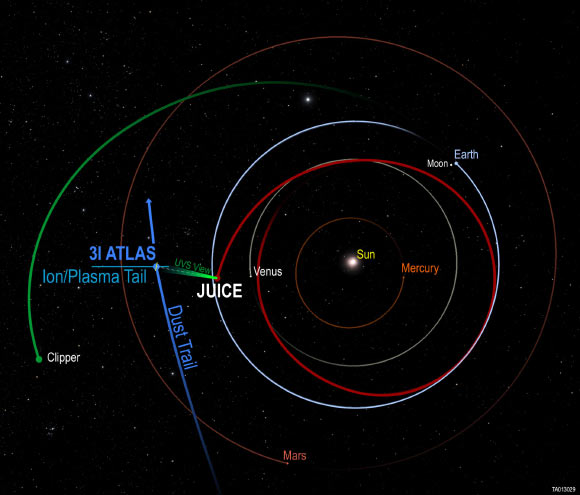
In November 2025, 3I/ATLAS passed between ESA’s Juice spacecraft and NASA’s Europa Clipper spacecraft. Image credit: NASA/ESA/Southwest Research Institute.
“When the comet passed between Juice and Europa Clipper, we were able to informally coordinate observations between the two spacecraft,” said Dr. Kurt Retherford, a planetary researcher at the Southwest Research Institute.
“We mainly observed emissions of hydrogen, oxygen and carbon. »
“These elements are produced when gases escaping from the comet’s nucleus break apart into atoms when exposed to sunlight.”
These unique observations were made with the Ultraviolet Spectrograph (UVS) instruments aboard the Juice and Europa Clipper spacecraft.
“Observing the interstellar comet was an exciting scientific bonus,” said Dr Philippa Molyneux, also of the Southwest Research Institute.
“The resulting rare and unique dataset includes gas emissions and dispersed dust.”
“This was the first time we had simultaneous direct views of the gas coma escaping from two directions.”
“Europa Clipper showed us the night side of the comet, with lots of scattered dust, while Juice mostly photographed glowing gas on the day side.”
Researchers discovered higher-than-expected levels of carbon emissions in 3I/ATLAS early on, especially compared to typical comets in our solar system, corroborating similar results obtained by other observations on the origin and composition of the interstellar comet.
Observing the evolution of emissions over several days revealed how the ratios of these molecules changed and how the comet evolved during its journey through our solar system.
“By studying the ratio of water ice to dry ice, we can compare the composition of this interstellar comet to that of comets native to our solar system,” said Dr Molyneux.
“This helps us understand whether the solar system in which 3I/ATLAS formed is similar to ours or different.”
“I think the coordination with Europa Clipper was a fun and impactful demonstration that showed how the two projects could coordinate observing plans,” Dr Retherford said.
“And as the SwRI team is involved in both missions, this was a highlight for us in terms of collaboration.


