The long, slow road to developing a female crash test dummy : NPR

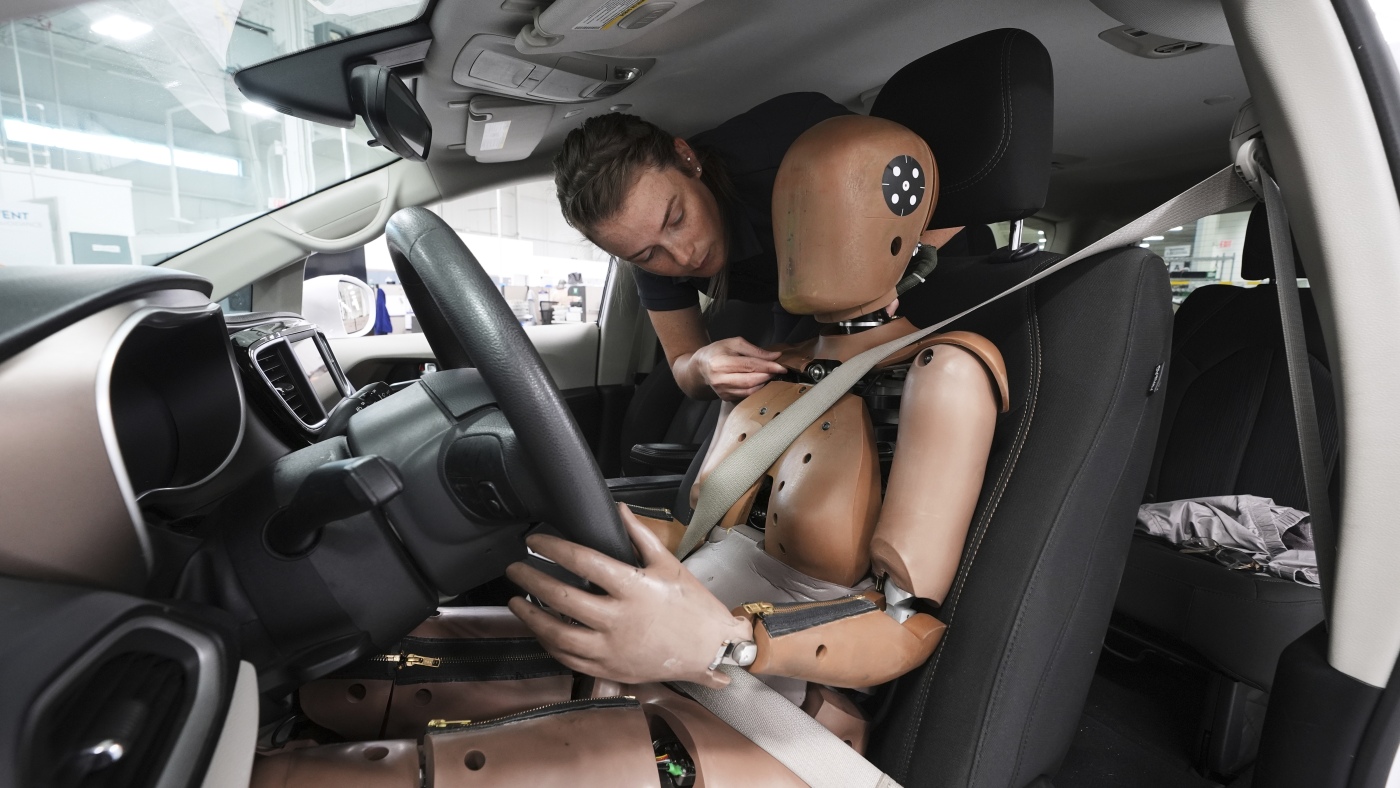

Kate Hippler adjusts a THOR-5F female crash test dummy into a vehicle at Humanetics in Farmington Hills, Michigan, Tuesday, June 10, 2025.
Paul Sancya/AP
hide caption
toggle caption
Paul Sancya/AP
When the Trump administration announced that it give the green light As for the design of a female crash test dummy, it was good news for advocates who have long fought for better representation of women in vehicle safety.

This model has had a long journey. And she is not yet at the end of the road.
In the United States, vehicle safety testing uses crash test dummies based on a male body. Advocates say it’s no coincidence that women are more likely than men to be injured in car crashes, even when controlling for the severity of the crash and the size of the vehicle.
Calls for an accurate female crash test dummy go back decades. Consumer Reports has traced them back to 1980.
In the early 2000s, regulators added a small “female” mannequin to testing – but it was only a smaller version of the male mannequin, with attached breasts. This does not reflect the true anatomical differences between male and female bodies.
Around the same time, the National Highway Traffic Safety Administration (NHTSA) began thinking about creating a more accurate female mannequin. For more than a decade, NHTSA has worked with Humanetics, the leading manufacturer of crash test dummies, to develop, build and test the dummy unveiled this week by the Trump administration.
The new mannequin is called THOR-05F, or Test Device for Human Occupant Restraint, 5th Percentile Female. (That is, a very small woman.) It’s actually based on the female body.
“A woman’s pelvis is more rounded and doesn’t hold the seat belt in the same way,” says Chris O’Connor, CEO of manufacturing company Humanetics. He also highlighted anatomical differences in the neck and significant differences in the lower leg that correlated with much higher rates of leg injuries in women.

The mannequin design had already been adopted by some foreign regulators, with European officials indicating plans to add it to testing within a few years. But the project had remained in limbo in the United States, where the NHTSA had said for several years that more testing and consideration was needed before officially adopting the mannequin.
Adding a new dummy to the crash test process will be expensive: In addition to development costs, individual dummies can cost more than $1 million each.
The new design will not necessarily represent all women; he has been criticized for being extremely small, rather than reflecting average body size. Some security groups having argued that using computer simulations, which can model bodies of different sizes, is a good way to diversify testing, although others argue that having better real crash test data to feed into In these models are essential.

The road to this week’s announcement from the Department of Transport has therefore been winding. “This is a long-awaited step toward full adoption of this new dummy for use in our safety evaluations and federal motor vehicle safety standards,” wrote NHTSA Administrator Jonathan Morrison.
And the publication of technical documents and specifications is indeed only one step. A final rule still needs to be published, and then the new dummy “will be considered” for inclusion in actual safety testing, the Transportation Department writes in its report. press release. These tests have not yet been rewritten to include the new design.
In an emailed statement to NPR, NHTSA says the agency uses the female mannequin in its own research and that the new version “provides the information the auto industry needs” to start using it as well. But when it comes to the federal New Car Assessment Program, which assigns safety ratings to new vehicles, the process of integrating the new dummy will begin in 2027-2028.
Women Drive Too, an advocacy group that has long advocated for the use of female crash test dummies, greeted this week’s news in a measured tone. “We welcome this action, but it alone will not be enough,” the coalition said. wrote in a statement. They continue to push for Congress to pass a law requiring the dummies to actually be used in real-world crash tests.
After decades of planning, use of the new dummies in actual federal safety testing is only a few years away.

.jpg?w=390&resize=390,220&ssl=1 "Lenovo’s ThinkBook VertiFlex Concept Laptop Has a Swiveling Screen")


