Extreme weather the UK’s new normal



 Media in Pennsylvania
The United Kingdom beats heat and precipitation recordings more and more frequently while its climate continues to warm up, warned it.
The country’s changing weather changes mean that the United Kingdom is now experiencing a climate “in particular different” of what was only a few decades, according to its report on the UK’s state climate.
We now have a lot of other very hot days and much fewer extremely cold nights, according to this last evaluation.
It shows how the global warming caused by the large greenhouse gas emissions that our civilization creates is to reshape the country’s climate.
Climate change brings more serious weather events such as storms and floods – and inevitably the changing climate of the country has an impact on the natural world, certain suffering species.
The report focuses on 2024, when the United Kingdom has experienced its hottest February second, the hottest in May, the hottest spring, the hottest fifth and the hottest fifth winter since the start of the records in 1884.
The Met Office stresses that some of these files have already been exceeded in 2025 – more evidence of this trend towards more extreme weather conditions.
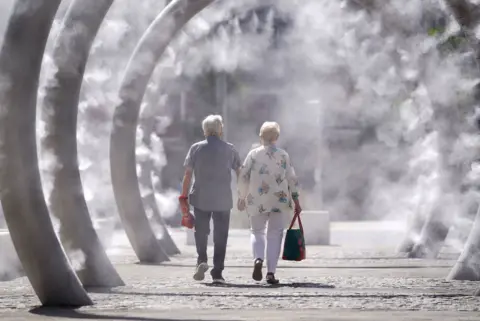
This summer, many parts of the country are plagued by their third heat wave with very hot weather reaching Wales, Northern Ireland and Scotland as well as southern England.
The first hosepipe ban of the year was imposed in Yorkshire last week after June the warmest in England, which came after the driest and sunniest spring in the country for 132 years.
The Yorkshire and the North West of England were declared in the official drought by the Environment Agency in June. At least one region is expected to be added to the list when the UK’s national drought group will meet on Tuesday.
Mike Kendon, a climatologist of the Met Office and principal author of the UK’s state climate report, said: “Each passing year is another step on the warming trajectory on which is on the climate.
“Observations show that our climate in the United Kingdom is now different from what it was a few decades ago.”
West and warmer
While an island was pressed between the vast Atlantic Ocean and continental Europe, the United Kingdom is at the intersection of a whole series of large aerial masses. This is why the country’s climate is so modifiable and this variability also makes the mapping of climate change more difficult.
The precipitation patterns fluctuate much more than the temperature, says it, but he notes that, in addition to warming up, the United Kingdom also becomes humid, precipitation increasing considerably during the winter. Between October and March, precipitation in 2015-2024 was 16% higher than in 1961-1990, he said.
Behind all these changes is the relentless increase in average temperatures motivated by climate change, according to the Met Office. Global temperatures have increased by more than 1.3 ° C since the industrial revolution when humans continue to release carbon dioxide and other greenhouse gases in the atmosphere at an unprecedented rate.
The Met Office calculates that the United Kingdom warms up at a rate of approximately 0.25 ° C per decade, the period 2015-2024 1.24 ° C warmer than the period between 1961 and 990.
As the National Weather Service of the United Kingdom, the Met Office is the temperature record for the center of England, the longest meteorological record in the world, based on measures taken using thermometers and other instruments. It extends from 1659 to the present day and shows that recent warming has far exceeded all the temperatures observed in more than 300 years.
The last three years have presented themselves in the top five of the hottest United Kingdom ever recorded, with 2024 the hottest fourth year of discs dating back to 1884.
Even a small lag of temperatures can considerably increase the frequency and intensity of extreme weather events, as shown in the graph below.
Look at how, as temperature distribution changes, those that were previously extreme are introduced into the beach and that new extremes become much more likely.
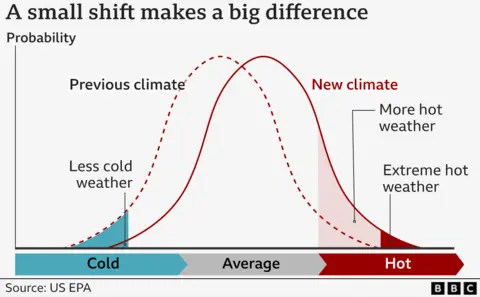
We often talk about how it was colder at the time. Well, this is confirmed by the data of the Pet Office. We really get more and less cold days. The Met Office says that there have been 14 days less with air frosts – when the air temperature falls below zero – in the last decade compared to the period 1931 to 1990.
Risk of growing flood
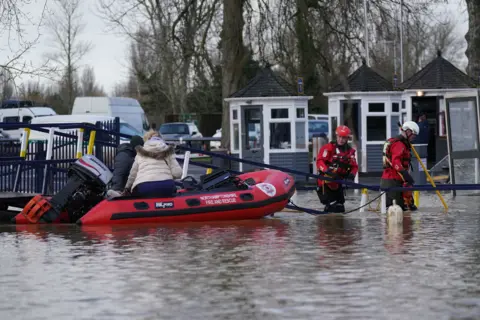
Like in recent years, floods and storms have caused the worst serious weather damage to the United Kingdom last year.
A series of named storms that struck the United Kingdom from the fall of 2023 helped to cause widespread floods in early January. This contributed to the weaponic winter half year – October 2023 to March 2024 – in more than 250 years.
The areas particularly badly struck by the floods included east of Scotland, the Derbyshire, Nottinghamshire and the West Midlands, with some places recording three to four times their usual precipitation for September.
In early January 2024, the Royal Shakespeare Company had to cancel performance for two consecutive evenings due to the floods at Stratford-Upon-Avon. In November, a wall collapsed in Tenbury Wells in Worcestershire after water in a local rose stream, flooding the city center.
The chief scientist in Met Office, Professor Stephen Belcher, said that the evidence of the impacts on climate change already brought showed that the urgent need of the United Kingdom adapts to cope with future extremes.
“The climate is likely to continue to change, and we have to prepare for the impacts that it will have on the weather we are experiencing,” he said.
For the first time, this report stresses that the British sea level increases more quickly than the world average.
While sea level continues to increase around the United Kingdom, the risk of flood will only increase, explains Dr. Svetlana Jenvrejea of the National Oceanography Center.
“We know that by historical events, this is only a matter of time until the United Kingdom is the next on the way to a major event on storm,” she said.
 Media in Pennsylvania
Nature changes with the climate
Inevitably, the evolution of the United Kingdom’s climate has an impact on the natural world.
Spring in 2024 was prior to the average for 12 of the 13 spring events ever recorded and was the oldest in the 1999 series for the appearance of Frogspawn and black birds.
The time of seasonal activity in plants and animals is known as phenology and is collected by a network of volunteers coordinated by the Citizen Science Project of Calendar Nature.
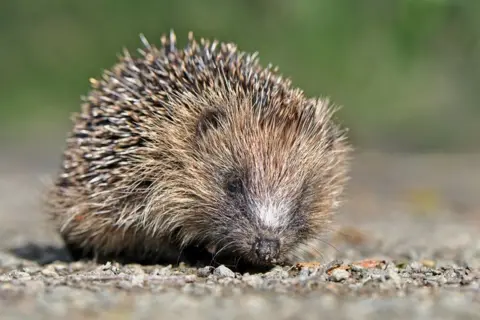
The changing natural event scheme can have a huge impact. Dormers and hedgehogs – two of the most threatened mammals in the United Kingdom – are particularly affected when the weather is very hot, for example.
 Getty
GettyFruits and nuts ripen earlier in hot weather and that means that less are available in the fall when these animals try to develop the fat reserves they need to see them during the winter.
At Alice Holt Forest Research Center outside London, they study how our trees and forests can be made more resistant to the future climate of the country.
The sad fact is that many of our current trees species simply cannot face, explains Dr. Gail Atkinson, head of the science of climate change at the center.
“After drought, you can see reduced growth, so that the trees do not grow as we expect,” she said.
“If you look in the canopy, you can see the leaves look a little in tatters and there are other signs of stress while you walk in the woods, including extreme examples, you could see that the trees are actually deceased.”
Alice Holt’s studies show a species that may well do because the United Kingdom continues to become warmer and weet more are coastal redwoods from California. He has cultivated trees from different latitudes for 60 years to see how they are doing in the British climate.
This means that, in the decades to come, the largest trees in the world could become a common spectacle here in the United Kingdom.



