Eyeing the Richat Structure – NASA Science


In a remote region of northern Mauritania, on the Adrar Plateau, lies a desert landscape rich in human history. This region of northwest Africa is dotted with Paleolithic stone tools, Neolithic cave paintings, and remains of medieval towns once used by caravans crossing the Sahara Desert.
Seen from space, the landscape appears to be shaped largely by natural forces. Wind sculpted the seas with colorful sand dunes and eroded plateaus capped with dark desert pavements, while ancient rushing waters carved dry valleys and networks of river channels.
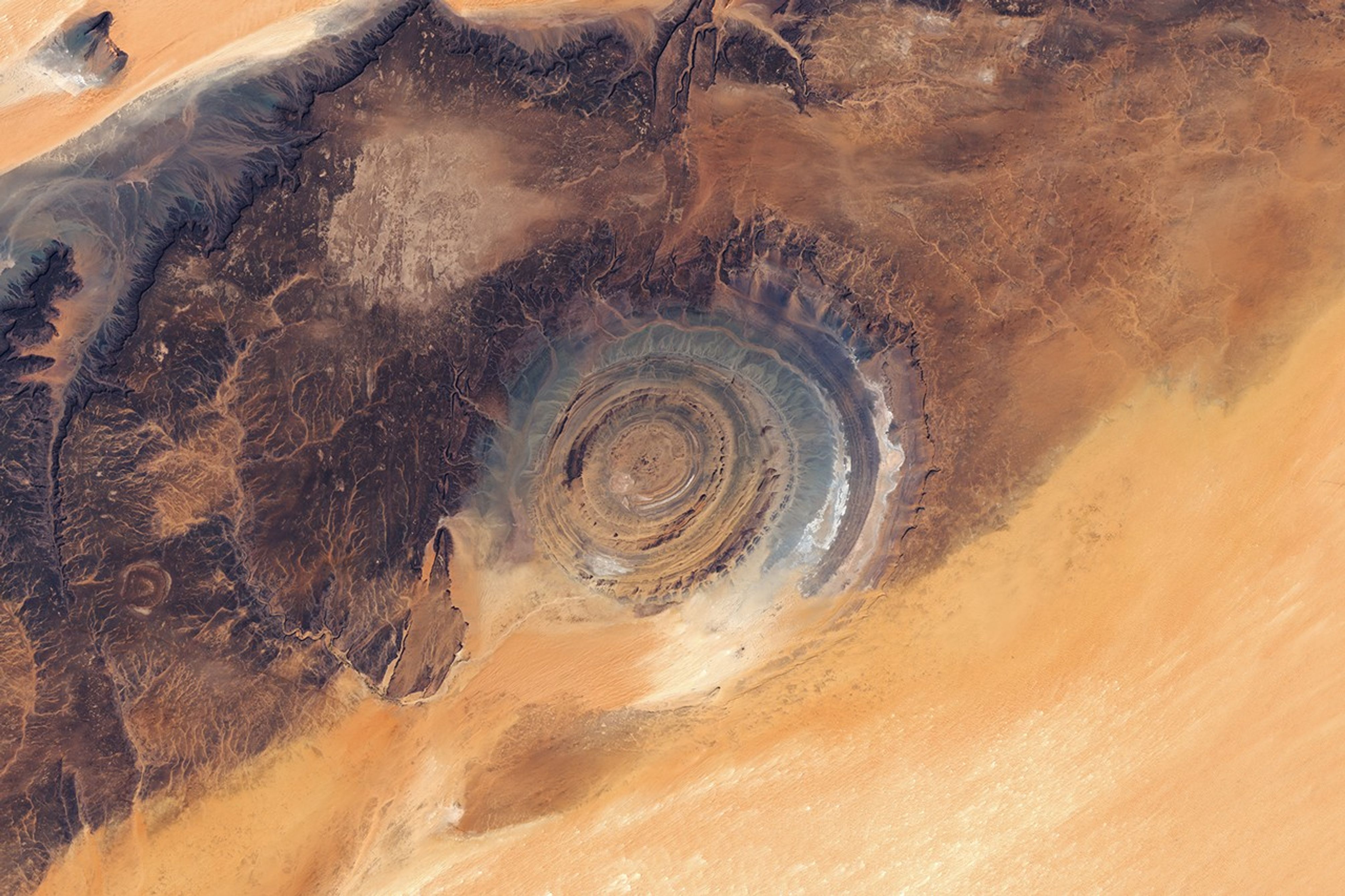
But the most striking feature of the area, seen from above, is the Richat Structure, a large geological formation made up of concentric ridges on the eastern side of the plateau. French geographers first described this feature in the 1930s, calling it Richat’s “boutonniere.” NASA astronauts Ed White and James McDivitt helped bring worldwide attention to what became known as the “Eye of the Sahara” after photographing it during their historic Gemini IV mission.
The 40-kilometre-wide structure was initially thought to be an impact crater, as large meteors can produce circular features on Earth’s surface. However, researchers later showed that it was actually a deeply eroded geological dome, formed by the uplift of rocks above an underground intrusion of igneous material. Over time, differing erosion rates among rock types in the exposed upper dome led to the development of circular ridges called cuestas. The orange and gray colors reflect the differences between sedimentary and igneous rock types throughout the structure and surrounding landscape.
NASA Earth Observatory image by Lauren Dauphin, using Landsat data from the US Geological Survey. Story by Adam Voiland.
March 5 and March 6, 2026
- Abdeina, EH, et al. (2024) How old is the Eye of Africa? A polyphase history for the Richat igneous structure, Mauritania. Lithos107698.
- Abdeina, EH, et al. (2021) Geophysical modeling of the deep structure of the Richat magmatic intrusion (northern Mauritania): overview of its establishment kinematics. Arab Journal of Geosciences14(22), 2315.
- The debrief (April 16, 2021) The Richat structure: “the eye of the Sahara” is one of the strangest wonders of the Earth. Accessed April 8, 2026.
- Geoconsciousness, Adrar Plateau. Accessed April 8, 2026.
- International Commission on Geoheritage, Richat Structure, a Cretaceous alkaline complex. Accessed April 8, 2026.
- Matton, G., et al. (2005) Solving the Richat enigma: Doming and hydrothermal karstification above an alkaline complex. Geology33 (8), 665-668.
- Matton, G. & Jébrak, M. (2014) “The eye of Africa” (Richat dome, Mauritania): An alkaline-hydrothermal complex isolated from the Cretaceous. Journal of African Earth Sciences97, 109-124.
- NASA Earth Observatory (July 10, 2022) The Eye of the Sahara. Accessed April 8, 2026.
- National Archives (June 4, 1965) Richat structure. Accessed April 8, 2026.


