Fake banknotes mocked a US president. And are now worth thousands.


If you’re a politician, it’s one thing to see your face and your policies ridiculed in a political cartoon. But satirical currency? That’s a whole other level of criticism.
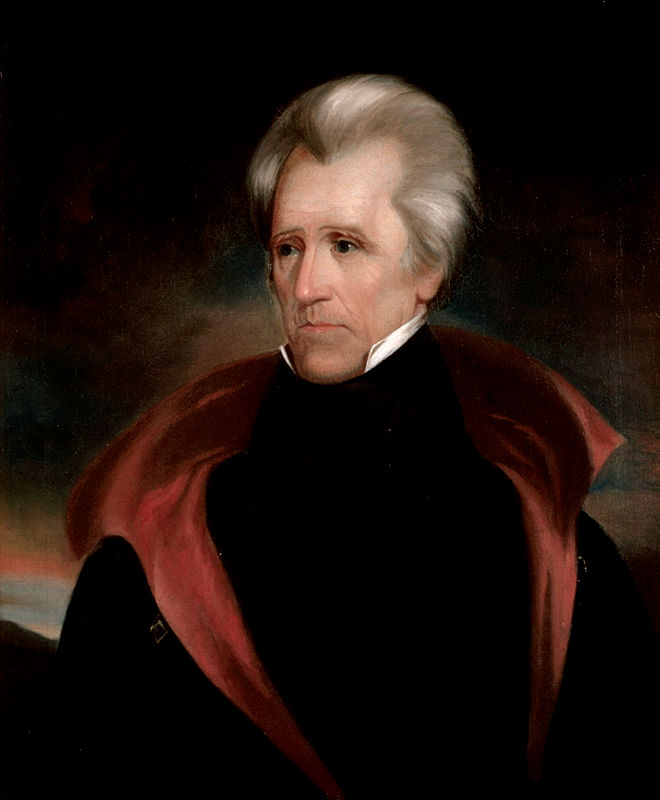
A special piece of this political history billed as “the most lopsided bank note ever printed” recently sold for a whopping $4,800. This fake bill lampoons the terrible banking policies of cheese-loving President Andrew Jackson and gives us a window into understanding the political slings and arrows thrown during the Hard Feelings Era, a real historical era from 1832 to 1844, named after a severe economic downturn linked to poor banking practices.
The Locofoco Party and a great tax panic
The precious paper ticket is a “Great Loco Foco Juggernaut”, named after the Locofoco Party. This radical wing of the Democratic Party was organized in New York in 1835. They opposed state banks, paper money, tariffs, monopolies, and financial policies that they considered undemocratic and conducive to special privileges. The unofficial banknote satirizes the Panic of 1837, a major economic depression caused largely by President Jackson.
“Andrew Jackson’s opposition to a central bank made state-chartered local banks much stronger players in a growing economy, but their protections were not as strong as those of the federally chartered Second Bank of the United States,” said John Kraljevich, director of Numismatic Americana at Stack’s Bowers Galleries which auctioned this note. Popular science.
Simply put, the president gave more control to the least regulated banks, which led to several ill-advised loans as more Americans moved to the West.
Speculators received a lot of credit from these small banks to buy land in the Western United States. All that easy credit and paper money exceeded the amount of cash they had, causing a risky land economic bubble, not so different from the 2008 housing crisis.
“When the federal government insisted on payment for land in gold or silver, many of these bank loans failed, the banks failed and specific payments were made. [which are] bank payments in gold and silver were suspended,” explains Kraljevich.
As a result, the money supply in circulation consisted of unbacked paper money with no real value. Billets were often called shin pads, in reference to the way they were placed inside boots to keep the feet dry. “They were as useless as the satirical notes that imitated them and ridiculed the politicians who created them,” says Kraljevich.
With the collapse of the financial system and public confidence in it, the country fell into difficult times, which some overcame with satirical currency.
“The satirical notes of the difficult times were written by mostly unknown individuals, produced to be sold to adherents of a particular political point of view, not unlike the political novelties of today,” says Kraljevich.
Political conventions are full of “new things,” like little trinkets, posters, clothing, and other opinions expressed. The now-infamous red Make America Great Again hats and signs calling for “lock him up” are some of the most memorable campaign souvenirs from the 2016 presidential election between Donald Trump and Hilary Clinton.
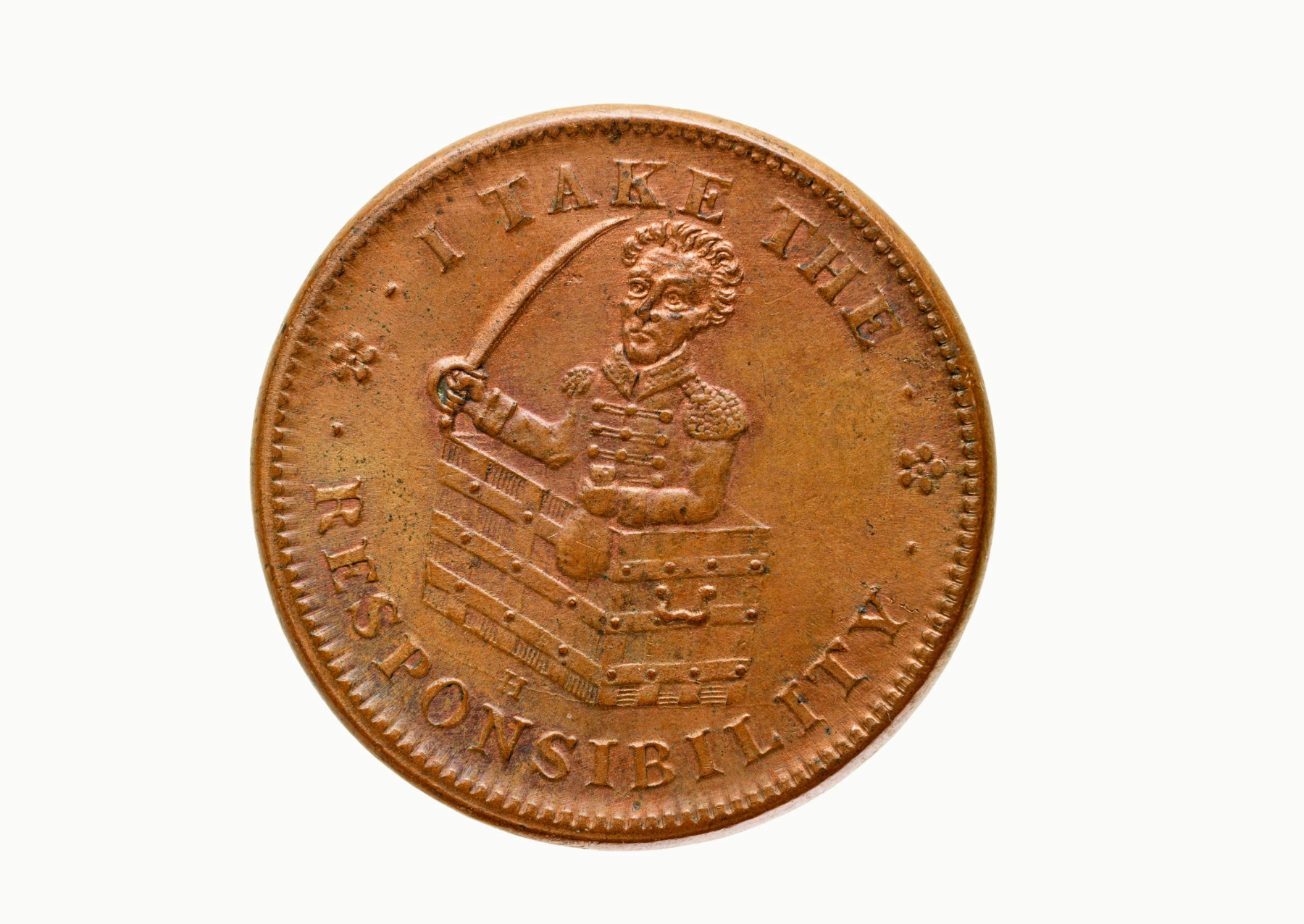
The symbolism of the “Grande Loco Foco Juggernaut”
In the particularly scathing ticket recently sold at auction, President Jackson, his then-vice president and future President Martin Van Buren, and their allies are depicted as animals and symbols of chaos. Martin Van Buren is depicted as a cat riding a “2,000 Jack Ass Power” wagon that is being removed, symbolizing the Locofoco holiday.
In one corner, President Jackson is depicted as an old maid who tramples on the “vote of Congress, the rights of the people and common sense.” Jackson is also depicted as an emperor, holding a flag of the American Constitution and a power of veto, referencing his influential and despised “Kitchen Cabinet.” This informal group of friends and unelected advisors influenced Jackson’s first term, much to the dismay of Congress.
Most of these paper ratings were issued anonymously to help protect a company from backlash. Others were boldly signed by the printers.
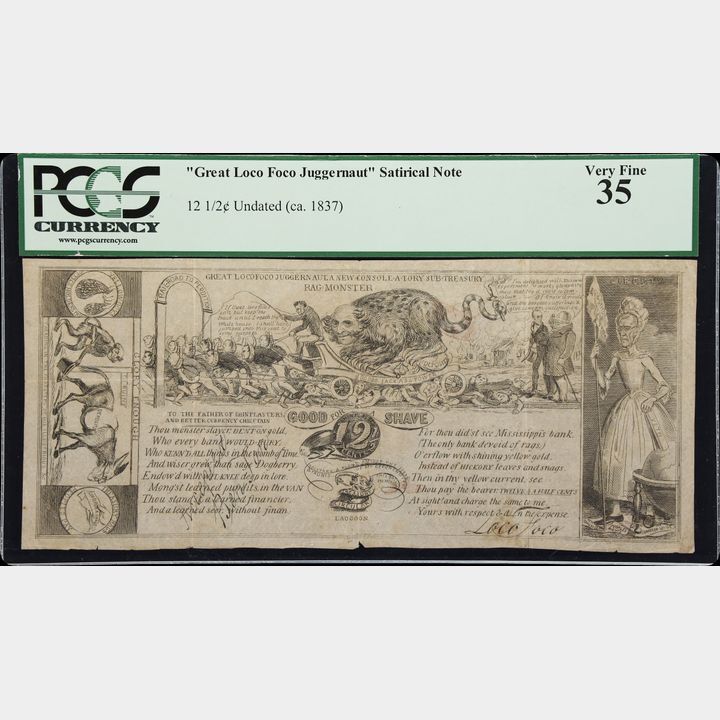
“The extraordinary Loco Foco Juggernaut note is signed by its well-known engraver, artist and actor David Claypoole Johnston, a Boston engraver who became one of the most prominent American cartoonists of his time,” says Kraljevich.
Many New Englanders, like Johnston, weren’t really fans of Jackson, so the printer’s policies were likely aligned with the anti-Jackson views stated on the bill. He could also have sought to make a quick buck by selling the satirical bill.
A political commentary that “leads nowhere”
Although the Great Loco Foco Juggernaut note did not enter circulation, the use of currency as a means to ridicule political leaders was not exclusive to the turbulent days of Andrew Jackson. During the Roman Empire, a process called damnatio memoriae removed busts of unpopular emperors from circulating coins.
According to Kraljevich, coin satirists also “engraved horns on the Pope, put hats or pipes on portraits, or removed Miss Liberty’s clothes.”
In modern times, fake banknotes satirizing politicians or advertising products have become more popular. During the 1968 presidential election between Republican Richard Nixon, Democrat Hubert Humphrey, and independent candidate George Wallace, civil rights activist and write-in presidential candidate Dick Gregory issued several satirical posts. When the Secret Service questioned him about counterfeiting money, Gregory told them that no one who looked like him (a black man) would ever be found on a real coin.
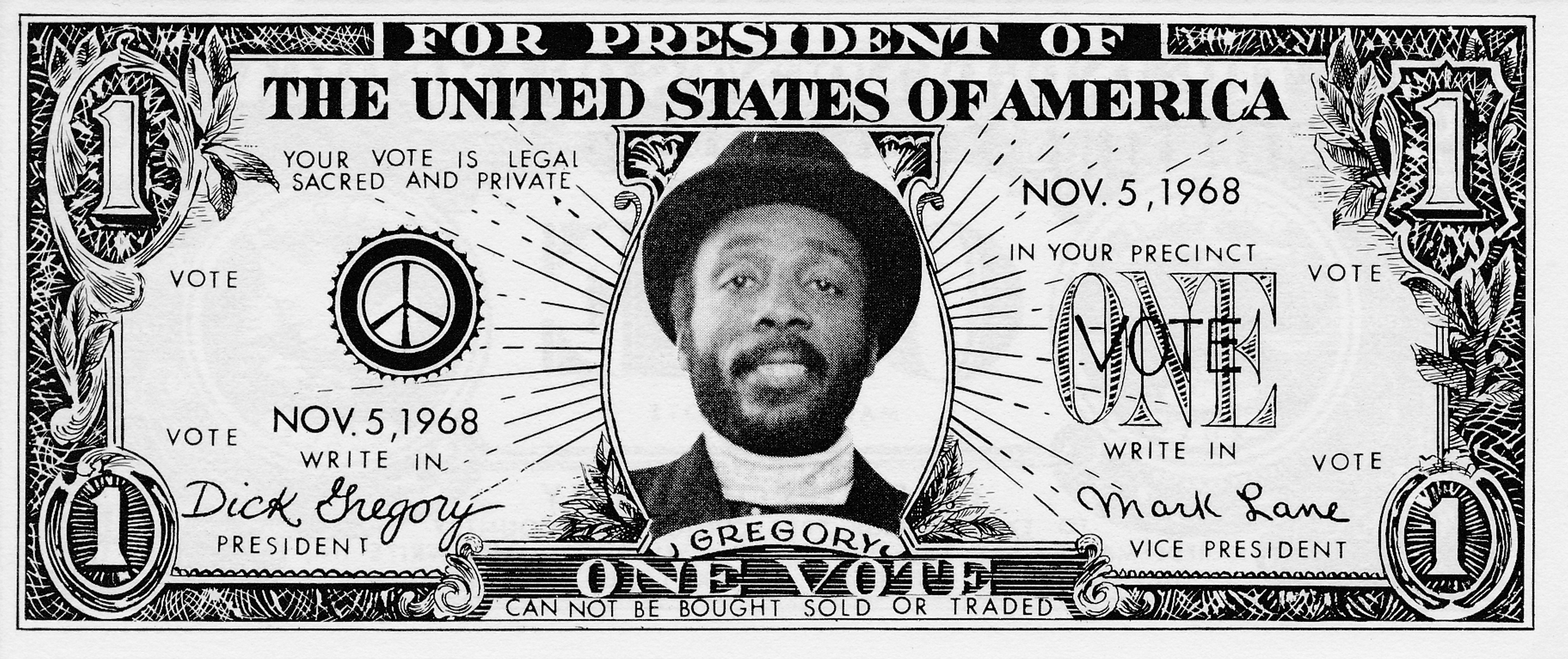
Stuart Lutz/Gado
“A satirical response to the state of race relations that shows why this type of culture is still vital and interesting,” says Kraljevich.
And this tradition of using money to either prop up politicians or bring them down continues to this day. These depictions will provide future historians and numismatists – those who study currency – with insight into today’s political debates and landscape.
“The fact that satirical banknotes depict Andrew Jackson as an emperor by his enemies and Donald Trump similarly by his supporters suggests that this method of political commentary is old and going nowhere.”
In This time whenPopular Science tells the strangest, surprising, and little-known stories that have shaped science, engineering, and innovation.

The best new PopSci 2025 releases


