First stop, the Moon. Next stop, Mars? Why Nasa’s mission matters

In a few days, NASA plans to launch the Artemis II mission, sending four astronauts on their way to the Moon.
Their journey around our nearest neighbor will pave the way for a moon landing and, ultimately, a lunar base.
NASA’s Artemis program took years of work, involved thousands of people and is currently estimated at $93 billion.
But for some, there is a distinct feeling of “been there, done that.”
More than 50 years ago, the American Apollo missions made history when the first humans set foot on the lunar surface. With six landings in total, it felt like the Moon had well and truly been checked off the list of things to do in space.
So why is the United States spending so much time, effort, and money on the return race?
Valuable resources

“The Moon contains the same elements that we have here on Earth,” explains Professor Sara Russell. [NASA]
The terrain may appear dry, dusty and rather arid, but this is far from the case.
“The Moon contains the same elements that we have here on Earth,” explains Professor Sara Russell, a planetary scientist at the Natural History Museum.
“One example is rare earth elements, which are very rare on Earth, and there might be parts of the Moon where they are concentrated enough to be able to mine them.”
There are also metals, such as iron and titanium, as well as helium, which is used in many fields, from superconductors to medical equipment.
But the resource that attracts the most is the most surprising: water.
“There is water trapped in some of its minerals, and there are also significant amounts of water at the poles,” Russell says.
There are craters that are permanently in shadow, she said, where ice can accumulate.
Having access to water is vital if we want to live on the Moon. It not only provides drinking water, but can also be split into hydrogen and oxygen to provide air for astronauts and even fuel for spacecraft.
Race for space domination

Astronaut Buzz Aldrin salutes an American flag on the surface of the Moon in 1969. [Getty Images]
The American Apollo missions of the 1960s and 1970s were motivated by a race for space dominance with the Soviet Union. This time, China is in competition.
China has made rapid progress in its space program. It has successfully landed robots and rovers on the Moon and says it will land humans there by 2030.
There is always prestige in being the first to plant your flag in the lunar dust. But now it really matters where you plant it.
The United States and China want access to areas with the most abundant resources, which means securing the best lunar real estate.

China put its flag on the Moon when it landed a robotic spacecraft in 2020 [CNSA HANDOUT via EPA]
The United Nations Outer Space Treaty of 1967 states that no country can own the Moon. But when it comes to what’s found on the Moon, it’s not that simple.
“Although you can’t own a plot of land due to the UN treaty, you can in principle operate on that land without anyone interfering with it,” explains Dr Helen Sharman, Britain’s first astronaut.
“So the biggest thing right now is trying to take your land. You can’t own it, but you can use it. And once you’re there, you have it for as long as you want.”
Paving the way to Mars

Living on Mars will be much more difficult than on the Moon [NASA]
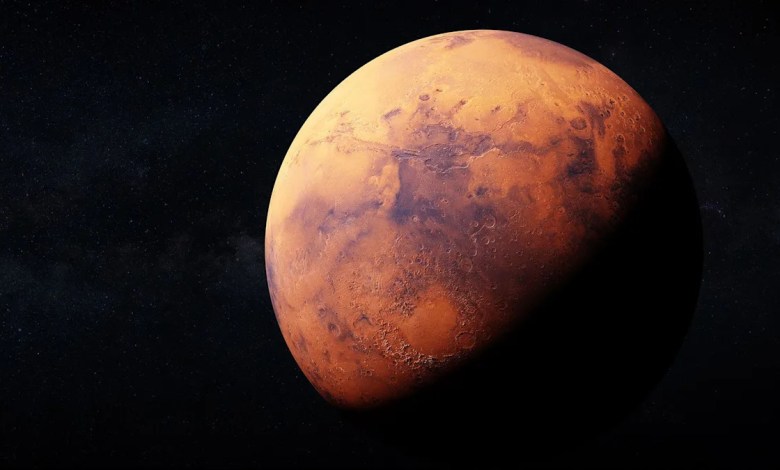
NASA has its eyes on Mars and wants to send humans there by the 2030s.
Given the technological hurdles to overcome, this is a fairly ambitious timetable.
But you have to start somewhere, and the United States has decided that the Moon is that place.
“Going to the Moon and staying there for an extended period of time is much safer, much cheaper and much easier to serve as a test bed for learning how to live and work on another planet,” says Libby Jackson, head of space at the Science Museum.
On a lunar base, NASA can perfect the technology needed to provide the air and water astronauts need. They will have to figure out how to generate electricity and build habitats to protect people from extreme temperatures as well as dangerous space radiation.
“These are all technologies that, if you try them for the first time on Mars and they go wrong, are potentially catastrophic. It’s much safer and much easier to try them on the Moon,” Jackson says.
Mysteries still to be elucidated

Apollo astronauts collected rock samples during their missions [NASA]
Scientists can’t wait to get their (gloved) hands on material from the Moon.
The rocks brought back by the Apollo astronauts transformed our understanding of our celestial neighbor.
“They told us that the Moon was formed by this incredibly dramatic event, in which a body the size of Mars crashed into Earth and the pieces that broke off formed the Moon. We know this from the Apollo rocks,” says Professor Sara Russell.
But she says there is still much to discover.
Because the Moon was once part of Earth, it holds a record 4.5 billion years in our own planet’s history. And with no plate tectonics, wind or rain to erase this record, the Moon is a perfect time capsule.
“The Moon is a fantastic archive of Earth,” says Russell. “A new crop of rocks from another area of the Moon would be incredible.”
Inspire a new generation

It is hoped that the Artemis missions will inspire people to pursue careers in science, technology and engineering. [Joe Raedle/Getty Images]
The grainy black-and-white images returned from the Apollo missions turned the dream of space into reality.
And although only a few lucky observers will become astronauts themselves, many of them will go on to careers in science, technology and engineering.

Black-and-white images transmitted from the Apollo missions turned science fiction into reality [NASA]
We hope that the Artemis missions – broadcast live and in 4K – will inspire a new generation.
“We live in a world of technology. We need scientists, engineers and mathematicians – and space has a brilliant ability to get people excited about these topics,” says Libby Jackson.
New jobs and a thriving space economy will allow the United States to recoup the billions of dollars invested in Artemis. As well as the possible fallout from technology developed for missions with utility on Earth.
But Helen Sharman says a return to the Moon will also give the world a much-needed boost.
“If we really come together, we can produce so many things that are beneficial to humanity,” says Sharman.
“It shows us what humans are capable of.”
The top image shows a digital illustration of the surface of Mars.


