First, They Came for Your Elections. Then, Your Guns.


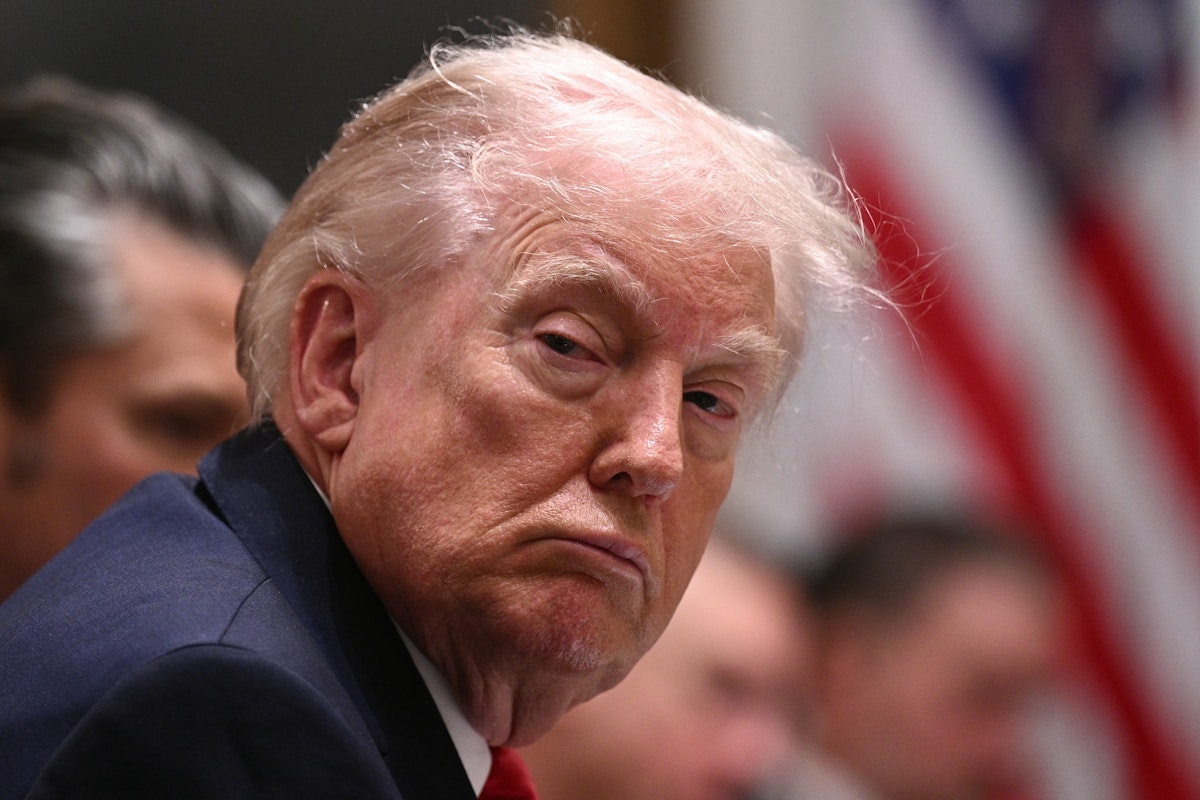
“I want elections to be fair, and if a state can’t have an election, I think the people behind me should do something,” President Trump said Tuesday. He then cited Detroit, Philadelphia, adding: “The federal government should get involved. It’s agents of the federal government who count the votes. If they can’t count the votes legally and honestly, then someone else should take over.” His comments came a day after he told podcaster Dan Bongino: “Republicans should say, ‘We want to take over.’ We should support voting, voting in at least 15 places. Republicans should nationalize the vote.”
Trump’s remarks are fundamentally unconstitutional. The Elections Clause grants states the right to decide “the times, places, and manner of holding elections for senators and representatives” and vests oversight exclusively in Congress; and the Tenth Amendment enshrines the principle of federalism that “those powers which are not delegated to the United States by the Constitution, nor prohibited thereby to the States, are reserved to the States respectively or to the people.” But Trump has never demonstrated much loyalty to the Constitution, let alone much understanding of it.
So some might view Trump’s rhetoric as an empty threat or perhaps the ramblings of an aging madman. But we cannot ignore it. The threat is real, as evidenced by Monday’s announcement that Trump personally oversaw an FBI raid on an election center in Fulton County, Georgia, where agents seized “truckloads” of ballots, as well as voter rolls and scanned images. Trump’s DOJ also demanded voter registration information from 44 states and the District of Columbia, including driver’s license and Social Security data, and filed lawsuits against 24 districts when they refused to comply.
Beyond the immediate fear that Trump intends to interfere in the upcoming national election, his comments and actions are a stark departure from previous Republican positions on states’ rights. Just a decade ago, when Trump first ran for president, the Republican Party platform included complaints against the Obama administration for “bullying state and local governments.” He declared his allegiance to the notion of states’ rights by asserting that “any violation of state sovereignty by federal officials is not merely a transgression of one unit of government against another; it is an attack on the freedoms of individual Americans.” And Trump himself said in 2016 that “a lot of things should actually be states’ rights.” He said he was prepared to leave issues related to transgender Americans and abortion to the states and promised to “make the states once again the laboratories of democracy.”
Yet the notion of states’ rights has faded as Trump has reshaped the Republican Party in his authoritarian image and sought to massively expand his executive power. He now considers that states’ rights do not correspond to his maximalist objectives. Thus, the administration has attacked the right of cities and states to adopt “sanctuary city” policies that limit cooperation with federal authorities enforcing Trump’s draconian immigration policies. Trump has issued executive orders targeting states’ own climate laws, despite the fact that, as attorney David Doniger of the National Resources Defense Council says, “the United States Supreme Court has upheld state authority to enact and enforce such laws from the early 19th century to the present.”
After the killing of nurse Alex Pretti in Minneapolis by a Border Patrol agent and a Customs and Border Protection agent, the president told reporters, “You can’t have guns. You can’t come in with guns.” And on Monday, Trump’s sycophantic U.S. Attorney for the District of Columbia, Jeanine Pirro, told Fox News that anyone who brings a gun into the city can expect jail time. “I don’t care if you have a license in another district and I don’t care if you’re a law-abiding gun owner elsewhere.”
In other words, Trump and his MAGA minions decided that the Second Amendment — long a part of Republican orthodoxy — did not apply to anti-ICE protesters. That dismayed not only gun rights groups but even some Republican lawmakers. “Why is a “conservative” judge threatening to arrest gun owners? Rep. Thomas Massie of Kentucky asked about Of course, they were in the minority: Most Republicans remained silent, tacitly acknowledging that they do not, after all, hold absolutist positions on gun rights and states’ rights.
Some might counter that Democrats have sometimes wrongly violated or disregarded states’ rights. That was the Supreme Court’s assertion in 2022 when it struck down an Obama-era Environmental Protection Agency regulation that a majority of justices said went too far in imposing federal carbon emissions standards on states without congressional approval. The Biden administration has also been accused of violating states’ rights to develop their own policies on Covid treatment and prevention. However, in both cases, the federal government was motivated by a desire to protect the health and welfare of the population and can be said to have acted in the best interest of the public. These were areas of legitimate legal disputes, not pure power grabs like we are seeing from the Trump administration.
Additionally, these were national policies that applied equally to all states and were not aimed at specific states for political reasons. The same cannot be said of the Trump administration. He called into question billions of dollars in federal funding intended for 14 blue states and the District of Columbia, and froze child care funding in five Democratic-led states. Trump’s vengeful intentions are hardly subtle: In illegally withdrawing $7 billion in funding for clean energy products, his officials all but bragged about their motives to a federal judge, who noted that they “freely admit that they made subsidy termination decisions primarily — if not exclusively — based on the fact that the recipient resided in a state whose citizens voted for President Trump in 2024.”
None of these actions demonstrate any particular respect for the rights of states to make decisions for their own people. Yet claiming that Trump changed his position on federalism would imply that he had a position on the issue in the first place. Trump, as we know, changes his position on issues – constitutional and otherwise – whenever it suits him. At the start of the Covid pandemic, he said he had “absolute power” to determine and enforce policies. But two days later, after pushback from Republican governors, he decided he was a states’ rights advocate after all, telling the governors: “You’re all very competent people, I think in any case, very competent people. And you’re going to take the lead.”
And in his policies, Trump has taken blatantly contradictory positions on federalism. He simultaneously argued that the federal government has no right to tell states to limit coal production and carbon pollution, but somehow it has the power to tell blue states they can’t set their own emissions standards.
Trump therefore only cares about states’ rights when it serves his political goals. But overall, during his second term, Trump has shown little respect for states’ rights and sovereignty. There is no clearer example than his militarization of American cities.
There is no more telling sign of government overreach than squads of heavily armed, unidentifiable thugs roaming America’s streets and terrorizing cities. Even today, after the murders of Renee Good and Alex Pretti, Trump has refused to back down and allow states to control their own streets, saying there would be no backing down in Minnesota. It’s the rare issue he’s been consistent on: He didn’t care about states’ rights either when he sent troops to Los Angeles, violating the Posse Comitatus Act, or when he federalized Washington, DC’s police force.
Meanwhile, Republicans, once the party of states’ rights, have barely paid attention to Trump’s destruction of a once-sanctified principle of the Republican Party. Their tepid acceptance proves what liberals have long maintained: that states’ rights have always been nothing more than a false excuse for the party to ignore national laws, including those enshrined or protected by the Constitution, with which it disagreed. Today, states’ rights are largely an obstacle to MAGA plans, particularly the weaponization of the federal government against Trump’s perceived enemies, whether immigrants, protesters, or entire states that voted against him. Thus, the principle of federalism is only additional collateral damage of the fascist regime.


