Webb Images Giant Exoplanet Candidate in Habitable Zone of Alpha Centauri A


This planet candidate, Alpha Centauri AB, could be a gas giant, orbit 1 to 2 times the distance between the sun and the earth, according to two articles to be published in the Astrophysical newspaper letters. If it is confirmed, this planet would be closest to the earth that orbit in the habitable area of a star -shaped star. However, because the planet is a gas giant, astronomers say that he would not support life as we know it.
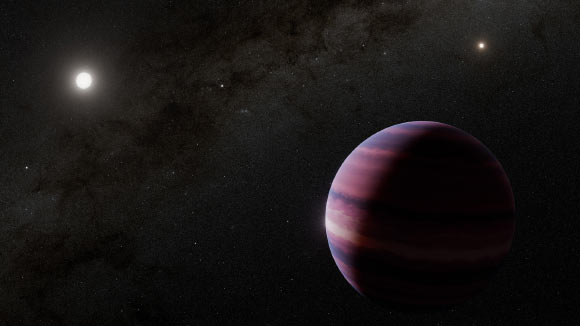
This concept of this desire shows what a gas giant in gas orbit could look like. Image credit: NASA / ESA / CSA / STSCI / ROBERT L. HURT, CALTECH & IPAC.
Located in the Constellation of Centaurus, Alpha Centauri is the stellar system closest to Earth.
Also known as Rigil Kentaurus, Rigil Kent and Gliese 559, the system is composed of the brilliant binary star formed by Alpha Centauri A and Alpha Centauri B, plus the light red dwarf star Alpha Centauri C.
The two darkest components are around 4.35 light years from us. Alpha Centauri C, better known as Proxima Centauri, is slightly closer to 4.23 light years.
Compared to the sun, Alpha Centauri A is of the same type G2 stellar, and slightly larger (1.1 times more massive than the sun and about 1.5 times brighter).
Alpha Centauri B, a K1 type star, is slightly smaller and less shiny (0.9 times the mass of the sun and about 45% of its visual brightness).
Alpha Centauri A and B Orbit a center of common gravity once every 80 years, with a minimum distance of about 11 times the distance between the earth and the sun.
Because these two stars are, with Proxima Centauri, our nearest interstellar neighbors, they are among the best studied by astronomers.
And they are also among the main targets of the search for potentially habitable planets.
“This system being so close to us, all the exoplanets found would offer our best opportunity to collect data on planetary systems other than ours,” said Dr. Charles Beichman, astronomer of the Jet Propulsion Laboratory of NASA and NASA Exoplanet Science Institute of Caltech’s Ipac Astronomy Center.
“However, these are incredibly difficult observations to make, even with the most powerful space telescope in the world, because these stars are so brilliant, close and quickly cross the sky.”
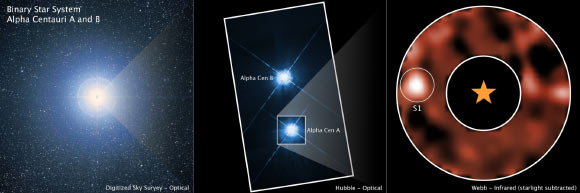
This image shows the system of alpha cantauri stars from several different observatories based on the ground and space: the Sky Survey (DSS), the NASA / ESA Hubble space telescope and the NASA / ESA / CSA James Webb space telescope. DSS’s ground image shows the triple system as a single light source, while Hubble solves the two stars in the shape of a sun in the system, Alpha Centauri A and Alpha Centauri B. The image of the Miri Instrument of Webb, which uses a coronagraphic mask to block the star. Image credit: NASA / ESA / CSA / Aniker Sanghi, Caltech / Chas Beichman, Nexsci, NASA & JPL-CALTECH / Dimitri MAWET, CALTECH / JOSEPH DEPASQUALE, STSCI.
The first observations of the system took place in August 2024, using the corongraphic mask aboard the median infrared instrument of webb (MIRI) to block the light of Alpha Centauri A.
While the additional brightness of the neighboring Star Voisine Alpha Centauri B complicated the analysis, astronomers were able to subtract the light of the two stars to reveal an object more than 10,000 times lower than Alpha Centauri A, separated from the star of about twice the distance between the sun and the earth.
Although the initial detection was exciting, they needed more data to reach a firm conclusion.
However, additional observations of the system in February 2025 and April 2025 revealed any object such as that identified in August 2024.
“We are faced with the case of a missing planet,” said Caltech Ph.D. Student Aniker Sanghi.
“To investigate this mystery, we used computer models to simulate millions of potential orbits, incorporating the knowledge acquired when we saw the planet, as well as when we did not do it.”
In these simulations, the team took into account both a 2019 observation of the potential exoplanet candidate by the very large ESO telescope, the new webb data, and considered orbits which would be stable gravitational in the presence of Alpha Centauri B, which means that the planet would not be the fall of the system.
“A non-detection in the second and third cycles of observations with WebB is not surprising,” said Sanghi.
“We found that in half of the possible simulated orbits, the planet was moving too close to the star and would not have been visible for Webb in February and April 2025.”
“On the basis of the planet’s brightness in medium infrared observations and orbit simulations, it could be a giant of gas approximately the mass of Saturn in orbit Alpha Centauri has in an elliptical path varying between 1 and 2 times the distance between the sun and the earth.”
“If it is confirmed, the potential planet seen in the webb image of Alpha Centauri would mark a new step for exoplanet imaging efforts,” said Sanghi.
“Of all the planets directly imagined, it would be closest to its star seen so far.”
“It is also the most similar in temperature and age at the giant planets of our solar system, and the closest to our house, the earth.”
“Its very existence in a system of two closely separate stars would dispute our understanding of the way in which planets are formed, survive and evolve in chaotic environments.”
If it is confirmed by additional observations, the results could transform the future of the science of exoplanet.
“This would become an object of touchstone for exoplanet science, with multiple opportunities for detailed characterization by Webb and other observatories,” said Dr. Beichman.
_____
Charles Beichman and al. 2025. Mondes next to it: a giant planet candidate imagined in the habitable area of CEN AI observations, orbital and physical properties and exozodi higher limits. Apjlin press; Arxiv: 2508.03814
Aniker Sanghi and al. 2025. Mondes next to it: a giant planet candidate imagined in the habitable area of CEN A. II. Modeling of binary stars, search for planet and exozodi and sensitivity analysis. Apjlin press; Arxiv: 2508,03812


