Fossil Shorebirds Tell New Story about Climate Change in Australia


Shorebirds are widespread birds whose reliance on coastal and humid environments makes them effective paleoenvironmental indicators. Wading birds are rare in the fossil record, but Pleistocene deposits from the Naracoorte Caves World Heritage Area, South Australia, have yielded an unusually high abundance of shorebird remains. A new analysis of fossils from Naracoorte Cave reveals how wetlands once thrived and then disappeared as the climate warmed 60,000 years ago. The study authors link a phase of pronounced drying that occurred around 17,000 years ago as the likely cause of the decline of many of the nine or more fossil shorebird species found in just one of Naracoorte’s caves.
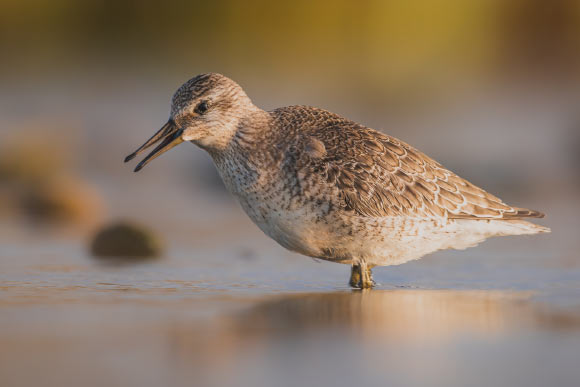
The red knot (Calidris canutus), juvenile, near Gourinet, Brittany, France. Image credit: Stephan Sprinz / CC BY 4.0.
“Shorebirds are rare in the fossil record, so finding so many in one cave (Blanche Cave) was a surprise,” said Flinders University Ph.D. candidate Karl Lenser.
“This shows that wetlands and mudflats, where birds like plovers, sandpipers and snipes feed, were much more common in the region during the last ice age.”
Climate change and habitat loss are leading to declining populations of live shorebirds in Australia.
Understanding how these species have responded to past climate change may be key to predicting how populations will be affected in the future.
Lenser and his colleagues were particularly intrigued by the fossils of a bird.
The plains vagrant – a small, endangered bird found mainly in small populations in Victoria and New South Wales – was one of the most common species identified in the study.
More than half of the nearly 300 bones examined by the authors were identified as wandering bones on the plains.
“Living plains wanderers are now very selective about their habitat, but other fossils from Naracoorte show that the area was probably forest… a far cry from the open, treeless grasslands that plains wanderers inhabit today,” Lenser said.
Naracoorte is the only fossil site in Australia where such large numbers of plains wanderers are found, suggesting that events over the past 14,000 years have caused a significant decline in populations of this intriguing bird.
This decline was associated with the plains wanderer being restricted to a narrower range of habitats where trees are absent, rather different from the forests it occupied over the past hundred thousand years.
“This sample of shorebirds is also very special because it documents the migratory species that fly from the northern hemisphere to spend the boreal winter in Australia each year,” said Dr Trevor Worthy from Flinders University.
“These include three species of sandpipers of the genus Calidris and Latham’s snipe (Gallinago hardwickii).”
“Also common in the fossil assemblage is the double-banded plover that migrates from Australia to New Zealand to breed.”
“Two birds were less than a year old, indicating they had fledged 2,000km from New Zealand only to be captured by an owl near White Cave in Naracoorte,” Dr Worthy said.
“There’s still a lot we don’t know about Australia’s birds during the last ice age, but fossils from caves like Naracoorte are helping to fill that gap,” Lenser added.
“The Naracoorte Caves preserve a half-million-year-old record of biodiversity in southeast South Australia,” said Dr Liz Reed from the University of Adelaide.
“As this study clearly demonstrates, caves provide a window into pre-European landscapes and provide information relevant to the conservation of endangered species today.”
“Visitors to Naracoorte Caves can view the excavations and learn about the science of South Australia’s only World Heritage Area.”
The results were published online in the journal Electronic paleontology.
_____
Karl M. Lenser and others. 2026. Fossil shorebirds (Aves: Charadriiformes) reveal trends in the Pleistocene wetlands of Naracoorte Caves, South Australia. Electronic paleontology 29 (1): a2; doi: 10.26879/1608


:max_bytes(150000):strip_icc()/Health-Stocksy-4064350-3ed9a140f2614a90b3bc04147a33424c.jpg?w=390&resize=390,220&ssl=1 "What Happens to Your Blood Sugar When You Eat Mangoes Every Day")

