Fossil unearthed in New Mexico over 100 years ago is never-before-species of giant duck-billed dinosaur


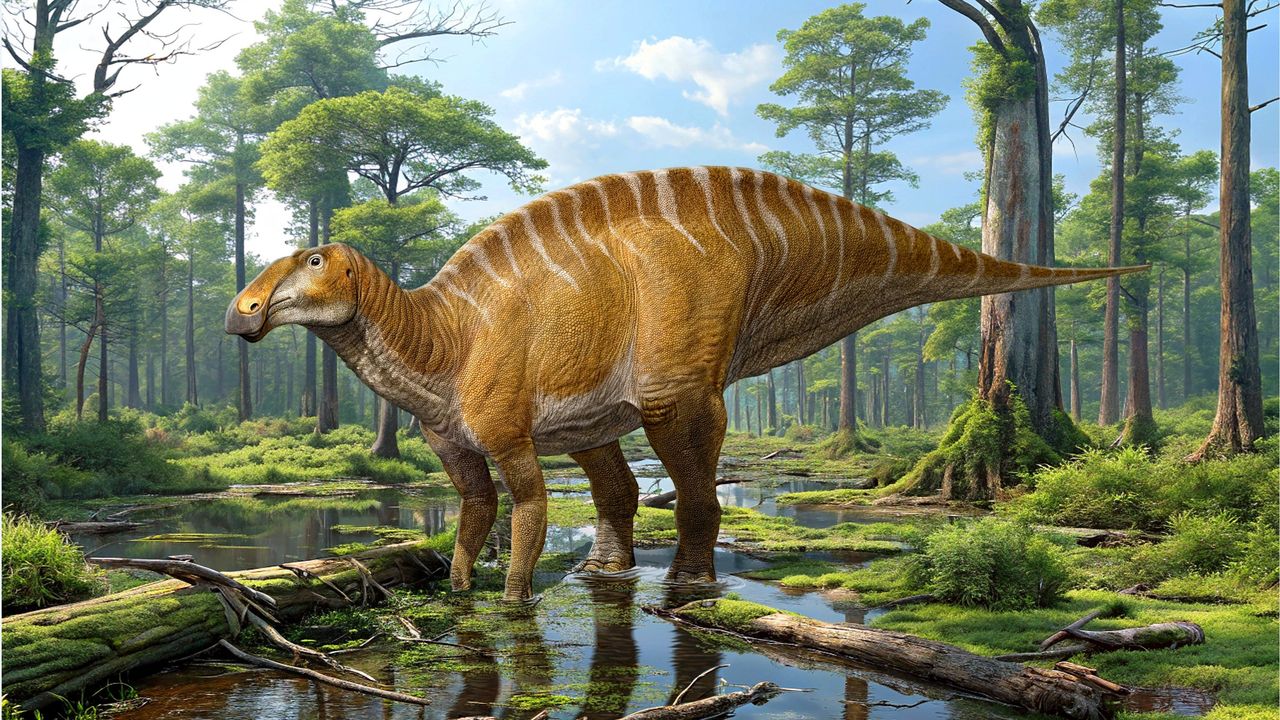
Scientists have discovered a huge species of duck-billed dinosaur that lived in what is now New Mexico about 75 million years ago.
The dinosaur, Ahshislesaurus Wimanilikely had a flat head and a low bony crest on its snout, researchers found in a study. The results, expected to be published in the Bulletin of the New Mexico Museum of Natural History and Science, suggest that duck-billed dinosaurs, or hadrosaurids, were more diverse and overlapping during the last 20 million years of humankind. Cretaceous Period (145 to 66 million years ago) than previously thought.
According to the press release, A. wimani could have potentially grown to 40 feet (12 meters) long.
A set of A. wimani fossils discovered in 1916 had already been identified as belonging to the genus hadrosaurids Kritosaurus. But existing fossil specimens are frequently reevaluated as more data and fossils become available.
In the new study, researchers revisited this set of fossils – including an incomplete skull, lower jaw and several vertebrae – from the Kirtland Formation of New Mexico. The fossils were housed at the Smithsonian National Museum of Natural History.
“As a general rule…skulls are really the basis for identifying differences between animals,” study co-author Anthony Fiorillothe executive director of the New Mexico Museum of Natural History and Science, said in a separate statement. statement. “When you have a skull and you notice differences, that carries more weight than, say, if you found a toe bone that looks different from that toe bone.”
Comparing the skull to those of other hadrosaurids, the team found that its shape and features were distinct enough from other hadrosaurid skulls to suggest that it was likely a different species. A. wimani is closely related to Kritosaurussuggesting that their evolutionary lineages had split shortly before.
“Kritosaurus is still a valid genus with species of its own”, co-author of the study Édouard Malinzaka paleontologist at Penn State University Lehigh Valley, said in the second release. “We took a specimen that was grouped as an individual of Kritosaurus and determined that it had significantly distinct anatomical characteristics to warrant it being its own genus and species. »
It is not yet clear how related species coexisted in the same environment, the researchers wrote in the study. But tracing the history and range of different species could help scientists understand the environment they lived in, as well as the evolutionary history of duck-billed dinosaurs.
“The lineages appear to have coexisted in the region for some time,” Malinzak explained. “This showed that this group not only exploded in diversity across the continent at one point, but also contributed to the global spread of this group during the Late Cretaceous.”


