Frescos of a peacock, fruit discovered in Roman villa near Pomepii belonging to Emperor Nero’s wife

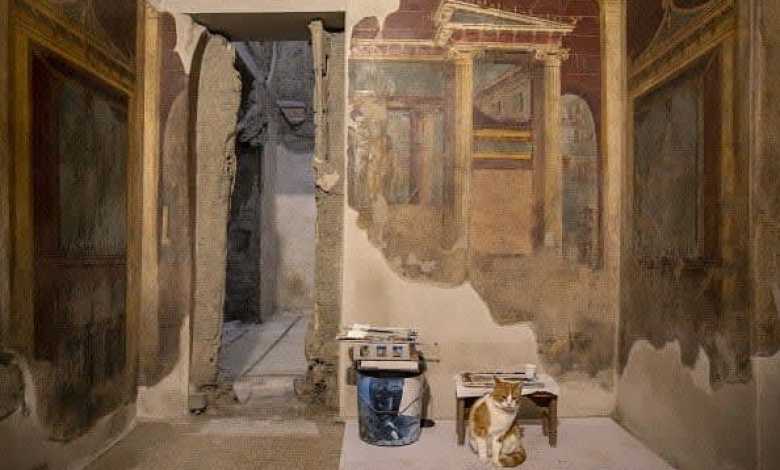

A cat is seen during the ongoing excavation and restoration work of the exceptional frescoes in the Room of the Mask and the Peacock, one of the most refined rooms of Poppaea’s Villa in Oplontis, Torre Annunziata, Italy, February 12, 2026. (Photo credit: Alessio Paduano/Anadolu via Getty Images)
The announcement of this discovery follows the first partial opening of the site to the public.
Archaeologists have discovered a bright red fresco during excavations of a villa believed to have belonged to Emperor Nero’s second wife in Naples, southern Italy, according to local media.
The announcement of this discovery follows the first partial opening of the site to the public.
Villa Poppaea, the Roman “pleasure villa”, is part of ancient Oplontis, an archaeological site located not far from Pompeii. Like Pompeii, it was destroyed during the eruption of Mount Vesuvius in 79 CE.
The site was first discovered in the 16th century, but excavations did not begin until the 18th century.
In 1974, archaeologists discovered the remains of a second building nearby (known as Villa B) which would have been used for wine and oil processing. These remains are closed to the public.
“Every search is a surprise,” the site’s director, Arianna Spinosa, told AFP. “We certainly expected to find some of the frescoes that can be seen on the other wall, but the surprises were of course many more. »
Peacocks, bright red, blue pigment
The fresco was reportedly found in the main living room of the villa, depicting the legs and body of a peacock emerging from the mud, against a yellow frieze background.
Giuseppe Scarpati, the site’s chief archaeologist, explained to AFP that the peacock, a sacred animal associated with the Roman goddess Juno, is “one of the decorative motifs that appears very frequently in the decoration of the villa”.
“We don’t know its limits to the north, east or west,” Scarpatti told AFP, adding that only 50 to 60 percent of the villa had been searched. “Potentially, the villa could still have many surprises in store for us. »
Other discoveries reportedly include depictions of birds, fish and fruit in vibrant pigments identified by archaeologists as “bright red cinnabar and Egyptian blue pigments,” according to Elena Gravina, the villa’s chief conservator.
AFP noted that Gravina further explained that these pigments were expensive at the time and evidenced the “commercial relationships and wealth of patrons, as well as the know-how and expertise of artisans.”


