
In 1995, a California parakeet earned the Guinness World Record for having the largest human vocabulary among birds. “Puck the Budgie” had learned an astounding 1,728 words before passing away at the young age of five in late 1994.
Puck even formed original phrases, such as “that’s what it’s all about” and “I love everyone,” showcasing a high cognitive ability that makes these tiny avians some of the smartest birds that you can keep as pets. But while birds like Puck could chat away in words we can understand, others tweet, quack, cheep, and trill to communicate.
Why do some birds talk like humans, and others converse in languages all their own? We turned to Timothy Wright, an associate professor of biology at New Mexico State University whose research focuses on the function and evolution of vocal communication in parrots, to find out.
Defining what we mean by “talk”
“Most if not all bird species have vocal communication systems and can ‘talk’ with other members of their same species,” Wright tells Popular Science. This means they can relay certain types of information to others, such as ‘predators incoming’ or ‘let’s pair up’, through various sounds. “But I have a feeling your readers mean ‘talking like humans,’” he says.
“In some cases a bird’s communication signals are learned, or acquired through social experience,” says Wright. Parrots, in particular, are specifically well known for their mimicry, which involves copying the sounds of other species as a tool for both social bonding and survival. Similar parrots, starlings, mynahs, and corvids (crows and ravens) are also masters of mimicry, including human speech.
Some birds that mimic humans can only say a few words or phrases. For instance, crows in captivity often repeat words like “hello” and “hi”. Then there are African Grey parrots like Gizmo, who can gab for 30 minutes straight.

African Grey Talking for 30 Minutes Straight | Gizmo the Grey Bird
Gizmo is a 20-year-old Congo African Grey parrot who was adopted in April 2022 after 16 years of being confined to a cage. He’s become quite the talker at his new home. Video: African Grey Talking for 30 Minutes Straight, Gizmo the Grey Bird
But why do some birds talk and mimic humans?
According to Wright, it has a lot to do with social bonding.
“What we know from parrots is that they form tight pair bonds with other individuals.” In fact, most parrots are socially monogamous, meaning they form strong, life-long pairs.
“With parrots in captivity there’s an absence of their own species around, so they’ve shifted that social bond onto humans,” says Wright.
“They’re now trying to mimic the individual that they’re most tightly bonded with and integrate you into their ‘flock.’” Therefore, if phrases like, “Good morning” and “What’s happening?” are part of your daily lexicon, they’ll likely become a part of the bird’s daily lexicon, too.
How exactly does mimicry work?
Birds that mimic humans have a couple of things going for them. First, they have a specialized network of brain nuclei known as the “song system” that’s responsible for learning and facilitating complex vocalizations.
Birds also possess a specialized vocal organ called a syrinx. It’s similar to the human larynx or “voice box” because it utilizes air pressure to vibrate vocal folds or membranes to generate sounds. However, the syrinx is located deep within an avion’s chest and is far more efficient than a human larynx, which sits right above a person’s trachea or “wind pipe”. While birds do have a larynx, it’s mostly used as a valve to protect the airway.
Related ‘Ask Us Anything’ Stories
Although some songbird species are “open-ended learners,” says Wright, meaning they can pick up new songs throughout their lives, most birds—like humans—learn a language more quickly early in life. So if a parrot is growing up in the wild among other birds, its chances of human mimicry are slim.
Do “talking” birds have any idea what they’re saying?
Sure, your ex’s budgie might be constantly telling you to “get lost!” but does it really have any idea what those words mean?
“Parrots are quite good at forming associations between sounds and actions,” says Wright. “For example, you’ll hear examples of parrots mimicking a doorbell just to get everyone riled up.” Or they might know that the word “cracker” gets them food. These are ways of “interacting with their ‘flock.’”
There’s also compelling evidence that birds who mimic do have abstract thoughts, such as the ability to categorize objects by their colors and shapes. Though Wright believes that when most avians copy a human sentence, it’s more likely a string of sounds to them than a thought-out sentence.
Still, wild birds have been shown to have syntax, or the ability to put together sounds or calls in a particular order. Take chickadees, which use varying numbers of “D” notes in their calls to indicate possible threats. The more “D” notes they use, the higher the risk. “So there may be more going on than we currently understand,” he says.
Birds have different dialects in the wild
Many wild birds can mimic the sounds of their surroundings. Wright found that these same birds often have distinct vocal dialects.
In his early work as a grad student in Costa Rica, Wright studied a pair of Yellow-naped Amazon parrots whose calls differed by region. “In one part of the country, they sounded like ‘wah wah wah wah,’ and in another, like ‘weep, weep, weep.’”
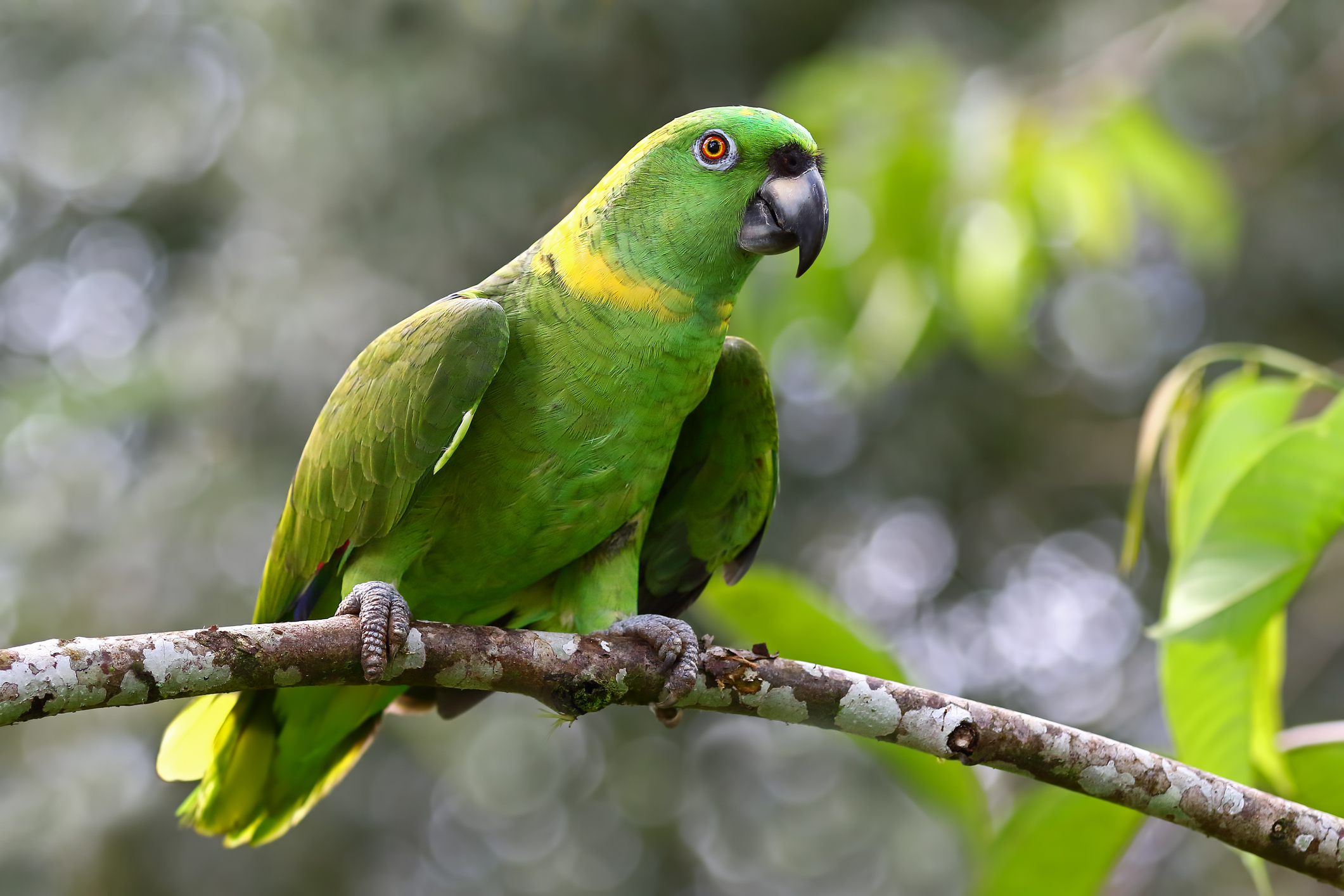
Studies show that these regional dialects are learned attributes rather than genetic, in the same way that some people call sandwiches “subs” while others say “hoagies”.
Are “talking” birds smarter?
“It depends on how you measure intelligence,” says Wright. Corvids, New Caledonian crows in particular, are incredible tool users and can even create tools for specific purposes, like accessing food.
But then you have birds that have superb vocal repertoires. The New Zealand kea is a large, cheeky parrot that can even solve complex puzzles.
How likely are you to encounter a “talking” bird in the wild?
Although there are cases of wild Australian cockatoos picking up human phrases like “hello cockie” from escaped pets, Wright says you should have little expectation of finding mimicking parrots in the wild.
“Still, you may discover new vocal dialects if you travel widely enough,” says Wright, “and contribute to science along the way.”
In Ask Us Anything, Popular Science answers your most outlandish, mind-burning questions, from the everyday things you’ve always wondered to the bizarre things you never thought to ask. Have something you’ve always wanted to know? Ask us.

2025 PopSci Best of What’s New


