For 40 minutes, the greatest solitude humans have known

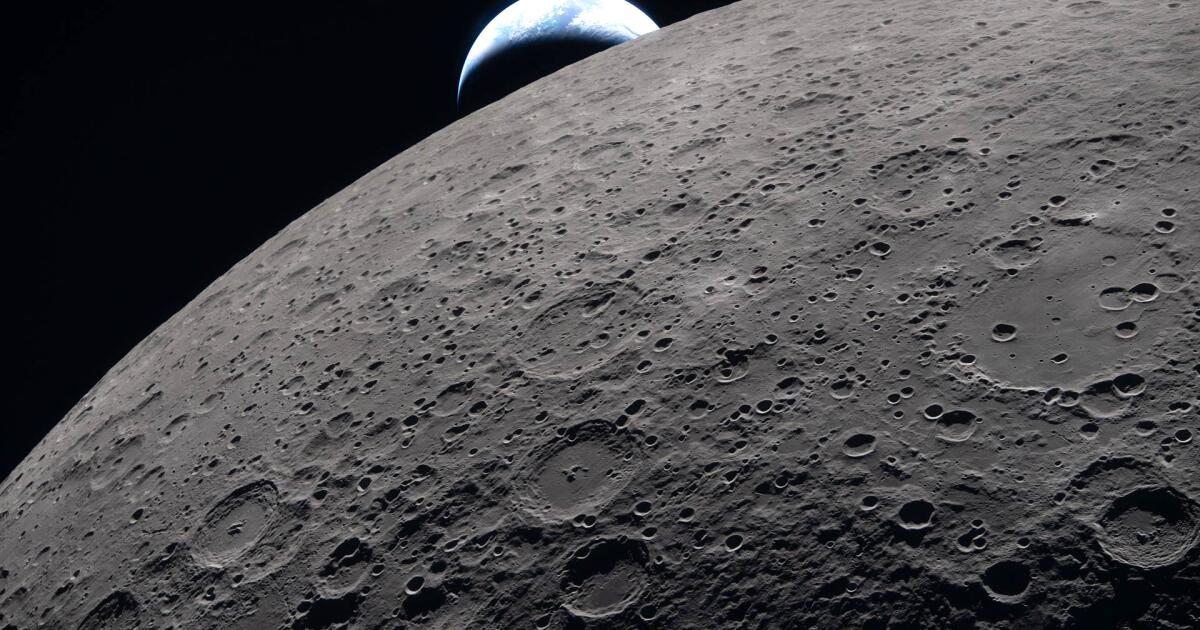
Earth’s crescent – our oasis containing everything we cherish, now just a speck in the infinite darkness – seemed to embrace the jagged lunar surface. The Moon’s thousands of scars were projected onto the Earth as it slowly disappeared from view.
“I’m actually getting chills right now just thinking about it,” said Artemis II Cmdr. Reid Wiseman, speaking to The Times while still in space Wednesday evening (Earth time). “It was just an incredible sight, and then it all disappeared.”
The crew of four – in the faint green glow of their spaceship, with no more room to maneuver than a Sprinter van – entered a deep solitude few people have ever experienced. Farther from Earth than any human in history, the crew could no longer reach Mission Control, their families, or any other living members of our home planet.
For 40 minutes on Monday, it was just them, their high-tech lifeboat and the moon.

Artemis II Cmdr. Reid Wiseman looks out the window of the Orion spacecraft as its first lunar observing period begins Monday.
(NASA)
The crew members paused their rigorous scientific observations for just three or four minutes to let the surreal feeling take hold. They shared maple cookies brought by astronaut Jeremy Hansen, specialist on the Artemis II mission and the Canadian Space Agency.
We humans eat seven fish on Christmas Eve, samosas on Eid al-Fitr, and maple cookies behind the moon.
But the astronauts still had work to do. NASA wanted to observe the hidden side of the Moon, eternally locked facing the Earth, with a very sophisticated instrument with which the agency has rarely had the opportunity to measure this landscape: the human eye.
The moon, appearing about the size of a bowling ball at arm’s length from the crew, hung suspended in nothingness. In complete silence, he waved to me.

-
Share via
Artemis II pilot Victor Glover heard the call of the terminator: the boundary between the moon’s day and night — lunar dawn. Here the sun cast stark, dramatic shadows on the moon’s sheer cliffs, rugged undulations, and seemingly bottomless craters.
Artemis II mission specialist Christina Koch described the scattering of tiny craters on the dayside proudly reflecting sunlight, like pinpricks in a lampshade. Hansen was drawn to the beautiful shades of blues, greens and browns that the surface reveals if you are patient enough.
Even though Earth was hidden behind the Moon a quarter of a million miles away, the crew couldn’t stop thinking about home.
For Koch, the desolation was just a reminder of everything the Earth provides: water, air, warmth, food. Glover could feel the love emanating from our pale blue dot, defying distance. Hansen thought about Earth’s gravity, still working to get the crew home.
And yet the crew was in the gravitational arena of the Moon, where its gravity dominates that of the Earth. It was the lunar monolith in front of them that gently redirected their little life vessel around the natural satellite and towards home.
Finally, the house emerged behind the dark orb.

The Moon completely eclipses the Sun, as seen by the crew of Artemis II. From the crew’s perspective, the moon appears large enough to completely block the sun, creating nearly 54 minutes of totality.
(NASA)
As a final spectacle, or perhaps a farewell, the moon temporarily obscured the sun: a lunar eclipse.
“We saw some great simulations done by our lunar science team, but when it actually happened, it blew us all away,” Glover said. “It was one of the greatest gifts.”


