Galaxies of life are collecting dust in museums – digitizing microscope slides can uncover billions of fossils for natural history

About 145 million: That’s the number of specimens — including plants, animals, minerals and human artifacts — that curators estimate are held at the Smithsonian National Museum of Natural History. However, these estimates do not reflect the billions of tiny individual specimens contained on microscope slides – thin pieces of glass that secure objects in place for observation – each representing a trace of a species at a specific location and time.
Microscope slide collections are an underutilized part of natural history collections because they are small, fragile, and generally poorly cataloged. A slide is usually recorded as a single specimen, although it may contain hundreds of thousands of identifiable samples. They play an important role in documenting present and past life, and are also an essential educational resource for training future scientists.
Our team of plant paleontologists and evolutionary biologists use microscopy techniques to extract the full potential of natural history collections. In our research recently published in the journal PLoS One, we developed a way to digitally image entire microscope slides and make the specimens they contain available to scientists and students around the world.
Unpublished treasures of specimens
The Denver Pollen Collection contains approximately 70,000 slides of fossilized pollen extracted from rocks of many geologic ages. The collection, now housed at the Smithsonian National Museum of Natural History, represents more than 60 years of effort by numerous geologists and paleontologists working for the U.S. Geological Survey, bringing together specimens from throughout the continental United States, Alaska, and many other parts of the world.
Presenting one of the most complete fossil records of plant life, scientists have used this collection to understand how vegetation and climate have changed over geologic time.

For example, by studying the Denver Pollen Collection, researchers found that about 50 to 56 million years ago, Alaska’s North Slope had a temperate to subtropical climate that allowed palm trees to grow north of the Arctic Circle.
The collection was also key in determining how quickly vegetation recovered from the asteroid impact that caused mass extinctions 66 million years ago.
Despite its scientific value, the number of specimens in the Denver Pollen Collection had never been estimated. When the Smithsonian received the collection in 2021, our team began digitally photographing some of these slides over the course of several years.
We estimate that this collection contains approximately 4.3 billion microfossils, four times more specimens than previously estimated in all the collections of the world’s 73 largest natural history museums combined.
Preserving specimens through digitization
Scanning microscope slides is important to preserve the information they contain. Many slides deteriorate: the mounting bracket that holds the coverslips can yellow and crack over time, obscuring the specimens.
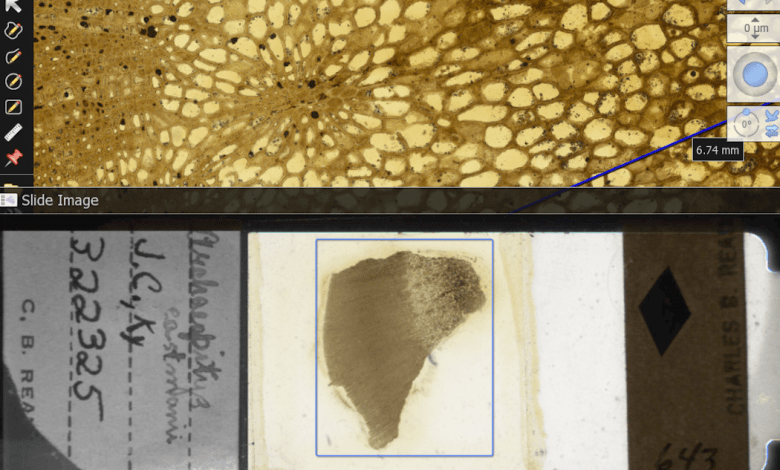
In our study, we show how the use of modern microscope slide scanners can help researchers digitize and preserve microspecimens – including pollen, diatoms and radiolarians – as well as small insects and various plant and fungal tissues. These scanners can scan entire slides in high resolution. Each analysis takes from seconds to minutes, depending on sample size. They can also capture 3D images of organs and features within samples.
Traditionally, natural history studies relied on the expertise of a single specialist. An expert can spend dozens of hours manually analyzing a microscope slide and find only a fraction of the thousands of specimens present. Additionally, other researchers can only verify their results if they have access to the same slide.
Through slide scanning and digital imaging, researchers can use AI models to detect most specimens on a slide and record their location on a slide. This makes it easier not only to relocate individual specimens, but also to access them remotely over the web, improving researchers’ ability to reproduce and verify the accuracy of studies.
Scanning samples on microscope slides not only preserves the information as the slides themselves deteriorate, but also makes it more accessible to researchers, students and the public.
Digital slide images allow students of botany, entomology, micropaleontology, and other fields to access extensive reference collections that may not be available in their home countries. This broadens the talent pool in these fields by allowing students from around the world to participate in original research, for example on how climate change affects the extinction and migration of different species.
Open access digital microscopy databases also facilitate scientific collaboration. Researchers can examine and measure images anywhere and at any time, without having to handle the physical slide. This reduces barriers to sharing science as well as the risk of damaging slides during transport or handling.
The future of microscope slide collections
The digitization of microscope slides in natural history museums and the automation of microfossil labeling provide researchers with more opportunities to share and study hundreds of billions of specimens in collections around the world.
However, digitalization is not without costs. We estimate that fully digitizing the Denver Pollen Collection would require nearly five years of continuous work and approximately 3.5 petabytes of storage. But we believe these efforts will produce a massive dataset that captures changes in Earth’s flora and climate over geologic time.
Digital microscopy opens new horizons to fields such as micropaleontology to explore the planet’s biodiversity. There’s an entire galaxy of nature waiting to be seen…and it’s already stored in museums and universities around the world.
This article is republished from The Conversation, an independent, nonprofit news organization that brings you trusted facts and analysis to help you make sense of our complex world. It was written by: Ingrid C. Romero, Smithsonian Institution and Scott L. Wing, Smithsonian Institution
Learn more:
Ingrid C. Romero has received funding from the Smithsonian Institution Climate Change Fellowship, the Office of the Associate Director for Science at the National Museum of Natural History, and the Smithsonian Office of the Under Secretary for Science. She is affiliated with the Micropaleontological Society and is currently chair of the palynology group.
Scott L. Wing receives funding from the Smithsonian Institution (Life on a Sustainable Planet Program and Smithsonian National Museum of Natural History).


