Government will not ‘be held to ransom’ by doctors strike, says Wes Streeting



 BBC
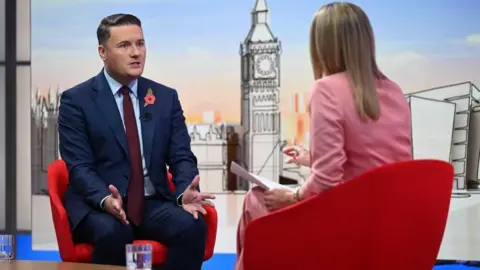
BBCThe Government will not be “held to ransom” by striking doctors, Health Secretary Wes Streeting has said.
A five-day strike by resident doctors is due to take place between November 14 and 19, as part of a long-running dispute over salaries.
Streeting told the BBC that a deal was available to increase the number of specialist training places and provide support for things such as exam fees.
But he said: “I can’t do that if I spend a quarter of a billion pounds to cover the cost of strikes.”
The British Medical Association (BMA) said Streeting could prevent strikes “by providing credible proposals and not playing games with strikes”.[ing] politics with doctors who devote their lives to the health of the nation.
In an interview with Laura Kuenssberg on Sunday, Streeting said the strike had “little or no public support” and would “inflict further harm and delay on patients.”
He added that the agreement, which does not include negotiations on salary increases, remained on the table.
But he told the programme: “What we will not do however is be held to ransom and what I will not do is allow these costs of strikes to be inflicted on other NHS staff who work constructively with us, or on patients in terms of the services they receive.”
This strike – the 13th in a wage dispute since March 2023 – is expected to cause significant disruption, particularly in hospitals.
The BMA and the government have been in dialogue throughout the summer and early autumn since the last walkout at the end of July, but talks broke down earlier this month.
Streeting said he would not negotiate on salaries after resident doctors, the new name for junior doctors, received pay increases totaling almost 30% over the past three years.
Instead, discussions focused on career development, working conditions and personal expenses such as exam fees.
But the union says resident doctors’ pay is still a fifth lower than in 2008, once inflation is taken into account.
They also said they wanted the government to address what they see as a shortage of jobs after the second year of training, when resident doctors access specialist training.
This year there have been more than 30,000 applicants for 10,000 jobs at this stage, although some will be foreign doctors.
Streeting said the government’s current offer, which would provide additional training places and help cover out-of-pocket costs, would be “a win-win scenario where, together, we move forward with the progress we are making in the NHS”.
But the BMA said the government had not presented us with “any proposals that would deliver the real change needed to solve this year’s jobs crisis”.
He added that he had asked for “as little as £1 more per hour over the next few years” in terms of a pay deal for resident doctors.
“Mr Streeting needs to be honest with patients: we are losing doctors to other countries and other professions because they cannot find work in the UK – despite their training here and their desire to work here,” the statement added.
Streeting also partly blamed previous industrial action for rising NHS waiting lists.
The latest figures show around 6.26 million patients were waiting for treatment at the end of August, compared to 6.25 million patients at the end of July.
“We had industrial action from resident doctors, which had an impact and set us back, as I feared and said at the time,” Streeting told the program.
“We have also seen demand outpacing business growth.”
He added that he believed the NHS would “start to see an improvement in waiting lists in the coming months”.


:max_bytes(150000):strip_icc()/Health-GettyImages-SpinachVsKale-515f530474b94375b30e5284c62e3332.jpg?w=390&resize=390,220&ssl=1 "Which One Has More Fiber and Nutrients?")
