Has the abrupt cutoff of foreign aid had an impact on violence? : NPR

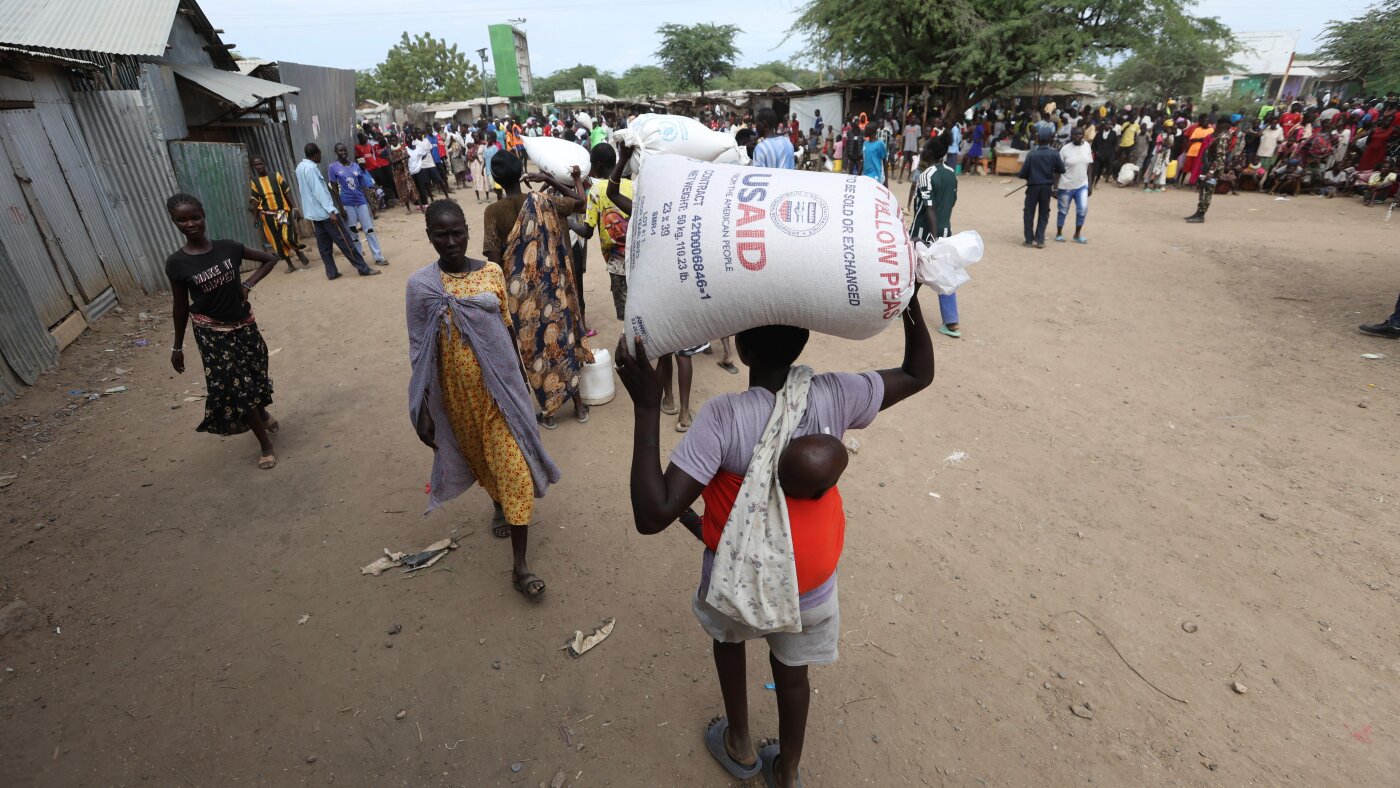

Refugees carry food to a distribution center run by the World Food Program at the Kakuma refugee camp in Turkana, Kenya. After US aid to finance food was cut, protests broke out.
Andrew Kasuku/AP
hide caption
toggle caption
Andrew Kasuku/AP
Does foreign aid have an impact on violence – on wars, on street fighting, on random attacks?
The answer is that yes, it does – in two opposing, and perhaps counterintuitive, ways. On the one hand, aid can provide jobs and resources. And this, in turn, can reduce incentives to engage in violent actions.
Yet it can also have the opposite effect. “Aid can also aggravate conflicts by introducing a motive for fighting,” says Austin Wrightdata scientist at the University of Chicago who works at the intersection of public policy and statistics. It refers to resources such as roads and supplies funded by foreign aid. In other words, “things that have value to control.”
The elimination of USAID – America’s premier humanitarian aid agency – gave researchers another angle to explore. Did the sudden withdrawal of aid funding do they have an impact on conflicts?
In a study published in the review ScienceeWright and colleagues conclude that the abrupt dismantling of USAID led to an increase in overall conflict in regions of Africa that received aid compared to those that did not.
“The rapid collapse of what is probably the most sophisticated humanitarian aid program in human history has had enormous consequences on the ground, undermining livelihoods and thus leading to an upsurge in violence,” concludes Wright.
The near-instantaneous evaporation of aid “suppressed livelihoods, undermined economic productivity,” he explains, weakening the incentives people might have to refrain from violence. And at the same time, “it hasn’t yet eliminated what the actors were fighting over. And so that’s what creates the chaos and the violence that we end up seeing.”
As an example, Wright refers to the protests that broke out in Kakuma refugee camp in northwest Kenya in July 2025. The approximately 300,000 refugees there were dependent on food and other services paid for by USAID. Wright says: “After the budget cuts, food distributions were sharply reduced and refugees took to the streets,” throwing stones and setting things on fire. One person was killed. “This is exactly the kind of incident our results capture.”
NPR has contacted the U.S. State Department for comment. Spokesman Tommy Pigott responded in part: “One of the biggest problems with this “report” is that it fundamentally ignores what is really happening in Africa. The Trump administration has made unprecedented progress toward advancing peace on the continent.
The interaction of aid and conflict
The researchers examined a map of USAID funds disbursed at the state or provincial level before the agency’s cessation.
“And then we add to that conflict activities,” he says, in the form of armed clashes, demonstrations, riots and violence against civilians. This data from the ten months before and after the start of 2025 came from an independent and detailed violent conflict database called the Location of armed conflicts and event data. “So we’re not just seeing that conflict has occurred in one location,” Wright says. “We see exactly when the conflict broke out.”
And they looked to see how any change in this violent activity could have corresponded to the elimination of USAID investments.
The team found that places that once received more aid tended to experience more conflict once that aid abruptly disappeared, often because those who relied on that aid became more vulnerable to recruitment by armed groups. “When aid is suddenly withdrawn, economic opportunities disappear quickly: wages dry up, clinics close, food programs stop,” Wright says.
“But the things worth fighting for (infrastructure, territory, political power, ethnic grievances, geopolitical tensions) do not disappear overnight,” he continues. This meant that in the short term, the loss of opportunities, alongside an animation of individual motivations to fight, caused an increase in violence.
Additionally, the conflict included fighting between armed groups, public protests that spontaneously turned hostile, and deliberate acts of violence targeting noncombatants, such as rebels attacking a village.
Wright thinks about conflicts that arise in environments where economic opportunities are low but grievances are numerous. “It’s an arrow that points directly to the moment of shutdown,” he says.
The results are “convincing”
The only exception he and his colleagues have found is in countries where the government supports stronger constraints on the executive leader. These are “contexts in which the president or an equivalent actor cannot declare war unilaterally.” [or] circumvent the elected bodies of Congress,” Wright says.
These institutions helped their constituents weather the storm caused by the sudden withdrawal of their funding. This meant that the impact on the conflict there was less. Wright quotes Nigeria’s additional health budget of $200 million And South Africa’s decision to help fill gaps in the treatment of AIDS and HIV, for example.
Researchers not involved in the study caution that it is a difficult subject to study. “Conflicts and their sources are very complex,” says Andy Solowa statistician from the Woods Hole Oceanographic Institution who was not involved in the study. “I think it’s generally difficult to get a definitive answer. But you do your best, and I think they did.”
Solow raised some concerns about the analysis, including that conflict may be contagious, allowing it to spread. This means that the individual violent events that the researchers took note of in their analysis may have been interrelated.
“These are technical problems,” he said. “But they are unlikely to overturn the basic result, which is that the shutdown led to increased conflict. I believe in their results. They are convincing.”
As the authors point out, the increase in violence may well be the legacy of the decision to suddenly end USAID. This is a reality that Wright says is concerning since “recent conflict is the best indicator of future conflict.” Once violence escalates, it tends to become self-reinforcing.”
This means that even if aid were to be restored, the situation is unlikely to improve as suddenly as it deteriorated. In other words, Wright said, “the damage caused by this period of increased violence would not simply be undone.”


