Here’s how the pros play on the clay courts of the French Open : NPR

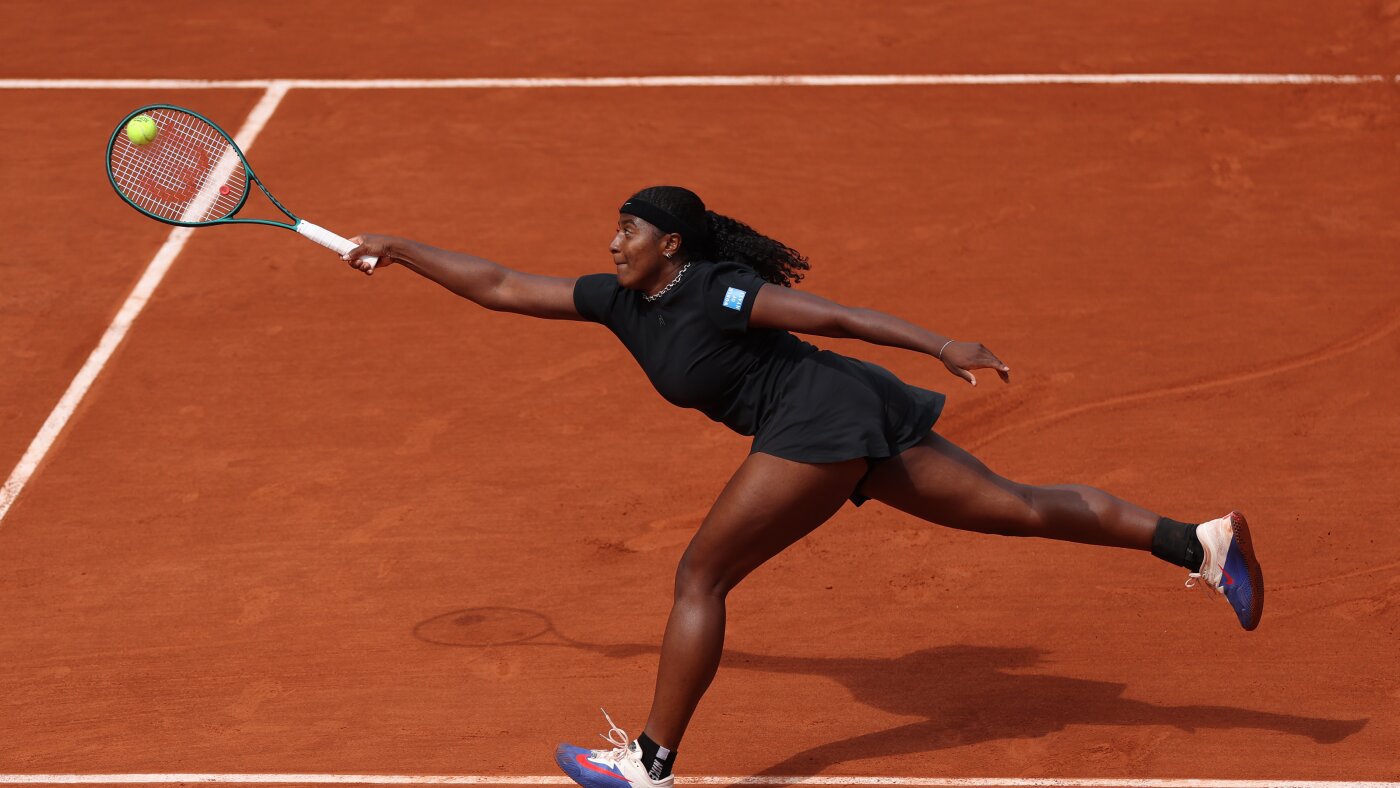

Hailey Baptiste of the United States plays a forehand against Madison Keys of the United States during the women’s singles fourth round match on day nine of the 2025 French Open at Roland Garros on June 2, 2025 in Paris, France.
Adam Jolie/Getty Images Europe
hide caption
toggle caption
Adam Jolie/Getty Images Europe
The men’s and women’s qualifying rounds at the French Open began Monday, the culmination of a season of professional tennis on a notoriously difficult surface to compete on: clay.
The court at Roland Garros, the stadium where the French Open takes place, is a five-layer sandwich of various stones and coal residue, topped with a thin layer of red brick dust. The mixture may be unstable because it may shift underfoot. In comparison, hard courts have a resin or acrylic topcoat that provides an even surface. Grass has a rougher texture which gives the ball a lower bounce.
But any athlete who makes it to the French Open is “a phenomenal tennis player at that point” and learns to adapt to clay, said Steve Johnson, a retired tennis professional who competed in 10 French Open tournaments. NPR spoke with him and two players competing at this year’s French Open about how they navigated that glowing court during their careers.
Marta Kostyuk
As a junior player, Ukrainian Marta Kostyuk performed well on clay. She had more stamina, but she was also much more rigid in her approach to the game, she said, which didn’t bode well once she moved on to the pros.
“I would start playing [a] in a way, and I wouldn’t change it,” she said.
So she had to learn to be more flexible. After all, clay is capricious. It shrinks and expands, so each step and bounce can be different from the others, she said.
The clay court season is also short. This is a series of tournaments that take place from the end of March to the beginning of June, a few months from the full season, and which are mainly dedicated to hard courts. So it can be difficult to get into a rhythm, Kostyuk said.
It doesn’t help that each clay court has its own DNA. For example, the Madrid pitch is located at a higher altitude, with thinner air which gives less resistance to the ball.
“So the bullets are flying,” she said.
His mother, Talina Beiko, played professionally and ensured that Kostyuk trained regularly on clay. The courts at Roland Garros have a heavier consistency, like the ones she grew up playing on.
“It’s a real clay court, the one that suits me,” Kostyuk said.
Kostyuk’s adaptability paid off. Within three weeks, she won back-to-back clay court tournaments in Madrid and Rouen, France, propelling her from 28th to 15th best singles player in the world in the Women’s Tennis Association rankings.
Steve Johnson
Red may be the clay of choice for many professional tournaments, but it’s not the only one.
Red clay is more naturally available in Latin America and Europe than in the United States, so clay courts in the United States often take on another consistency and shade, green.
“It’s a little thinner, it’s a little more slippery than red clay,” said Johnson, the retired professional. “It makes you feel a little bit like you’re on red clay, because you can move and slide, but the base isn’t there.”
It may take some time for American players, like Johnson, to adjust to the red clay. In Johnson’s early playing days, that could mean three or four tournaments. But with experience, that window has shrunk to a week or two, he said.
“As a young pro, sometimes you feel like you have to rethink the shuttlecock a little bit depending on the new surfaces you’re playing on,” he said.
But playing on clay usually involved at least some adjustments to his technique, he said. Clay slows the ball down, giving more time to respond to a shot. So, Johnson could “mistake” someone – going in a different direction than your opponent expected. He could play more aggressively, he said, or change his defensive style.
Clay is also very sensitive to climatic variations. The texture may be firmer on a dark, cool day and softer on a hot day, Johnson said.
“It’s like you’re playing two completely different tournaments,” he said.
Hailey Baptiste
Hailey Baptiste is a 24-year-old American ranked 25th best player in the world in women’s singles by the WTA. She also said it was rare for young American athletes to play on red clay courts. But there were two at the tennis club where she trained in suburban Maryland when she was younger.
Not only did she start on clay very early, but it is her favorite surface.
“I really like sliding,” Baptiste says. “I feel like it’s almost easier, because you can just let go of your weight when you stop, rather than having to do a ton of adjustment steps all the time on hard terrain.”
Baptiste said she has strong quads, which make it easier for her to control herself on slides, a crucial tool for staying balanced, slowing down and resetting on clay surfaces.
Last year, she reached the fourth round of the women’s singles at Roland Garros and the first round of the doubles. She is in doubles again this year.
She’ll likely discuss strategy with her partner as the match approaches, but she has no plans to reinvent that wheel Johnson talked about. Plus, she’s paired with someone who has dominated all types of courts: Venus Williams.
“Every time I play a tournament, I play to win the tournament,” Baptiste said.