Hey, Nvidia: DLSS 5 can’t make great art with imperfect science


Summary created by Smart Answers AI
In summary:
- PCWorld examines Nvidia’s controversial DLSS 5 technology, which uses “real-time neural rendering” for photorealistic gaming lighting, but faces criticism from gamers who say it compromises artistic integrity.
- The debate centers on whether DLSS 5’s technical improvements justify what critics call the “yassification” of the game’s art, with some seeing it as unwanted beauty filtering that devalues the original artistic vision.
- Despite CEO Jensen Huang’s defense of the technology as “generative control,” the controversy highlights the ongoing tension between technical innovation and the preservation of authentic artistic expression in gaming.
Have you ever had any debates about art? I do. They are complicated, especially those involving video games. And now Nvidia has added even more chaos to the mix with DLSS 5.
Announced at GTC 2026, this new dynamic lighting technology is described by Nvidia as “real-time neural rendering” that adds “photorealistic lighting” to pixels, at a level that allows game developers to rival Hollywood in creating realistic graphics. The public disagrees, and neither do my colleagues among the vocal opponents.
Welcome to The Full Nerd newsletter, your weekly dose of hardware talk from PCWorld enthusiasts. You missed the surprising topics on our YouTube show or the latest news from the Web? You are in the right place.
Would you like this newsletter to arrive directly in your inbox? Register on our site!
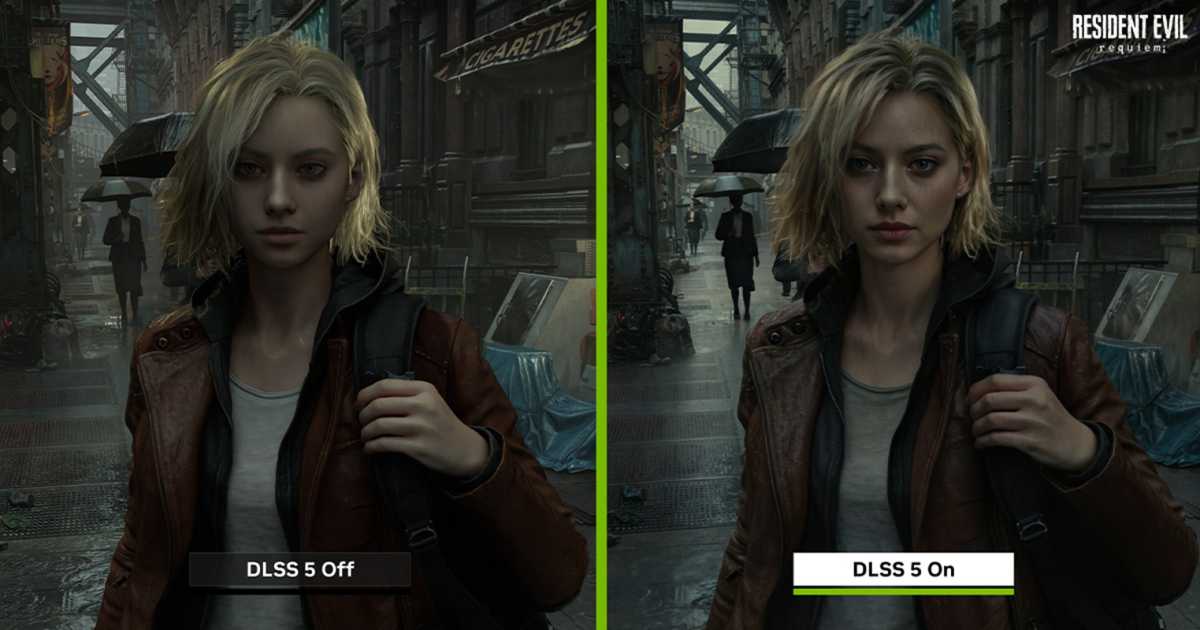
Players accuse DLSS 5 of “yassifying” the game’s art, that is, generously applying beauty filters to characters and environments. (As @thedragonbrandy.bsky.social commented on Bluesky, “We’ve gone from raytracing to sloptracing.”) For his part, PCWorld editor Mark Hachman sees DLSS 5 as “the scattering of AI content across games, devaluing them in the process.”
Nvidia CEO Jensen Huang hit back, saying the criticism was “completely false.” His rebuttal focused on the technique, pointing out that this new technology applies “generative control” to a game’s geometry, rather than serving as post-processing.
Who is right in this argument? I can’t make this call, although I have my sympathies. Both sides have valid points. As they do in virtually every fight over art.
Here’s my theory as to why: Regardless of the medium, art can be divided into two main elements: “science” (i.e. technical execution) and emotion. You can’t just have one or the other. You need science to provoke a reaction in your audience, to capture it with skills that only a master artist can execute. The more varied and refined your technique, the more complex and powerful the response you will get. But it also takes emotion to hook an audience, to reach them on a deeper human level. The harder you press these emotional buttons, the deeper the connections you make.
Science helps tell the story effectively. Emotion drives people to invest in that history. But weaken one and the other disappears with it. This is the heart of this confrontation, in my eyes.
Nvidia
Nvidia presents itself as helping with game development; DLSS 5 “does not change artistic control” of game studios, according to Huang. Yet this view ignores what gamers see: DLSS 5 is not working as expected.
When the science in art is done well, the audience doesn’t notice it. Most enjoy the experience and leave the technical details to the enthusiasts. If Nvidia had succeeded on this front, DLSS 5 would be viewed more positively, which would be a beneficial advantage. (Perhaps even a reason to justify the cost of an expensive graphics card to support this feature.) Instead, gamers are dissecting the execution of DLSS 5 to the point of questioning its necessity.
This may be due in part to the lack of knowledge about DLSS 5’s implementation and the real control the game’s artists have over its effects. (For example, did anyone at Capcom enhance Grace’s look with more makeup and hair highlights, despite it being missing in the original? Resident Evil: Requiem scene? Or is it really the influence of DLSS 5?) Yet even with this lack of information, DLSS 5 proponents would do well to listen, rather than dismiss the critics as ignorant idiots.
Non-experts in a field do not have the knowledge or language to concretely explain what they notice. Their descriptions usually translate to feelings or are attributed to incorrect root causes. Despite this, their comments remain valuable. A distracted audience is not an invested audience – an observation I’ve made many times when evaluating art myself. And here, distraction is precisely what DLSS 5 claims to solve. Players don’t believe what they see is accurate.
Personally, I believe in DLSS 5’s goal of elevating the science of game creation. But I also agree with the fans: it won’t happen if the tool isn’t better calibrated – or perhaps better implemented – by the time it launches.
In this episode of The Full Nerd
In this episode of The Full Nerd, Adam Patrick Murray, Brad Chacos, Alaina Yee, and Will Smith discuss the DLSS 5 announcement (and its reception), Microsoft’s Project Helix, and details of Intel’s Arrow Lake Refresh. We spend over 90 minutes using just Nvidia’s new lighting technology, and we weren’t the only ones chatting during the stream. I pulled out some of my favorite comments:
@brandontrost8888
dlss5 looks photorealistic. This is certainly not an AI fault. This is a real game changer@DerxWiedergaenger
people are angry because it looks like garbage. It completely removes shadows and completely overwhelms lighting. As it turns out, it looks like someone turned on vivid mode on their TV.@puretrack06
Thomas the tank engine mod for everyone
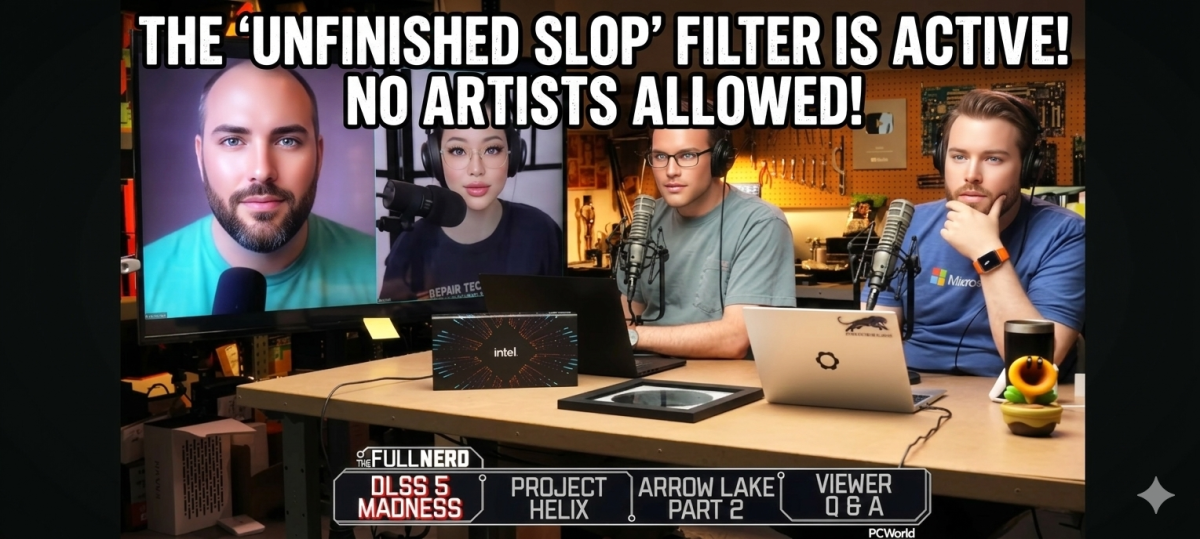
Much debate took place with little consensus, but we managed to agree that Nvidia should have called this something other than DLSS 5. (Where’s the super sampling?) Plus, we agree that our viewers are pretty awesome, because they created this image below while we were talking.
BMG / Discord
Did you miss our live? Subscribe now to The Full Nerd Network YouTube channel and enable notifications. We also answer viewers’ questions in real time!
Don’t miss our other shows either: you can watch episodes of Dual Boot Diaries, The Full Nerd: Extra Edition and Expedition: Handheld through our channel!
And if you need more gear talk during the rest of the week, join our Discord community: it’s full of cool, laid-back nerds.
This week’s nerd news
DLSS 5 may be dizzying among enthusiasts, but there are plenty that have made headlines for attention or shock. For my part, I am surprised at the repairability of the Apple MacBook Neo. This is even less the case when it comes to AI creating big headaches… or software exploitation.

Foundry
- Up is down, down is up: Apple received high marks on YouTube for the repairability of the MacBook Neo. In reality, we are currently living in an alternate universe.
- A surprise to no one: OpenAI would move forward with its adult mode for ChatGPT, against the advice of its advisors. I’ll let Ars Technica s73v3r’s commenter speak for me: “Why are we allowing such a dangerous product to be marketed? We banned cheap Lawn Darts.»
- Danger of browser extensions: My colleague Michael Crider discovered that a Chrome extension had been stealing his data for years.
- Better living through science: Researchers believe they can identify six different types of depression using functional MRI (fMRI). The practical application of this knowledge may be slower to follow, but perhaps in time people will have to suffer less to find the right treatment.
- Brown City: Noctua fans, your time has come. No need to be subtle with your love of chocolate brown: now you can fit your entire PC into a case featuring this aesthetic.
- East Minority Report our future? Jailed for almost six months due to faulty AI facial recognition today. Maybe in jail for thinking about Jaywalking tomorrow.

Jared Newman / Foundry
- Vintage vibes, modern performances: I loved this project undertaken by PCWorld contributor Jared Newman: creating your own personal radio station to pair with an old radio. (Be careful, this article commits slight violence by reminding us that technology from 1976 is now vintage.)
- Reboot regularly? If DarkSword-like exploits become more common, I might stop focusing on the persistent uptime of my devices.
- This is not the Newegg I know: Congratulations to this buyer, who got an accidental 91% discount on a full version of the system due to a pricing error. And I got through it.
- The right kind of shade: Intel has partnered with Microsoft to launch its Intel Graphics Shader Distribution Service, which stores precompiled shaders in the cloud to speed up game loading times, up to 37 times.
- Old Bandages: It’s pretty cool to realize what alternatives exist to today’s basic products – and probably how they became solutions.
As much as I’ve talked about DLSS 5 this week, I could debate it even more. I’m very interested to see what we learn about this technology in the future and how public conversations help shape its direction.
See you next week!
Alaina
This bulletin is dedicated to the memory of Gordon Mah Ungfounder and host of The Full Nerd, and Hardware Editor at PCWorld.


