Hezbollah rocket hits Byzantine-era church in Nahariya, damages protective infrastructure

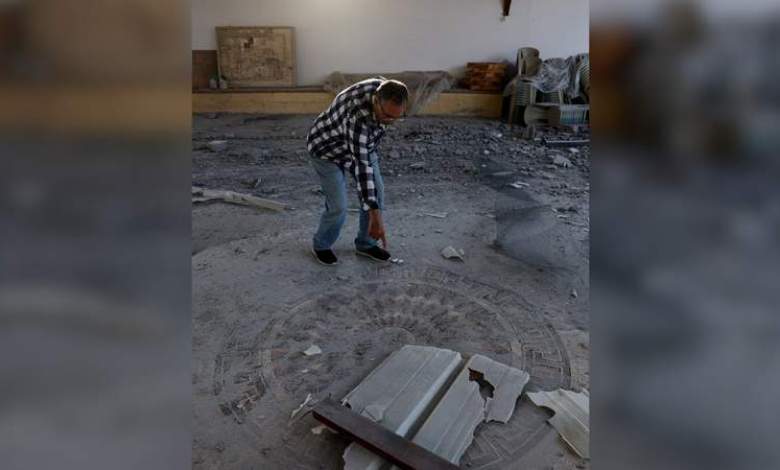
Originally destroyed by the Persians in 614 CE, the mosaic was painstakingly restored by the IAA over two years and officially opened to the public in 2022.
A rocket fired by Hezbollah toward northern Israel on Friday hit the remains of a Byzantine-era church in Nahariya, damaging its modern protective structure, the Israel Antiquities Authority (IAA) said. The Jerusalem Post.
The church, rediscovered by the Nehariya Municipality in 1964, houses a colorful mosaic floor dating back to around 550 CE.
Originally destroyed by the Persians in 614 CE, it was painstakingly restored by the IAA over two years and officially opened to the public in 2022.
On Sunday, a team of IAA archaeologists and conservators, along with representatives from the municipality and the Israeli Tax Administration, conducted an on-site assessment of possible damage to the mosaic.
Although the mosaic was covered in debris from the damaged protective structure, it itself was not damaged, the IAA told the agency. Job.

Man cleaning the Byzantine-era mosaic in Nahariya, taken in 2022; archive photo. (credit: YOLI SHWARTZ ISRAEL ANTIQUITIES AUTHORITY)
The mosaic depicts colorful animals, symbols of Christianity
Signs of the mosaic’s initial destruction by the Persians are still visible, as it is stained black and white in places, and large quantities of molten lead have been found at the site.
The mosaic itself spans over 500 square meters and is richly decorated in greens, reds, yellows, browns, whites and blacks.
It has more than 100 medallions, of which 87 have survived, depicting scenes from everyday life, including animals, humans, hunting scenes, grapes, pomegranates and symbols of Christianity.
In the center of the floor there is a stunning rose window with a three-dimensional optical illusion, which has almost completely survived the centuries.
“From the decorations of the basilica, we see that the person who built it was very rich and invested a lot of money to build it,” IAA regional director Kamil Sari explained in 2022, adding that an inscription in ancient Greek indicates that the church was built by the archbishop of Tyre, now Sidon, Lebanon.
The church complex was built on the remains of an earlier temple dating back 4,500 years ago.
Judith Sudilovsky contributed to this story.


