Hidden Greenland Lake Punches through Giant Blocks of Ice in ‘Extremely Surprising’ Event


The hidden lake broke through the Greenland ice in the “extremely surprising” event
The water usually flows downwards, but something strange has happened under the Greenland ice cap when a flood hit the surface to cover an area almost twice the size of the New York central park
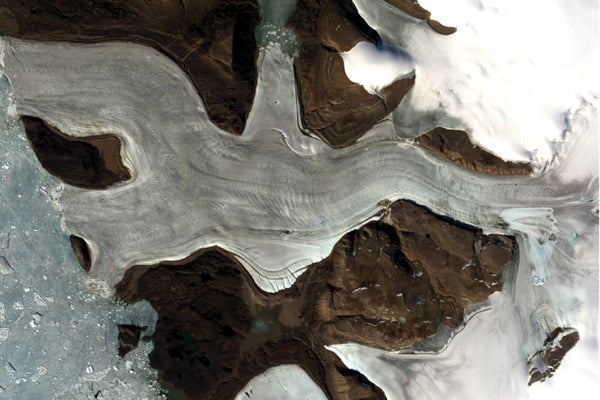
The harder Greenland glacier and the lighting site for sub-glacial floods (bottom right) can be seen in this Landsat satellite image acquired on August 1, 2014.
An under-groenland sub-gleado flood bursts up across dozens of meters of ice, pushing the blocks the size of five-story buildings and traveling an area almost twice the size of Central Park in New York, according to the research published in the journal Nature geoscience.
This occurrence of a water fountain instead of pouring along the base of the Greenland ice cream cap was “extremely surprising”, explains Winnie Chu, assistant professor of geophysics at the Georgia Institute of Technology, who was not involved in the document but studies the country’s ice. “Having cast iron waters that essentially force its bedroom, which requires extremely unique conditions,” explains CHU.
The event occurred in 2014 near the harder glacier in northern Greenland, a place where a sudden flood would not be noticed on the ground. Mal McMillan, professor of earth observation at the University of Lancaster in England, and his colleagues discovered the flood a decade later while looking for signs of lakes under the ice in satellite imagery.
On the support of scientific journalism
If you appreciate this article, plan to support our award -winning journalism by subscription. By buying a subscription, you help to ensure the future of striking stories about discoveries and ideas that shape our world today.
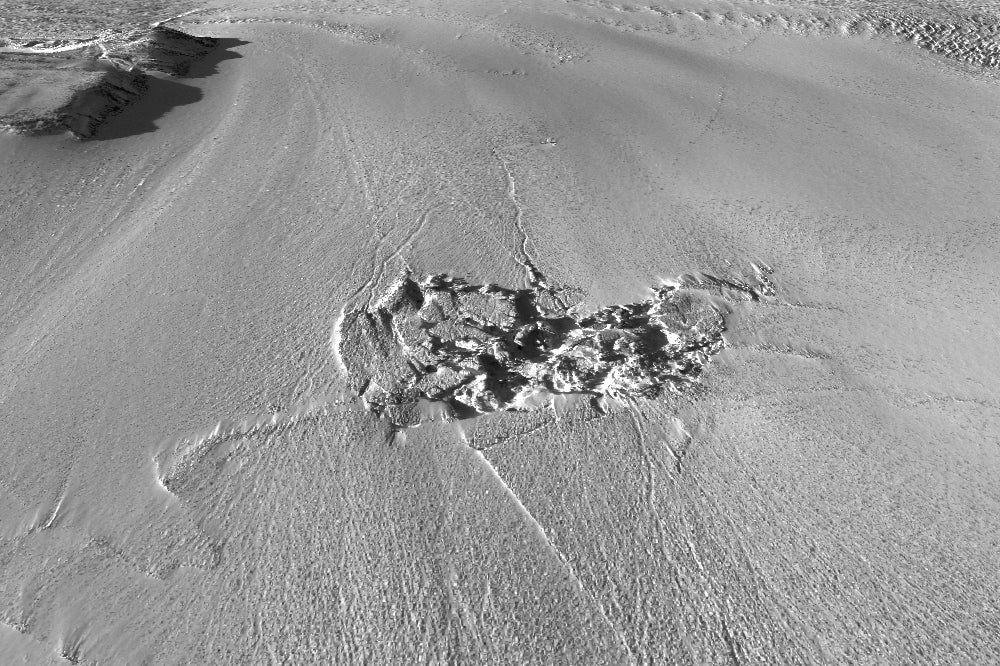
This 3D perspective shows the explosion fracture area on the hardest glacier in Greenland, based on satellite imaging acquired on April 28, 2015.
CPOM, Lancaster University © Digitalglobe, Inc. (2015), supplied by European spatial imagery
These lakes are important because they affect the overall cycle of water and the movement of ice in Greenland. As a rule, they are formed from the cast iron water on the surface that flows and is trapped between the ice and the foundation. On occasion, they were emptying quickly, sending water flowing between ice and rock, sometimes towards the sea and sometimes under the glaciers, where they grease the skates and help the glaciers flow more quickly.
These lakes are however small, so taking into account their impact on the models of the Greenland ice cap has been difficult so far. Increasingly good images have allowed researchers to see tops or divots in the ice which indicate that a sub-Glacial lake is filled or empty. By examining this historic data near the harder glacier, the team of the new study noticed a two -square ice zone which had collapsed in an 85 -meter -deep abyss. “We dug more deeply, and what we found, which was even more interesting …, was this downstream fracture area, which we did not expect to see,” explains McMillan.
Beyond the fracture area were six square kilometers of smooth ice, wiped by a giant deluge. The researchers realized that the collapsed area was a sub-Glacial lake that had quickly passed. About a downstream kilometer, however, the water struck a kind of obstacle. Instead of descending, it pushed up, creating an upheaval of ice and crevices blocks and which must have been a dramatic spring of 90 million cubic meters of water, or the amount of water passing over Niagara falls in nine hours. All this occurred in the space of about 10 days.

This satellite image shows the Lake Sub-Glacial Lake region on August 12, 2012, before the drainage of the sub-Glacial lake and the lighting flood occurred.
CPOM, Lancaster University © Digitalglobe, Inc. (2015), supplied by European spatial imagery
The water then drained under the ice cap and can have found itself under a harder glacier, which – in the manner or not – made a large calving event, in which a piece of ice plunged into the sea, during the same period of 10 days. The glacier has also experienced unusual changes in its flow this summer, suggesting that the flood had an impact on its dynamics, researchers reported in the new article.
“This is another piece in the puzzle of the way in which large pieces of ice on our work on the planet,” explains Robin Bell, professor of marine and polar geophysics at the Lamont-Doherty Earth Observatory of Columbia University, which was not involved in research. The following question is how this puzzle piece fits into the overall history of Greenland rapid warming, McMillan says: “We must understand if it happened on other occasions.”


