How a Rocket in Iran Reverberates in Gaza


As Israel bombards Iran with rockets, it closes borders across Gaza and the West Bank, stopping the flow of food, aid and bodies.
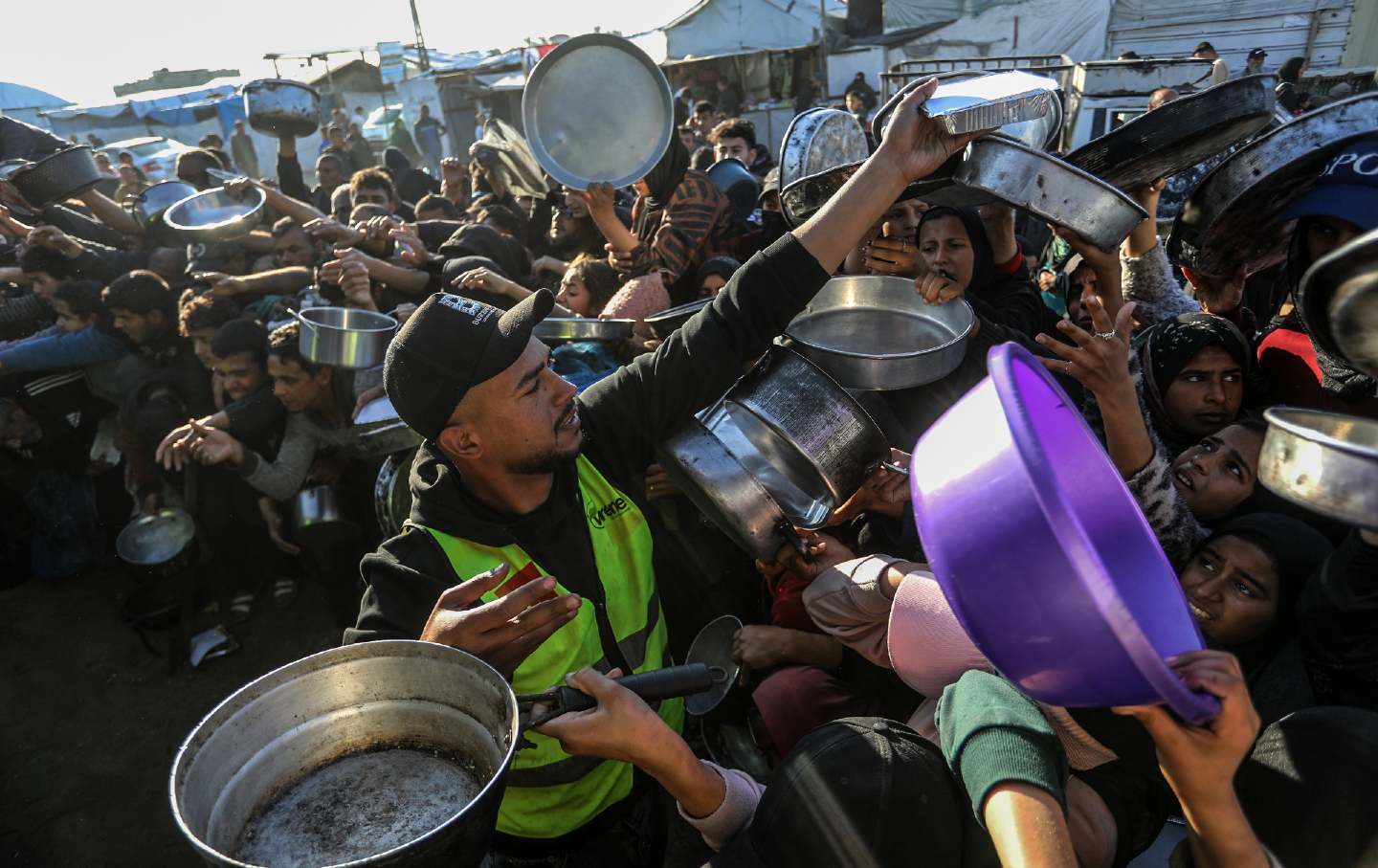
Palestinians, mainly children, wait to receive hot meals distributed by a charity as food shortages continue and the entry of aid is restricted.
(Abed Rahim Khatib/Anadolu via Getty Images)
“I’m here at the market, come help me, I bought a lot of things to take with me.”
With this short message, my father told me recently that he had decided to go to the market. He knew the prices were high, but he chose to buy more food despite the price. In Gaza, people don’t always buy food because they need it today; they buy it because they fear it will no longer be available tomorrow.
It was the morning of Saturday, February 28, 2026, the same as that reported by international news after Israel, along with the United States, launched a military strike inside Iran. To much of the world, it probably seemed like a distant crisis, one that they could read, even in the midst of their horror, through a political or military lens. But in Gaza, the news was more than a distant event: it was an early warning of what might happen.
In a country that has endured two years of genocide and long years of blockade, any regional escalation is immediately interpreted as a direct threat to daily life. Israel often takes advantage of these moments to tighten its control over Gaza, restrict access to essential goods and limit movement, making daily life even more precarious for residents, while much of the world and the media remain distracted or ignorant of what is happening on the ground.
The signs appeared quickly. Israel has sealed off Gaza’s borders, blocking not only the flow of goods but also humanitarian aid. It even closed crossing points allowing patients to leave Gaza for urgent medical treatment abroad.
With these closures, fuel and gas trucks – which were just beginning to resume activity after the ceasefire forced Israel to lift its near-total siege – stopped entering the territory. These supplies are essential for running generators, cooking, and operating some basic facilities. In a place where more than 2 million people live in a small, densely populated area and daily life depends almost entirely on what enters through these passages, any closure can quickly become a full-blown crisis, especially during Ramadan, when families need more food and basic necessities.
Current number

A few hours after hearing the news, I went to the market myself.
What I saw there was fear and anxiety. People’s faces were tense as they crowded into stores to buy essential and non-essential goods in larger quantities than usual. Queues stretched outside stores and people moved quickly between stalls, filling bags as much as they could.
Meanwhile, prices were already rising.
I went to the vegetable seller first, as he is usually the first one affected in such circumstances. Two days earlier, ten kilos of potatoes cost around $10. When I arrived the same amount was around $30. And it wasn’t just potatoes: the prices of many vegetables and other food products, such as flour and sugar, were rising rapidly.
The fear people felt and their haste were not based on political analysis, but on long experience of crises. For nearly 20 years, Gaza residents have lived under a blockade, which Israel reinforced to siege level during the worst days of the genocide. For months, they endured the harshest days of famine, facing death traps at aid distribution points, with thousands dead or injured just to get a kilo of flour and a basic meal. Some were forced to drink salt water to survive, while others walked for hours to gather some food for their families.
By this time, food was no longer just a daily need: it had become an obsession.
For me, it got to the point where I was looking for a way to produce food myself. At one point, I found myself trying to farm as much as I could, not because I wanted to, but because the thought of not being able to feed my family was terrifying.
That’s why when people hear about border closures or regional escalation, they don’t treat them as distant news: they hear them as a loud, resounding alarm.
However, not all families are able to respond to this alarm. Some don’t have the money to buy more, while others don’t have space to store them in cramped homes or worn-out tents in the dead of winter. Preparation becomes a privilege that not everyone can afford.
As Ahmed Asfour, 26, explains: “I didn’t have enough money to buy anything because my work was stopped, but I borrowed and bought what I could, fearing that the crossings would remain closed and we would return to days of famine. »
As international aid organizations warned that food and medical supplies could run out quickly in Gaza and a halt to fuel imports could cripple essential services, life in the occupied West Bank took a dire turn. Once American and Israeli bombs began falling on Iran, Israel closed all checkpoints between cities, isolating Palestinians from each other and forcing them to take circuitous routes to reach their homes. The occupation also banned access to the Al-Aqsa Mosque in Jerusalem and the Ibrahimi Mosque in Hebron for several consecutive days during Ramadan – a measure without precedent in history.
In Gaza, the question is: will I find food today? In the West Bank, it’s: can I go to my home, my mosque? For Palestinians, any regional tension quickly turns into tangible restrictions on daily life – via crossings into Gaza or checkpoints in the West Bank – amid ongoing violations and pressure on the population.
Popular
“Swipe left below to see more authors”Swipe →
Dr Ismail al-Thawabta, a humanitarian expert, warned that the lockdowns constitute a form of collective punishment prohibited by international humanitarian law, particularly the Fourth Geneva Convention. “The current closure of the Rafah crossing and its serious humanitarian consequences constitute a legal and moral responsibility of the occupying authorities and demand accountability within the framework of established international mechanisms,” he explained.
In recent days, the Israeli occupation has partially reopened the Rafah crossing, but Thawabta noted that concerns remain about the speed and volume of incoming supplies and whether this gradual process will be enough to stabilize markets. So far, the flow of supplies remains very limited. Many essential products, including cooking gas, chicken and other basic foodstuffs, have disappeared from markets, forcing people to return to cooking over wood fires, an ordeal they had recently tried to move away from, especially this month of Ramadan.
And so, in Gaza, the fear remains. Here, geopolitics is not measured by rockets or influence maps. It is measured by the price of bread, the number of days the food will last and the simple and recurring question: will the passage open tomorrow?
This is why it is not necessary for a rocket to fall on Gaza for its shadow to be felt. Even before a war officially begins and before Gaza is mentioned in an official statement, the impact of the escalation has already begun. In Palestine, the war abroad is always felt at home.
Even before February 28, the reasons for Donald Trump’s imploding popularity couldn’t have been clearer: rampant corruption and billions of dollars’ worth of personal enrichment during an affordability crisis, a foreign policy guided solely by his own abandoned sense of morality, and the deployment of a murderous campaign of occupation, detention, and deportation on American streets.
Today, an undeclared, unauthorized, unpopular and unconstitutional war of aggression against Iran has spread like wildfire across the region and Europe. A new “forever war” – with an ever-increasing likelihood of US troops on the ground – could very well be upon us.
As we have seen time and time again, this administration uses lies, misdirection, and attempts to flood the zone to justify its abuses of power at home and abroad. Just as Trump, Marco Rubio, and Pete Hegseth offer erratic and contradictory justifications for attacks on Iran, the administration is also spreading the lie that the upcoming midterm elections are threatened by non-citizens registered to vote. When these lies go unchecked, they become the basis for further authoritarian encroachment and war.
In these dark times, independent journalism is the only one that can uncover the lies that threaten our republic – and civilians around the world – and shine a light on the truth.
The nation‘s experienced team of writers, editors and fact-checkers understand the scale of what we face and the urgency with which we must act. That’s why we publish critical reporting and analysis on the war with Iran, ICE violence at home, new forms of voter suppression emerging in the courts, and much more.
But this journalism is only possible with your support.
This month of March, The nation must raise $50,000 to ensure we have the resources to produce reports and analysis that set the record straight and empower people of conscience to organize. Will you donate today?


