How do erasers actually work? It’s surprisingly complicated.


Long before humans used “delete” to erase typos, we corrected errors and revised written language the old-fashioned way: by erasing errors from the page.
The quintessential pink eraser is now a mainstay of household junk drawers, classrooms and office supply cabinets, but how exactly do these nifty little pieces of technology work? How do erasers erase?
The history of erasers
Humans have been marking objects with graphite for thousands of years. However, modern pencils, which encase graphite, or a mixture of graphite and clay, in wood, date back to the 17th century.
Contemporary erasers, for their part, came into fashion late. Their precursors are stale bread and balled wax. Then, in the 18th century, natural rubber was used as gum. Later, in the 19th century, raw rubber erasers were hardened with heat and sulfur. And finally, plastic erasers made their debut in the 20th century. Whether the erasers are snackable, heat-treated, or even electrified, the fundamentals of erasing remain. Pencils and erasers work together through the forces of attraction and friction.

“When you run a pencil across paper, tiny little pieces of carbon flake off and stay on the paper, and that’s what leaves the pencil mark,” says Dr. Joseph A. Schwarcz, a chemistry professor who directs the Office for Science and Society at McGill University. Popular science. The “lead” of the pencil – a misnomer, because it is not really lead – is not only lodged between the fibers of the paper; As the graphite particles break away, they also move to the top of the page and stay there because of a “very small attraction between the molecules,” Schwarcz says.
That’s where gum comes in, says Schwarcz. “There is greater support from these little [graphite] particles to the rubber rather than the paper, so when you rub the rubber on the paper it removes them.
Several thousand years before colonizers commercialized rubber, Mesoamericans developed tools and recreational items made from natural latex by capturing and processing the fluid from native rubber trees. Although synthetic erasers, made of substances such as polyvinyl chloride, are now more popular than natural rubber in some parts of the world, all erasers generally work the same: “The graphite particles are attracted to the eraser more than to the paper,” says Schwarcz.
“There is also a slight abrasion effect, where the graphite particles are dislodged by friction,” adds Schwarcz. This process erodes some of the paper, which is why there are so many different varieties of erasers; Softer erasers tend to be gentler on the page, while firmer erasers are generally more durable and precise.
The Science Behind Attraction
The chemical attractions described by Schwarcz are called Van der Waals forces. “Molecules have tiny charges distributed across the atoms, and positive charges will attract negative charges. So the paper will have molecules with negative charges that will be attracted to the positive surfaces of the graphite,” Schwarcz explains. Basically, when you write with a pencil, the graphite stays on the page thanks to the forces of attraction.
But the attraction between graphite and paper is rather weak. So when you rub an eraser on a piece of paper, the friction disrupts the attraction between the graphite and the page, and the graphite that was once on the paper ends up sticking to the eraser.
At the molecular level, graphite is made up of many two-dimensional sheets of carbon, called graphene, stacked on top of each other and held together by Van der Waals forces.
“There’s this cloud of electrons on one layer of graphene and another cloud of electrons on another layer of graphene,” says Dr. Justin Caram, associate professor of chemistry at the University of California, Los Angeles. Popular science. The electrons on these sheets can “fluctuate randomly” to make one side slightly positively charged and the other slightly negatively charged.
“Because positive and negative charges interact with each other, it binds things together,” Caram explains. In other words, we have Van der Waals forces to thank for why graphite sticks together on a page.
Although individual sheets of graphene are “completely neutral and have no intrinsic dipole” – or intrinsically positive and negative sides – “they still interact with each other due to these random fluctuations.” Caram adds: “That’s what a van der Waals force is. It’s basically a force between two things where the electrons can move around and compensate for each other,” keeping things together, albeit a little weakly.
Related Stories “Ask Us Anything”
What about markers and erasable inks?
Whiteboard markers and dry erasers work similarly to pencil erasers, but with added complexity, incorporating a smooth writing surface to prevent ink absorption and an oily release agent to suspend the ink on the board. A simple wipe with a dry eraser easily disrupts the bond between the oily agent and the whiteboard.
However, some erasable inks work differently. Pen manufacturers such as Pilot use thermochromic ink that reacts to changes in temperature (much like a mood ring), becoming clear when exposed to heat.
So when you rub an eraser against the page, that friction raises temperatures above 140 degrees Fahrenheit, triggering a regulator in the ink. This temporarily breaks “the bond between the color former and the color developer,” Pilot writes, “effectively erasing your writing.”
The word “effective” does a lot of heavy lifting in this sentence, because everything you wrote is still technically there, absorbed into the document. Pilot explains: “With sufficient cooling (such as placing the paper in a freezer), approximately [negative four degrees Fahrenheit]the components would combine again and your writing could reappear!
To err is human
The ink generally does not react to temperature like erasable inks, making it difficult, if not impossible, to “erase” errors without damaging writing surfaces like paper. “The ink is transported by the liquid in the fibers [ of a piece of paper]and when the liquid dries, the ink stays in place,” Caram explains. Compared to graphite, “it’s much more integrated into the actual molecular network that makes up the paper.”
Mass-produced correction fluids, pens, and correction tapes (think: Wite-Out, Tipp-Ex, and Liquid Paper) took off in the mid-20th century to cover up typed errors. Yet the underlying concept of covering up errors by effectively masking them is much older.
Ancient Egyptian craftsmen used white paint to cover up errors on papyri, including shrinking a jackal’s intestine in an illustration from the Book of the Dead, researchers at the Fitzwilliam Museum in Cambridge said in March.
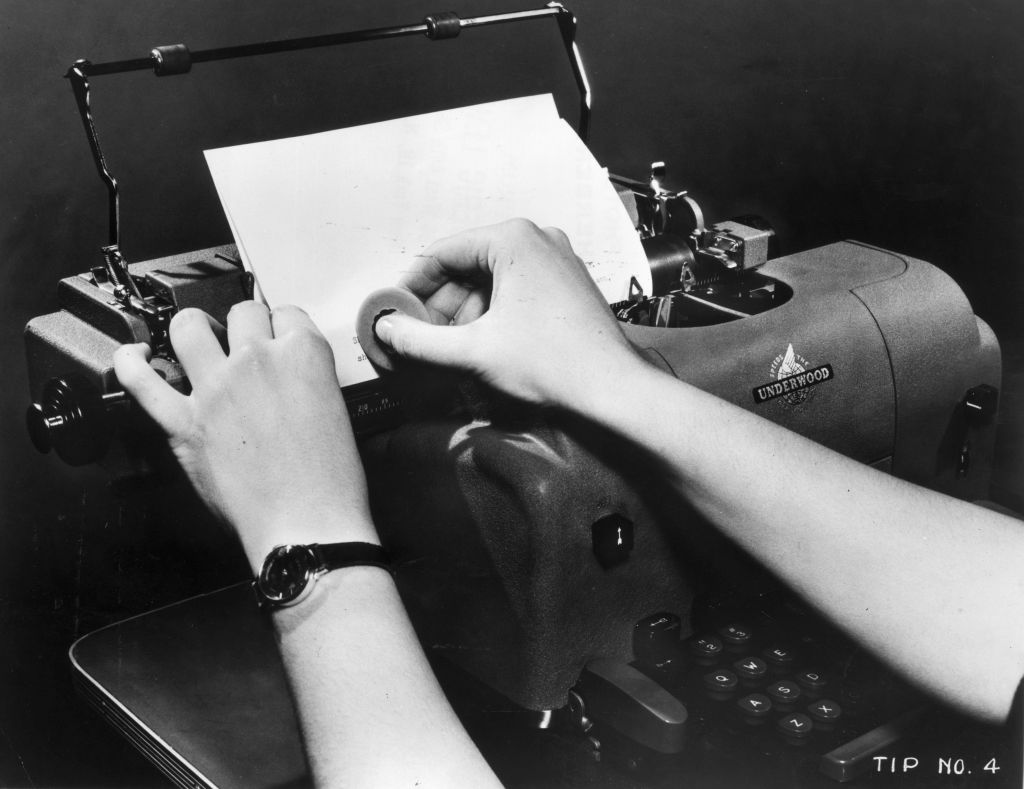
Many pencils now feature built-in erasers, an innovation that was first patented in Philadelphia in 1868. Yet as inseparable as they seem today, modern pencils and erasers didn’t immediately marry each other.
Japanese pencil and stationery manufacturer Tombow, for example, released its first pencil in 1913; the company tells Popular science that she developed her first eraser, the Iron Helmet Eraser (“Tetsu-kabuto Jikeshi”), 26 years later.
Due to “wartime economic blockades”, Tombow said its initial rubber was “made from oils and fats instead of natural rubber”. Material shortages then led to the development of plastic erasers.
Today, even though screen time defines much of modern life, the modern pencil and eraser endure as students, artists, and office workers buy them by the billions each year.
While sales of pencils and pens are expected to increase (and autocorrect is now ubiquitous in written communication), errors and revisions haven’t really gone anywhere; some tools simply make them more (or less) obvious to others.
Whether you’re a scribe editing a sacred text or a student erasing scribbles in the margins, mistakes are only human. And somehow, hiding them is too.
In Ask us anythingPopular Science answers your wildest and most burning questions, from everyday things you’ve always wondered to bizarre things you never thought to ask. Do you have something you always wanted to know? Ask us.

The best new PopSci 2025 releases


