How Trump’s Iran war objectives have shifted over time : NPR

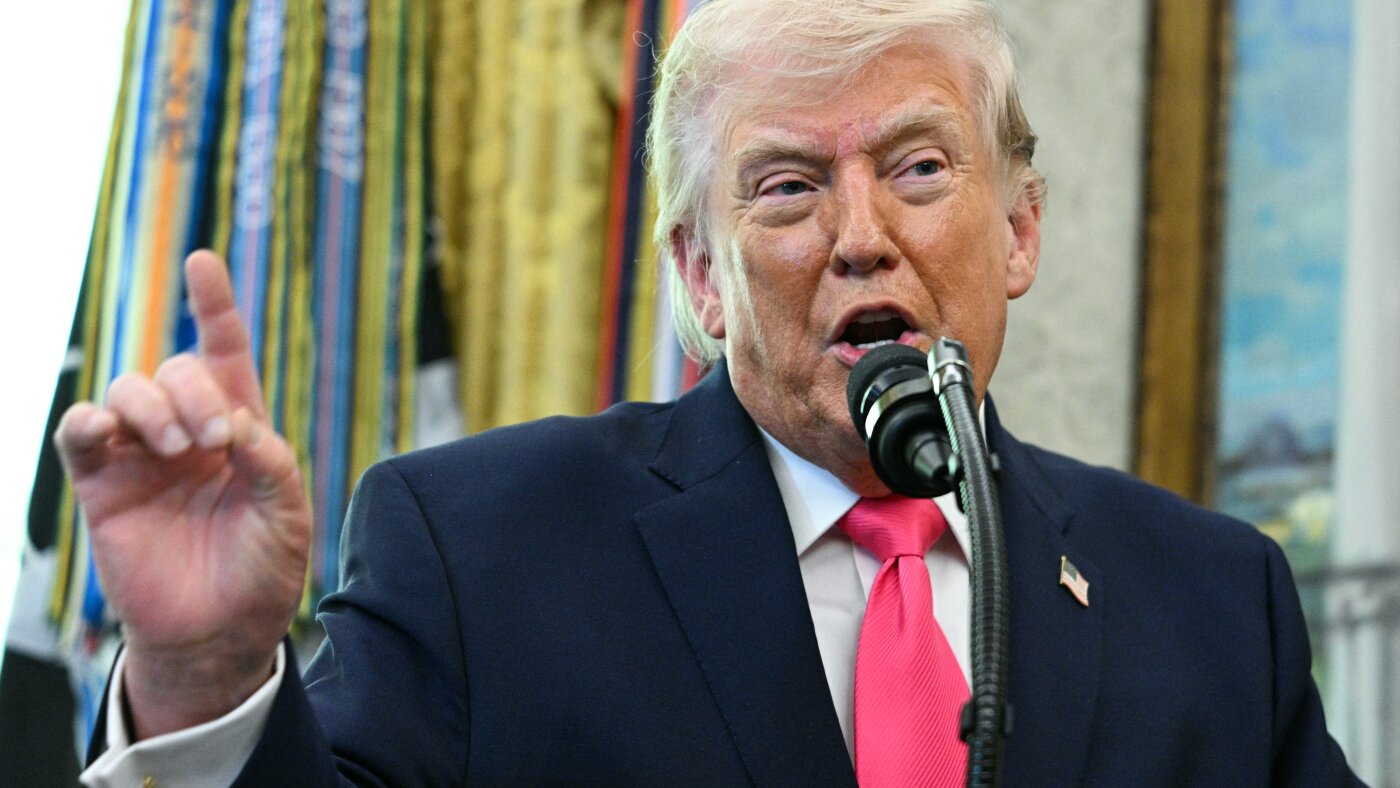

US President Donald Trump speaks in the Oval Office of the White House in Washington, DC.
JIM WATSON/AFP
hide caption
toggle caption
JIM WATSON/AFP
At the start of the US-Israeli war in Iran, President Trump gave numerous reasons for launching strikes against Iran, from stopping its nuclear capabilities to regime change.
Now, Trump appears ready to talk about an endgame as behind-the-scenes negotiations begin.
His goals for starting the war – and ending it – have changed in the weeks since the strikes were launched on February 28.
Here’s a reminder of what he said – and where America stands today.
Protesters and revolution
When Trump announced the strikes early Saturday morning, he called them the “greatest chance” for the Iranian people to take back their country.
The strikes killed Iran’s supreme leader, Ayatollah Ali Khamenei, whom Trump called “one of the most evil people in history.”
Khamenei oversaw the brutal crackdown on what Trump said were up to 30,000 demonstrators protesting against the regime in Tehran. The Human Rights News news agency reported that at least 7,000 protesters have died through February and that an additional 11,700 cases are under review, although they acknowledge that given internet shutdowns it has been difficult to obtain accurate assessments.
“All I want is freedom for the people,” Trump said. The Washington Post just a few hours after these first strikes.
Trump also called on Iranian soldiers to “lay down their arms” and urged them to join forces with the Iranian people to seize power.
“It will be yours,” he said.
He would echo these calls days later, calling on “Iranian patriots” to seize this moment.
“America is with you. I made you a promise and I kept that promise. The rest will be up to you, but we will be here to help,” he said on March 1.
But as the war continued into weeks three and four, Trump spoke less and less about the protesters and recently made no calls for demonstrators to overthrow the government.
Change of diet
While Trump’s Cabinet leaders stuck to more focused military goals, Trump repeatedly articulated a much broader goal from the start.
Barely a week after the fighting began, on March 6, Trump upped the ante by demanding that there would be no deal with Iran “except UNCONDITIONAL SURRENDER,” on social media.
“After that, and after the selection of a GREAT AND ACCEPTABLE leader or leaders, we, along with many of our wonderful and very courageous allies and partners, will work tirelessly to bring Iran back from the brink of destruction, making it economically bigger, better and stronger than ever,” he added.
He repeatedly touted the U.S. military operation in Venezuela and used it as an example of the type of regime change he sought in Iran.
But Iran instead announced that Mojtaba Khamenei, the son of Ayatollah Ali Khamenei, would take over as supreme leader, a sign that he had no plans to distance himself from the regime.
Trump and his team quickly appeared to distance themselves from these earlier promises.
Top officials have consistently sidestepped questions about whether regime change is a goal, focusing instead on military goals outlined by the administration.
And Trump also appeared to move away from unconditional surrender, telling NPR on March 13 that it doesn’t matter whether Tehran actually declares surrender as long as the United States is in a dominant position.
On Monday, however, Trump appeared to return to the idea of regime change with the start of new talks.
“There is automatically a regime change,” he told reporters on March 23, emphasizing that all previous leaders were dead and his team was dealing with new people who he described as “very reasonable, very solid.”
Iran has publicly stated that it is not engaged in any direct or indirect negotiations with the United States.
Peace
When he launched the war, Trump emphasized that the bombing would continue uninterrupted “as long as necessary to achieve our goal of PEACE IN THE MIDDLE EAST AND, REALLY, THE WORLD!” »
But those are not the goals set by his top aides and officials, including the Secretary of Defense and the Secretary of State. Instead, they focused on four military goals: preventing Iran from acquiring a nuclear weapon, destroying Iran’s navy, destroying the country’s ballistic missile arsenal, and destroying its ability to produce more such weapons.
And Trump appears to have given up at least partially on his goal of world peace. Instead, he scaled back his ambitions towards the world and claimed that the war would help establish peace only in the region by weakening the Iranian military.
Nuclear capabilities
The only consistent goal Trump pursues is ensuring that Iran never obtains nuclear weapons.
After postponing U.S. strikes on Iranian power plants, Trump repeatedly discussed development and agreement on key issues, while providing few details. He mentioned one: “It starts without nuclear weapons, and they have agreed to this, there will be no nuclear weapons. They will not have, and they will not have enrichment, any of those things,” Trump said on March 24, although the regime has always insisted that it is not going to build nuclear weapons.
It continues to maintain a stockpile of nearly 1,000 pounds of enriched uranium believed to be buried in the mountains. The president has not said how far he is willing to go to seize or destroy materials that could potentially be used to make a nuclear weapon — because that would likely involve sending in ground troops.
Ballistic missiles
In his first comments after the strikes were announced on February 28, Trump claimed that Iran was building missiles that “could soon reach the American homeland.”
But this claim is not supported by any public reports from American intelligence services. The Defense Intelligence Agency reported last spring that Iran would not be able to develop a long-range missile by 2035.
Defense Secretary Pete Hegseth has accused Tehran of building missiles and drones to create a “conventional shield” for its nuclear ambitions.
Secretary of State Marco Rubio echoed this point on March 2, saying Iran was producing 100 ballistic missiles a month that “they can hide behind.”
“That’s what they were trying to do, is put themselves in a position of immunity where the damage that they could inflict on the region would be so great that no one could do anything about their nuclear program or their nuclear ambitions,” Rubio said on March 2.
Support for terrorism
In a recent bilateral meeting with the German chancellor, Trump said “something had to be done” regarding the amount of funding Iran was providing to its network of proxy groups fighting in the region, including Hamas, Hezbollah and the Houthis.
“When you look at all the problems, they really have been purveyors of terror all over the world for many, many years,” Trump said on March 3. “And it’s something that needed to be done.”
A week later, he added: “Look, for 47 years, no president was willing to do what I’m doing, and they should have done it a long time ago,” Trump said on March 16. “It would have been much easier. No president wanted to do it. »
Reopen the Strait of Hormuz
The strait was not a reason given by Trump to start the war, but it was a clear target to end it after Iran decided to close the passage in retaliation.
“If necessary, the United States Navy will begin escorting oil tankers through the Strait of Hormuz as soon as possible. Regardless, the United States will ensure the FREE FLOW OF ENERGY to the WORLD,” Trump said on March 3.
The United States has yet to escort the tankers across the strait and Trump has failed, so far, to recruit national leaders to join his proposed military coalition to help secure the threat. He called those nations “cowards” and threatened to rethink the United States’ relationship with the NATO alliance.
And Trump continues to threaten Iran militarily — and NPR reports that additional Marines are heading to the region.
The strait remains largely closed to traffic, but Trump on Tuesday discussed a potential development that he said was worth “a huge amount of money.”
“I’m not going to tell you what this gift is, but it was a very large prize, and they gave it to us. And they said they were going to give it,” Trump said. “So that meant one thing to me: We’re dealing with the right people.”
Trump said it was not nuclear-related, but oil and gas-related – and related to the Strait of Hormuz.

:max_bytes(150000):strip_icc()/Health-GettyImages-2050597144-ae66ce31a2b146898af0c4595303d576.jpg?w=390&resize=390,220&ssl=1 "The Real Reason Alcohol Makes You Sleepy—Plus, 7 Things That Help")


