Hubble Space Telescope accidentally witnesses comet C/2025 K1 (ATLAS) breaking apart

When you purchase through links on our articles, Future and its syndication partners may earn a commission.

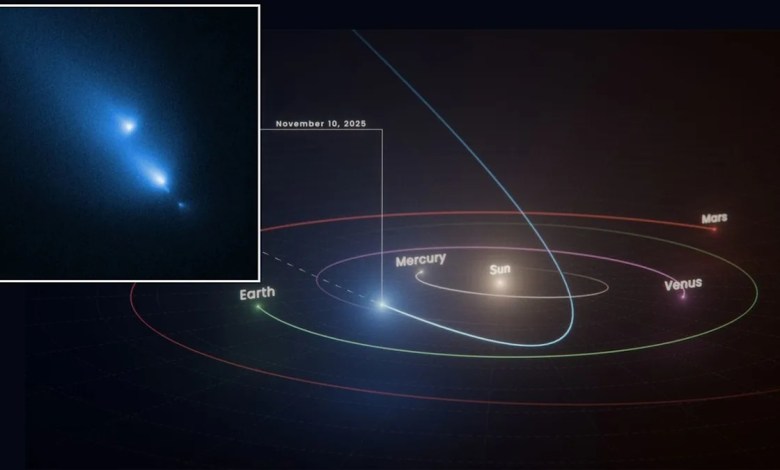
This diagram shows the path taken by comet C/2025 K1 (ATLAS), or K1, as it passed the sun and began its journey out of the solar system. NASA’s Hubble Space Telescope captured the inset image of the fragmenting comet just a month after K1’s closest approach to the sun. | Credit: NASA, ESA, Dennis Bodewits (AU); Image processing: Joseph DePasquale (STScI)
NASA’s Hubble Space Telescope has captured a rare cosmic moment: a comet shattering in real time.
During its routine imaging of the universe, the space telescope spotted an unexpected object called C/2025 K1 (ATLAS)or comet K1 for short. Remarkably, Hubble observations revealed that the comet’s nucleus was active fragmentationaccording to a NASA press release.
“Sometimes the best science happens by accident,” said John Noonan, co-author of the study and professor of physics at Auburn University. the declaration. “This comet [was] observed because our original comet was not visible due to new technical constraints after we won our proposal. We had to find a new target – and just as we observed it, it broke, which represents the slimmest of chances. »
Comets are icy, rocky objects in the outer solar system that heat up as they approach the sunreleasing gas and dust to form a glowing coma and tail. They can also break when solar heating and gravitational forces overwhelm their fragile structure.
Astronomers observed K1 for three consecutive days, from November 8 to 10, 2025, and found that it had already started to break up before Hubble turned her gaze towards him. The telescope captured the comet splitting into at least four pieces, each surrounded by its own coma. One fragment appeared to split again during observations, suggesting the process was still ongoing.
Researchers estimate that the disintegration began about a week earlier, likely triggered by the comet’s close approach to the sun, known as perihelionwhen overheating and stress are at their peak.
K1 was discovered in May 2025 by the ATLAS (Asteroid Terrestrial-impact Last Alert System) survey and is a long-period comet from far away Oort Clouda vast reservoir of icy bodies at the edge of the solar system. These objects are considered relics of the early solar system, preserving matter largely unchanged for billions of years. Before fragmenting, K1 was likely a little larger than an average comet, measuring about 8 kilometers in diameter, according to the release.
Comets like K1 are often described as “dirty snowballs,” made of ice, dust, and loosely bonded rocks. As they approach the sun, the ices sublimate into gas, creating jets that can push outward onto the core. Combined with internal weaknesses and gravitational stress, these forces can cause the comet to fracture.
But K1’s breakup revealed an additional mystery. Ground observers did not see the comet brighten immediately after its fragmentationas would be expected when fresh ice is exposed. Instead, there was a delay between the rupture and the visible explosions.

This series of NASA Hubble Space Telescope images of the fragmentation comet C/2025 K1 (ATLAS), or K1 for short, was taken over the course of three consecutive days: November 8, 9, and 10, 2025. Captured by Hubble’s Space Telescope Imaging Spectrograph (STIS) instrument, the sequence shows the gradual disintegration of the comet over this brief period. This is the first time Hubble has observed a comet this early in the decay process. | Credit: NASA, ESA, Dennis Bodewits (AU); Image processing: Joseph DePasquale (STScI)
Scientists think this could be because a comet’s brightness comes primarily from sunlight reflected from dust, not ice. Newly exposed ice may first need to develop a thin layer of dust that can then be blown away, or heat may need to build up below the surface before releasing an expanding dust cloud, according to the release.
“Never before has Hubble captured a fragmenting comet so close to the time it actually collapsed. Most of the time, it’s a few weeks or a month later. And in this case, we were able to see it just a few days later,” Noonan said in the release.
“This tells us something very important about the physics of what’s happening on the comet’s surface. We may be seeing the time it takes to form a substantial layer of dust that can then be ejected by the gas.”
Observing a comet disintegrate in real time is extremely rare, because these events are unpredictable and often too faint to observe in detail. Hubble’s high-resolution images allowed scientists to track the fragments as they walked away, providing an unusually clear view of the process. As these fragments continue to separate and fade, K1 provides a rare and fleeting window into how some of the oldest objects in the solar system are evolving.
Their conclusions were published on February 6 in the magazine Icare.


