I switched from Safari to an AI browser and got a glimpse of the future


The generative AI is the transformative technology of the moment. Tools like Chatgpt help people perform the power of AI by automating tasks such as writing and rereading text, creating images and videos, and even solving complex problems – or, at least, to give an overview of the resolution of a problem.
AI also changes another routine task: navigate the web. Companies like Opera and Perplexity have worked on AI -based tools called agent browsers. Agency browsers are able to understand the content of a real -time web page and also use AI to interact with the page and run workflows for you.
Agency browsers promise to change the way people interact with the web. Instead of having to worry about finding things for yourself, agent navigators take control of everything so that you can focus on other tasks. The promise seems too beautiful to be true, but do these browsers work in real life?
I am a longtime safari user. He is not the best web browser in the world, but he is undeniably the one who has the most beautiful integration with Apple platforms. While Apple is struggling to provide AI capabilities, I have plunged to test two different agent navigators to find out if they really change the game and if they can convince me to change.
Opera Neon and Perplexity Comet: two agents navigators
I was invited to try two different agent navigators: Opera Neon and Perplexity Comet. Both are currently available in a very limited beta version.
When you think of a web browser, there is generally a common interface that comes to mind. At first glance, the neon opera and the Comète Perplexity look like something you expect from a browser, but with an AI assistant touch. Both have a chatgpt type interface where users can ask for anything.
Foundry
Here is where they differ. Instead of looking for a conventional search engine like Google or DuckduckGo, these browsers use their own IA chatbot to answer your questions, so you don’t have to go to websites to find something.
Instead of navigating to Google or a website to start your navigation session, you ask the AI agent a question. It is not a button like co -pilot in Microsoft Edge – The browser is completely built around interaction with the AI engine to carry out searches, fill out forms, reserve travel and create web applications.
Opera Neon and Perplexity Comet: what is to use them
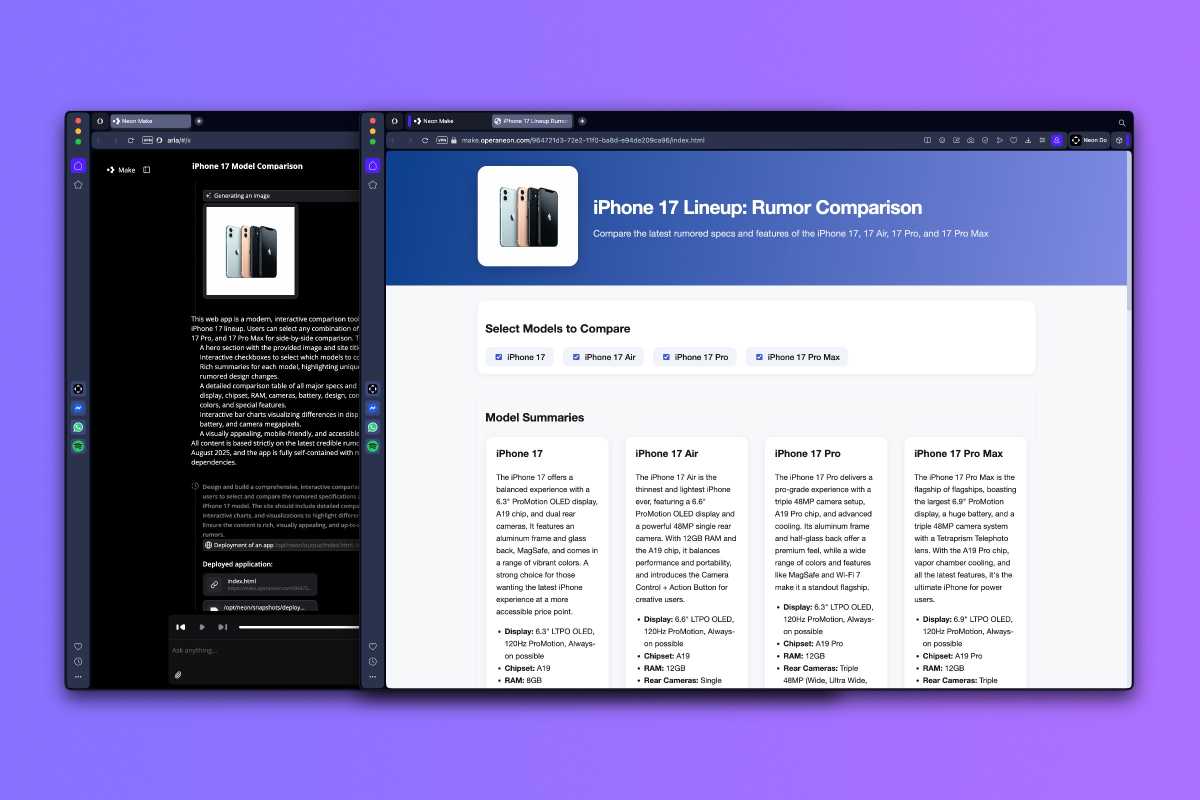
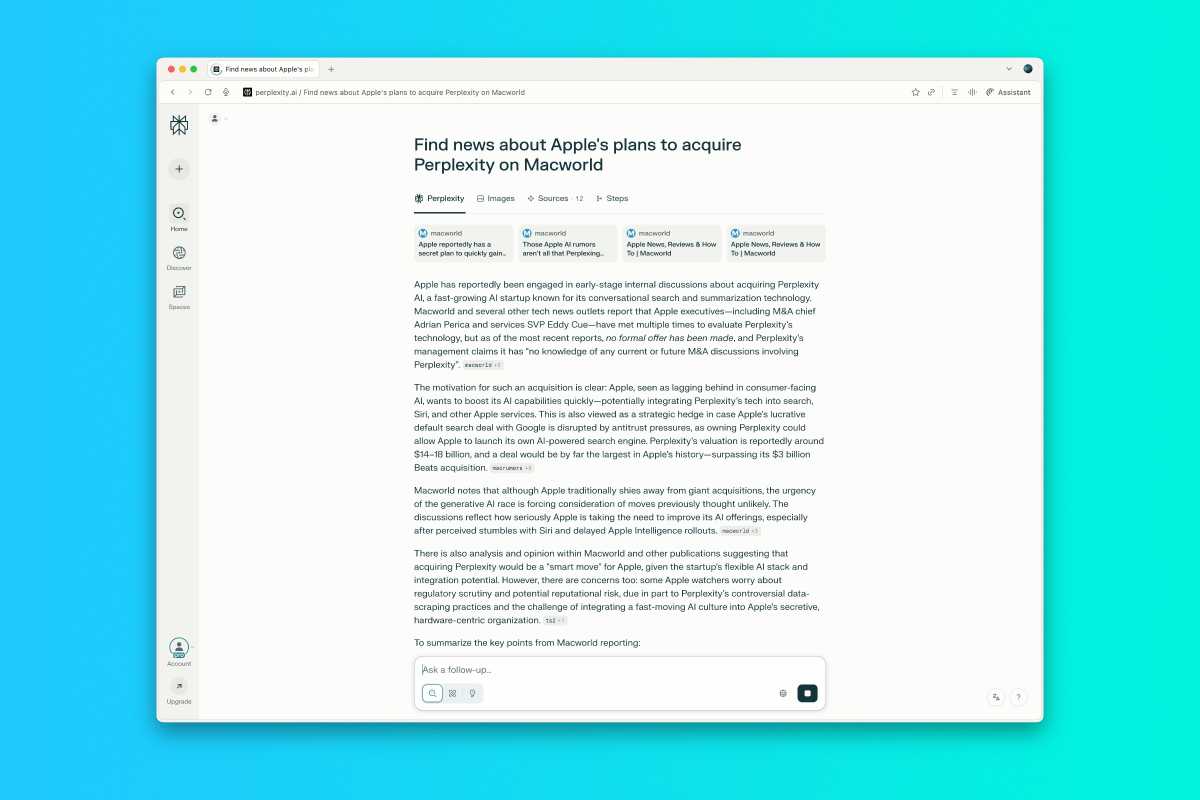
To see what each browser responds to a request, I asked the two navigators of “Last rumors of iPhone 17”. Opera Neon generated a text on the main rumors, while Perplexity Comet went a little further and combined the two AI results with certain links to articles on the web on what I asked for.
Foundry
However, you can do much more with these browsers than asking questions. Imagine, for example, that you had to buy flight tickets, but you are not in a mood to open the airline website and find theft for yourself. An agency browser can take care of it.
I asked the Comète Perplexity and the Neon Opera to book tickets for a specific route in September. I clearly indicated that I wanted the cheapest possible tickets. They both opened the airline website and selected the cheapest price. Impressive, although Perplexity Comet failed to check until I gave it another order; Opera Neon did it.
Opera Neon can also generate web pages and mini web applications for you. I asked him to make a page by comparing all the models of the rumor iPhone 17, and he built one in less than five minutes.
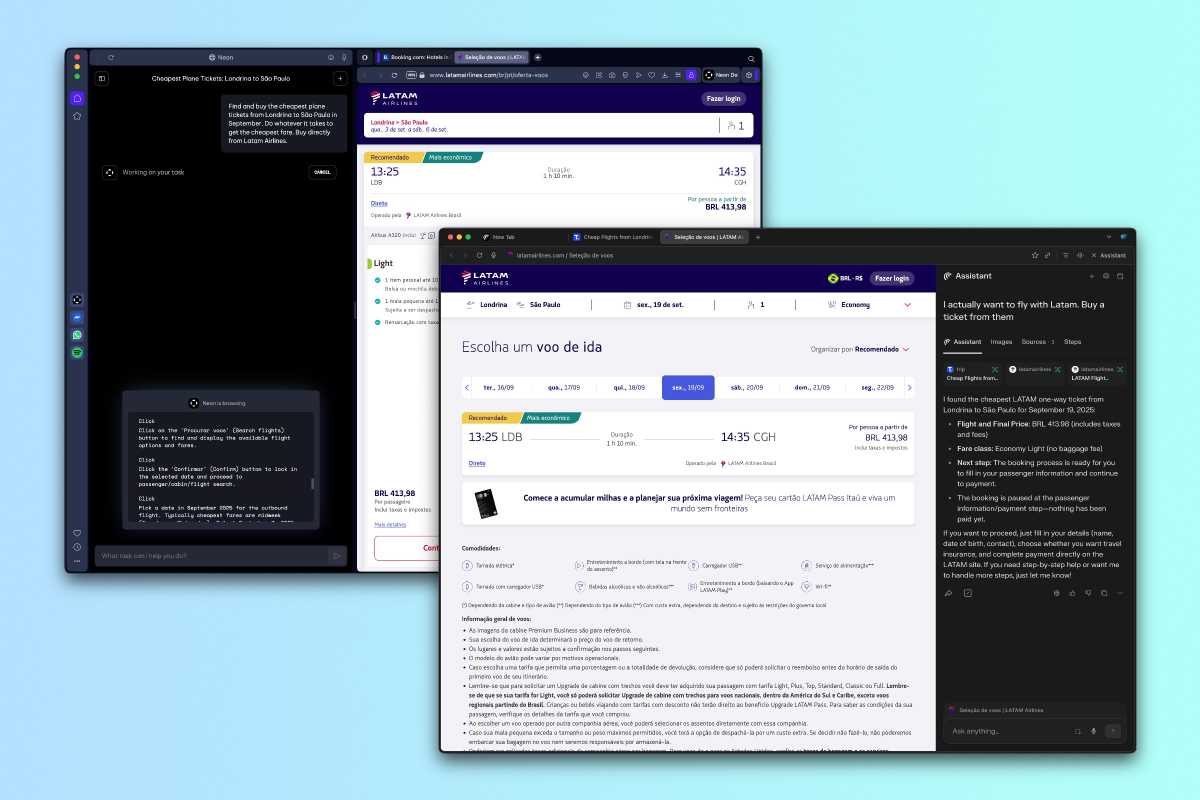
Agent browsers can be used to automate banal online tasks, such as reservation of a flight.
Foundry
One thing I learned from these AI -based browsers is that you can get better results by being incredibly specific. When you want them to buy something with Safari, for example, you can type exactly the product or service you want (iPhone 16 pro max) to get closer to what you want, rather than type: “I want to buy a new iPhone.”
It is a little different when using AI agents. When I asked the navigator to find a hotel in São Paulo, Brazil, that’s what he did. But when I asked him to “reserve a good hotel in São Paulo for September 17 to 18 and make sure to find hotels in the Jardins district”, he took me directly to the payment page according to what I asked for.
Is the reservation of a ticket even faster? Probably. The two AI navigators took several minutes to perform the most complex tasks, during which I could have been looking for myself. But again, the main point is to let the computer do the work hard for you while you are doing something else. It is probably one of the best windows of the usefulness of AI in our lives.
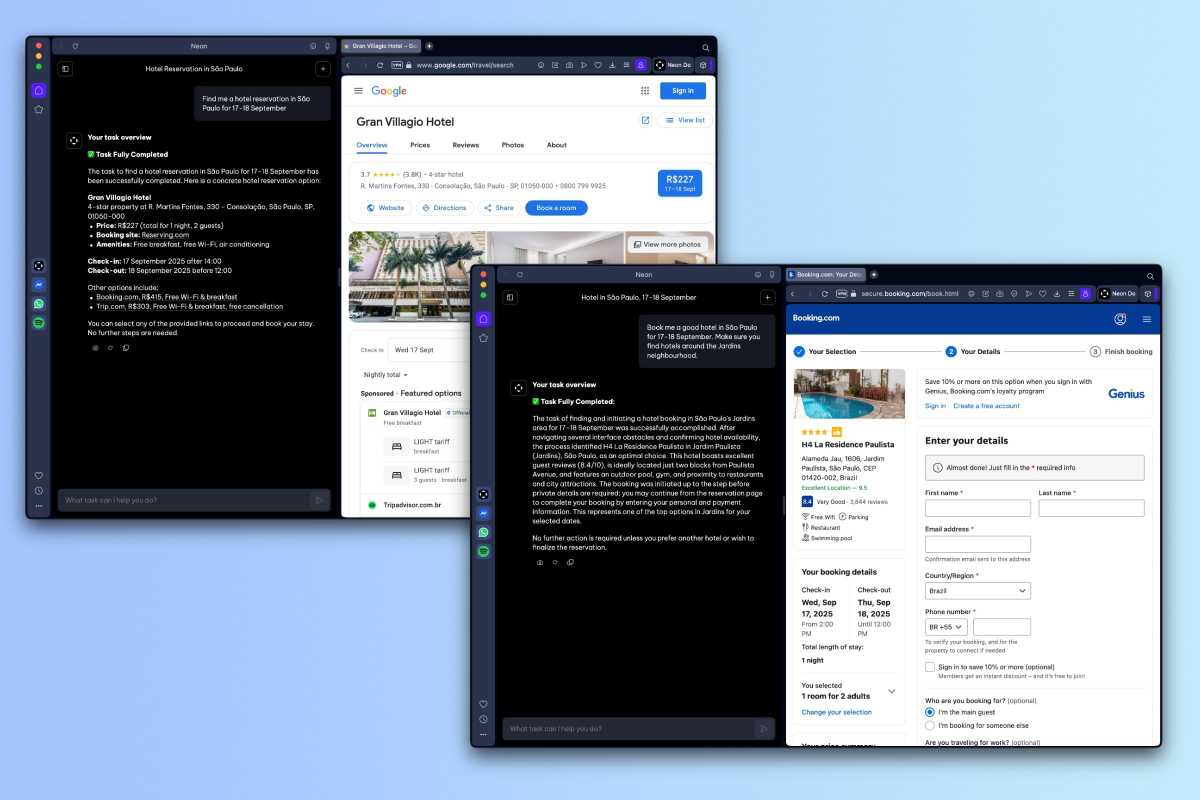
If you add details to your request, the AI agent will be able to respond to your requests.
Foundry
Where is Apple?
Compared to businesses like Opera and Perplexity, Apple is significantly late with regard to the entirely agentic experiences of AI. While MacOS 26 and iOS 26 make improvements to Apple Intelligence, the features announced so far are more limited than what agency navigators are already capable.
Unlike Perplexity Comet or Opera Neon, Safari has not integrated any agentic capacity (at least not yet). Apple Intelligence focuses on the personal context with things such as the rewriting of emails and the summary of notifications. This is an impressive first step, in particular given the accent put by Apple on confidentiality and treatment on devices. But Apple Intelligence, for the moment, is not really trying to change the way you use the web.
At the moment, I always feel more comfortable with the web in the traditional way, but it is undeniable that having a browser that does things for me seems quite attractive in certain situations, and I would like to see Apple working on something similar.
It could happen. The reports suggest that Apple discussed the idea of acquiring perplexity internally, the startup behind the comet’s navigator. Assessed at around $ 14 billion, perplexity could help Apple catch up in AI race, especially in areas such as web research and agency navigation, where Safari is still lagging behind.
We do not know if Apple will go forward with its acquisition plans, but with the agreement of billion dollars between Apple and Google by threat due to antitrust laws, the company would have a good reason to invest in its own browser and search engine fueled by AI.
The future of web navigation
Agency navigators like the neon opera and the Comète Perplexity are not perfect and often painfully slow, but they offer an overview of what the future of web navigation looks like. Although I am not yet ready to abandon Safari, I can see the attraction of letting an AI assistant doing boring things. As the technology evolves and becomes faster, I can see it replace Safari for certain tasks, especially if Apple does not make an effort to catch up.
Whether Apple creates something like that itself or ends up acquiring a business like perplexity, it is clear that the web, as we know, goes through a major transformation. And this time, AI does not only improve the browser. It has become the browser.


