NASA chief Jared Isaacman says Texas may get a moonship, not space shuttle Discovery

When you purchase through links on our articles, Future and its syndication partners may earn a commission.

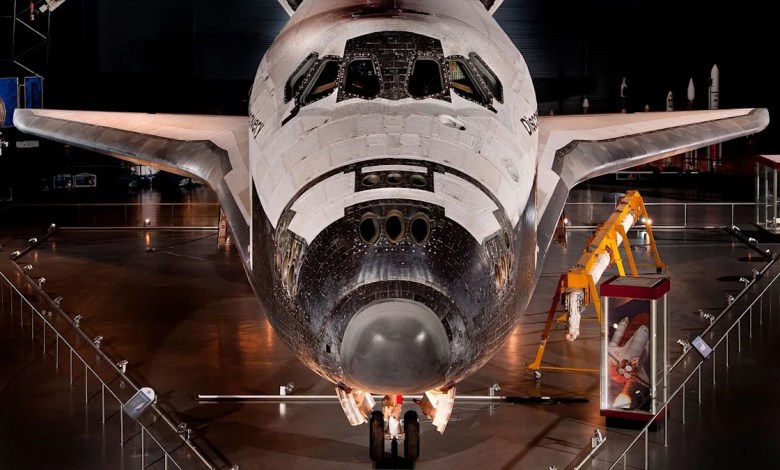
The Space Shuttle Discovery on display at the Steven F. Udvar-Hazy Center at the Smithsonian Air and Space Museum in Virginia. | Credit: Smithsonian/Dane Penland
Houston, we may have a problem… with your senators’ plans to bring a NASA space shuttle to Texas.
New NASA chief Jared Isaacman said a controversial proposal to move the space shuttle Discovery to Texas from its current home on display in a hangar at the Smithsonian Air and Space Museum in Virginia could result in another spacecraft landing entirely in Houston.
“My predecessor has already chosen a vehicle,” Isaacman said of Transportation Secretary Sean Duffy, who led NASA as acting chief until this month. in an interview with CNBC on December 27. “My job now is to ensure that we can undertake such a transport within the budget we have and, of course, most importantly, to ensure the safety of the vehicle.” Isaacman officially took charge of NASA on December 18, a day after being confirmed by the Senate.
The plan to move Space Shuttle Discovery, NASA’s most widely used orbiter, bound for Houston, was originally laid out by Senator Ted Cruz (R-Texas) and Senator John Cornyn (R-Texas). Texas senators included a provision for the move in the so-called One Big Beautiful Bill Act, which President Donald Trump signed over the summer.
Cruz and Cornyn said Houston, NASA headquarters Johnson Space Center where astronauts train and where mission control is located, should have its own iconic human spaceflight vehicle on display. Discovery flew 39 space missions between 1984 and 2011, when NASA discontinued the shuttle program.
The other shuttles withdrawn from NASA – Atlantis, Effort And Business The test vehicle, which never reached space, is on display in museums in Florida, California and New York, respectively. Two other shuttles, Challenger and Columbia, were lost in tragic space accidents in 1986 and 2003, respectively.
But there’s a catch to moving Discovery. (Several of them, actually.) NASA donated the shuttle to the Smithsonian in 2012, moving it to Houston would therefore require the government to recover the orbiter.
And there is the cost. The One Big Beautiful Bill included $85 million to cover the cost of Discovery’s move, but critics said that budget paled in comparison to the actual funds needed to safely move the 100-ton spacecraft, as well as construct a building for its final display. Officials from the Steven F. Udvar-Hazy Center at the Smithsonian Air and Space Museum, where Discovery is currently on displayestimate it would cost up to $150 million for the move alone.

The Space Shuttle Discovery mounted atop a 747 Shuttle Carrier Aircraft (SCA) approaches the runway for landing at Washington Dulles International Airport, Tuesday, April 17, 2012, in Sterling, Virginia. NASA’s shuttle carrier planes are now retired. | Credit: NASA/Paul E. Alers
Finally, the question arises of how to physically move the space shuttle.
Discovery is 122 feet (37.2 meters) long and has a wingspan of 78 feet (23.8 m). NASA originally flew the shuttle to the center of Udvar-Hazy, atop a Shuttle carrier plane (a modified Boeing 747 wide-body aircraft), then used a series of cranes to hoist the orbiter to the ground. The agency’s two shuttle carrier planes have since been retired from service, one of which is on display at the Space Center Houston with a simulated shuttle on top.
Smithsonian officials said Discovery may need to be partially dismantled to move it to Houston, risking serious damage to the spacecraft.

The Space Shuttle Discovery on display at the Steven F. Udvar-Hazy Center at the Smithsonian Air and Space Museum in Virginia. | Credit: NASA/Bill Ingalls
With all that as a backdrop, Isaacman told CNBC that ensuring Discovery’s safety and weighing the costs of a move to Houston will factor into deciding whether NASA will actually push for the shuttle’s move.
“And if we can’t do that, you know what? We have spaceships going around the moon with Artemis 2, 3, 4 and 5,” Isaacman told CNBC.
NASA is currently preparing to launch four Artemis 2 astronauts around the Moon from February 2026. The space agency hopes to launch its Artemis 3 moon landing mission by 2028. The two missions and their follow-ups on Artemis 4 and Artemis 5 would send astronauts to the Moon using a Orion spacecraftwhich will be launched on a giant Space Launch System rocket.
“One way or another, we’re going to ensure that Johnson Space Center gets its historic spacecraft where it needs to be,” Isaacman said.


