January’s full Wolf Moon leaps past the Eiffel Tower in stunning photo of Paris skyline

When you purchase through links on our articles, Future and its syndication partners may earn a commission.

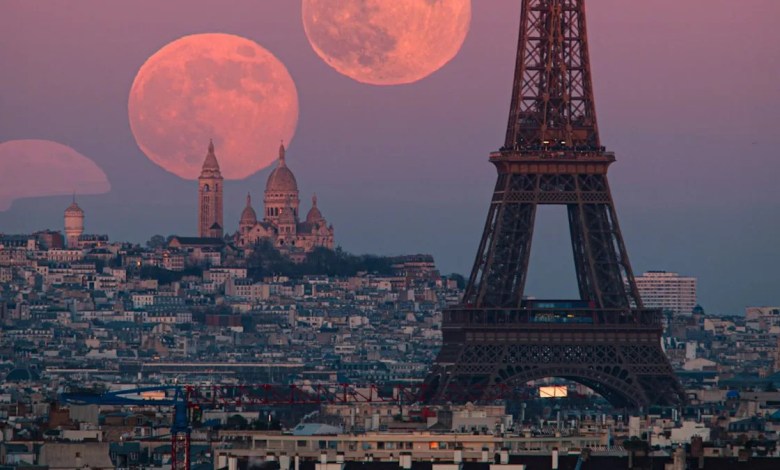
A composite image tracing the path of the January full moon above the Parisian sky. | Credit: Martin GIRAUD | @tinmar_g (Instagram)
Photographer Martin Giraud captured a breathtaking view of January’s full “Wolf Moon” rising above the Paris skyline on the evening of January 3 as it passed behind the iconic iron silhouette of the Eiffel Tower and the dome of the Sacré-Cœur basilica.
Nikon Z8

Nikon Z8 on a white table
The Nikon Z8 excels in almost every area and we consider it the best overall camera on the market. It has a 45.7 MP full-frame sensor, 8K video capabilities, excellent low-light performance, very high FPS burst speed and much more. It’s expensive, but you get what you pay for. Check out our Nikon Z8 review for a more in-depth look.
Presentation of the Giraud composite plan the moon as it broke away from the horizon to follow a path across the pastel-colored sunset sky, while an atmospheric effect called Rayleigh scattering gave its disk a stunning orange-yellow hue. The disproportionate profiles of the moon seem subtly distorted by their proximity to the horizon and the dark silhouettes of Lunar Mary (seas) can be spotted by darkening its surface, where ancient lavas once flowed in impact basins billions of years ago.
“Before the new year, I noticed on my planning app that the first full moon of the year, also a super moonwould line up perfectly with the Eiffel Tower and the Sacré-Cœur Basilica from a location I had scouted before,” Giraud told Space.com in an email. “Despite the cold and snow in the morning, the weather forecast for Paris called for completely cloudless skies, so I decided to give it a try.”
Giraud used a Canon 6D camera with a Samyang telephoto lens with an ISO of 100 to capture the individual images used in creating his composite photo. “This image was taken with a 150-600mm lens at 500mm,” Giraud continues. “The Eiffel Tower was 6.3 km [3.9 miles] far from my location, and the Basilica of the Sacré-Cœur at 11.1 km [6.8 miles] far away, which explains why the Moon appears so large in the frame.”

A composite image tracing the path of the January full moon above the Parisian sky. | Credit: Martin GIRAUD | @tinmar_g (Instagram)
The January full moon is often called “Wolf Moon” which refers to the packs of predators that can sometimes be heard howling during the scarcity of winter. This occurred near perigee – the point in its monthly orbit where it is closest to Earth — giving rise to an impressive supermoon, which can be up to 14% larger than the smallest moon of the year.
Want to try your hand at astrophotography? So don’t forget to read our guide full of practical advice on how to photograph Earth’s natural satellitewith our selections of best cameras And lenses to capture the majesty of the night sky.
Editor’s note: If you take an image of the moon and would like to share it with Space.com readers, please send your photo(s) and comments, along with your name and location, to spacephotos@space.com.


