Jurassic Ichthyosaur Fossil Found in Cuba


Deep in a limestone cave in western Cuba, paleontologists have discovered the most complete ichthyosaur skeleton ever discovered on the island.

Ophthalmosaurid ichthyosaurs. Image credit: Dmitry Bogdanov / CC BY 3.0.
The ichthyosaur skeleton was discovered in 2023 in a river cave in El Cuajaní, within the Viñales Geopark and National Park, in western Cuba.
The exposed segment of the skeleton includes the U-shaped curved spine with associated ribs, isolated vertebrae, and a single hindlimb.
“The specimen is preserved in the rock slab that forms the ceiling of the river cave now known as Cueva del Ictiosaurio, approximately 60 m from its entrance,” said Dr Manuel Iturralde-Vinent of the Academia de Ciencias de Cuba and colleagues from Cuba, Argentina, Poland and the United States.
The fossil dates back about 145 million years, to the Tithonian age of the Late Jurassic epoch.
Until now, observations of ichthyosaurs from Cuba have been largely limited to older Oxfordian deposits.
“This fossil represents the most complete ichthyosaur discovered in Cuba to date,” the paleontologists said.
“This expands the temporal record of ichthyosaurs on the island, which previously only included specimens from the Oxfordian.”
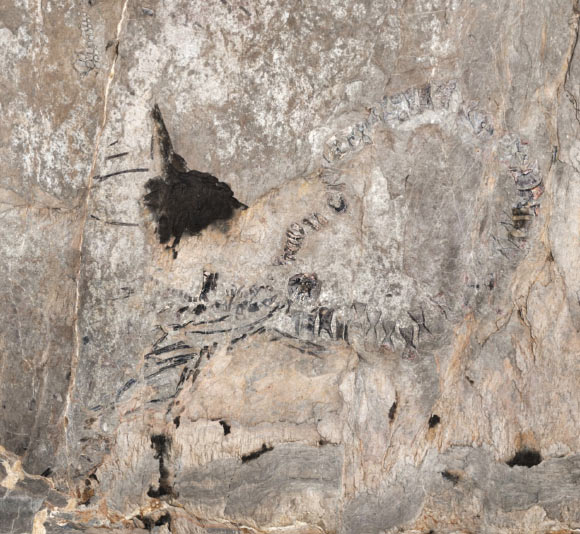
The partial skeleton of the El Cuajaní ichthyosaur. Image credit: Iturralde-Vinent and others., doi: 10.1080/02724634.2025.2609717.
Although the El Cuajaní Ichthyosaur, as researchers informally call it, cannot yet be assigned to a specific species, its anatomy suggests affinities with a family of ichthyosaurs called Ophthalmosauridae.
“The morphology of its hind limbs is comparable to that of tithonian platypterygiine ophthalmosaurids, resembling Caypullisaurus bonapartei And Aegirosaurus leptospondyl“, they explained.
According to scientists, the animal lived in a deep, open sea within the First Caribbean Seaway, a key marine corridor connecting distant parts of the Jurassic world.
“The Caribbean Seaway became an important marine corridor since the mid-Oxfordian, connecting the eastern and western Tethys, playing a central role in the dispersal of marine fauna since the Late Jurassic between Europe, the Gulf of Mexico and the Pacific,” they said.
“This corridor had recent Triassic and Lower Jurassic ancestry represented by intercontinental rift valleys that should not be considered part of the early Caribbean Basin or Gulf of Mexico per se, but were precursors located in west-central Pangea. »
“The El Cuajaní ichthyosaur adds to the growing body of Tithonian ichthyosaurs recently discovered in the region and may contribute to a better understanding of the biogeographic history of the group,” they concluded.
Their article was published on February 6 in the Journal of Vertebrate Paleontology.
_____
Manuel Iturralde-Vinent and others. A partial skeleton of an ichthyosaur (?Ophthalmosauridae) from the Tithonian (Late Jurassic) of western Cuba. Journal of Vertebrate Paleontologypublished online February 6, 2026; doi: 10.1080/02724634.2025.2609717


